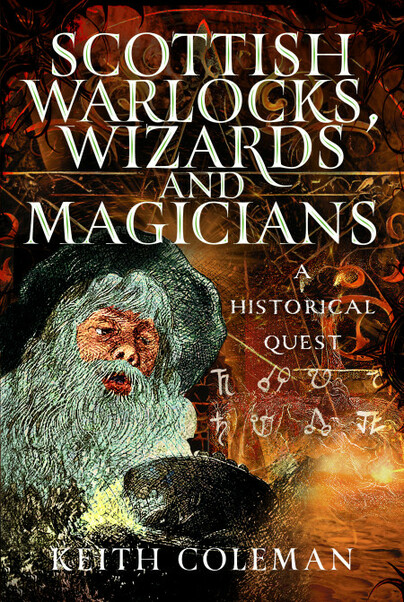
Scottish Warlocks, Wizards and Magicians
Author guest post from Keith Coleman.
Writing a book about real-life wizards, it prompts me to wonder which are the most fascinating characters I came across in research. This isn’t an easy question to answer since a lot of the material relating to witchcraft is so fragmentary that you are often left wondering what on earth a brief reference can mean. Why, for instance did 16th century knight and courtier Sir William Stewart, get charged with summoning Oberon – the king of the fairies – in some obscure magic ritual when a less fanciful charge, say of conspiring to kill someone important, would equally have sealed his fate.
And fate of those highlighted in my book Scottish Warlocks, Wizards and Magicians is a weighty issue. Many of those men detailed were given the traditional Scottish send-off for convicted witches of being ‘worried’, that is strangled at the stake, and then burnt to ashes. It is important to recognise that far fewer men than women were actually accused in Scotland, perhaps 10-15% of the total. And more men perhaps got away with charming, healing and meddling with witchcraft than women did. Scotland was far more motivated to persecute witches because of its rigorous conversion to Calvinism, its legal system, and its social structures. The stark, cyclical waves of witchcraft persecutions, which lasted nearly until the repeal of the Witchcraft Act in 1736 (it is easy to call these outbreaks panics, but the causes for them were more complex), remain a national disgrace. But did witch-hunting simply equate with women-hunting? Few experts would think so, and neither do I.
What made the men accused different? Some of them were vagrants, beggars or criminals, and therefore targets as easy to persecute as the majority of women. Some were very different. Ritchie Graham, one of the key figures in the North Berwick witch hunt in the 1590s, was a conspicuous figure, corpulent and pleasure loving, as well as a self-confessed necromancer. He hobnobbed with nobility, members of the government and even King James VI’s sworn enemy the Earl of Bothwell. One can imagine him striking fear and awe into susceptible people, swaggering around with his great staff covered in nails and decorated with human hair. He turned state’s witness against Bothwell and gave evidence that the nobleman was definitely a right-hand man of Satan. It was not enough to save him. After a period of protective custody, he outlived his usefulness and was executed.
At the other end of the heyday of witchcraft lived Grigor Willox Macgregor of Banffshire. Gamekeeper, wiseman, charlatan, Grigor was an object of dread and admiration, but he also lived into a period when superstition was on the wane. (He died in 1833, impoverished like many dabblers in the dark art.) Willox was consulted by people who came from great distances to consult with him over the loss of goods, or to buy his remedies and spells. If some in the community laughed about his supposed powers, and a good many ministers and others up the social scale from him did, few did so openly to his face. Did he have any actual powers or was it all sleight of hand? Maybe his boastfulness and his showy supernatural implements of power, magical family heirlooms like the Kelpie’s Bridle and the Mermaid’s Stone, give the game away. The power he possessed seem to be in inverse proportions to his ego.
Less showy than Willox, but much more fascinating and significant was Andro Man (whose name we could modernise to Andrew Mann). Another native of Banffshire, Man was an old man when he was put on trial at the end of the 16th century and had been earning a living in the magical and healing arts for four decades or more, during which time he seems to have entirely evaded the attentions of the authorities. The reason for his success was the demand for his services, which consisted of healing men and beasts, and importantly helping the rural community’s farmers maintain the abundance of their crops and the wellbeing of their herds. Mann travelled far and wide, travelling many miles south to Angus and curing members of the wealthy Southesk family, and this mobility is a key feature of the lives of some of the healers and male witches I feature in the book. Men with a supernatural vocation – or at least some men – had the freedom and ability to travel far more freely than women could do in early modern times. Travel may broaden the mind, but it also allows the dissemination of folk beliefs and legends.
Andro Man knew of traditions of the Fairy Queen which run deep in Scottish Lowland culture. He claimed to have been led into the Otherworld by her and inducted into the possession mystical powers because of their close connection. He also revealed his association with a number of dead people in Fairyland, or rather he had commerce with those who tradition insisted had been kidnapped and trapped in that uncertain realm. These included, in his testimony, ‘the king that died at Flodden’, King James IV, a monarch who most sober historians would agree died in that terrible, calamitous battle in 1513.
Tradition is a long time dying, as Andro would surely have recognised. Into the 20th century farmers in North-East Scotland were still deliberately setting aside an untilled piece of their land as a token gesture to the dark forces to ensure the fertility of their land. It was a ritual which Mann was specifically charged with, and admitted, at his trial. In the same stubborn corner of the country the Horseman’s Word, a supernaturally tainted proto-trade union of farm workers may still exist in small pockets, reflecting a timeless and unchanging belief.
These small details of superstition, belief, small but persistent acts of healing, spells, the underground trade of illicit legends are undoubtedly more fascinating than the bizarre elements associated with the subject of witchcraft, and allow one of the darker windows into the workings of human behaviour to be opened a little more widely.
Order your copy here.