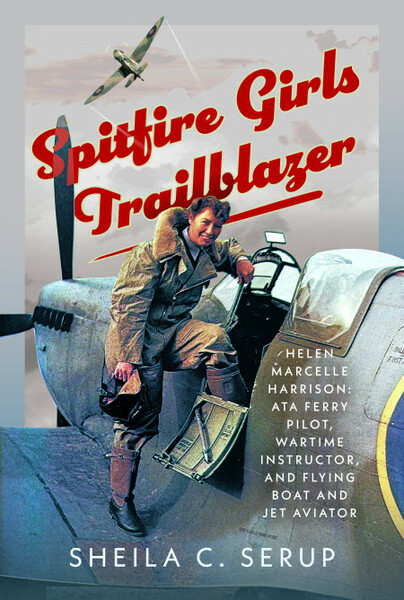
Spitfire Girls Trailblazer, Helen Marcelle Harrison: ATA Ferry Pilot, Wartime Instructor and Flying Boat and Jet Aviator
Author guest post from Sheila C. Serup.
Pioneering pilot Helen Marcelle Harrison piqued my interest when I discovered her longevity as a wartime instructor, ferry pilot and floatplane instructor in four countries.
When I began to research and write about her life, I was curious about two aspects. How did she soar above institutional discrimination in the early days of aviation? Secondly, where did she find the strength and fortitude to fly an impressive 14,000 injury-free hours as a pilot-in-command? More questions abounded as my research delved deeper. How did she train her keen mind to pilot 75 different planes during her career?
In her 34-years as an instructor, crack aviatrix Helen Harrison inspired generations of pilots, many of whom built distinguished aviation careers for themselves. She launched possibilities in people’s minds.
My research into Helen’s flying life began years ago in parallel during my work on my first book, No Old Bold Pilots. This research was challenging as accounts of her early years as she pursued licenses in four countries were scarce in records, journals and news reports. Research in the Eisenhower Presidential Library in Abilene, Kansas revealed warm personal letters between Helen and pilot extraordinaire Jacqueline Cochran. These original letters illuminated Helen as a confident, experienced military flying instructor who dared to reach for the impossible – a position as a ferry pilot with the Air Transport Auxiliary. Letters between Jackie and Helen’s mother Gertrude shone a bright light on the enduring love and unwavering support of her family.
Helen’s story is a love story with multi-faceted depths and brilliance. Her joy of flying captivated and sustained her, each and every day. Her aura and effervescence in the sphere of aviation in England, Singapore, South Africa, USA and Canada attracted the next generation of young women. When aviation became her lifelong vocation, Helen broke ground as a single mother of three sons when she became the breadwinner as women were entering the workforce. The loyalty and commitment of her parents enabled Helen to pursue far-flung training and flying experience. The trials and errors of training and earning hours of experience honed her astuteness and acuity of mind.
Ferrying planes for the Air Transport Auxiliary in England was both exhilarating and deeply terrifying. Pilots needed all their faculties to transport aircraft. They coped with variable English weather, dodged balloon barrages, and stayed alert to enemy fire in the air and friendly fire from the ground. The ATA women pilots flew different planes every day, rapidly learning the nuances of each aircraft while shattering stereotypes and prejudices.
On a flying mission, First Officer Helen Harrison experienced a close call in a Westland Lysander, an aircraft designed for miliary liaison and cooperation. She crash-landed at 110 miles an hour. Miraculously, she was unhurt. After an inquiry, she was found not responsible and was commended. Flying a Spitfire was a dream and a thrill. The Spitfire belonged in the air, and its responsiveness gave meaning to the cliché that ‘you didn’t fly a Spitfire, you wore it’.
After a furlough at home in Canada, she ferried a twin-engine B-25 Mitchell across the Atlantic as a co-pilot. Arriving in Scotland, she became the first Canadian woman to perform a cross-Atlantic ferry flight.
For the love of her family, she took a leave of absence to attend to matters at home. When the ATA began to downsize as the Second World War began to fade. First Officer Helen Harrison began the most challenging chapter of her aviation career. The ATA was a magnificent experiment which succeeded beyond expectations. The behind-the-scenes ferrying work of pilots, including First Officer Helen Harrison, was instrumental in turning the course of war.
At the close of her glorious career with the ATA, she strove to reinvent her self-identity in postwar Canada. Helen found herself on the cusp of a tidal wave of pilots returning home and struggled to reclaim her place in the skies. Returning to British Columbia, the province of her birth, she cheerfully and persistently forged a path as a flight instructor on both land and floatplanes.
While researching and writing about Helen Harrison’s career following the war, I found the answers to my curious questions about the trajectory of her flying life. Not only did her career encompass military and civil aviation in four countries, it spanned a superb era of aviation innovation and design. Helen bore witness as the gender barrier began to lower for women pilots applying for commercial flying positions.
How did she rise above institutional discrimination in the early days of aviation? And secondly, where did she find the strength and fortitude to soar in her career to an impressive 14,000 injury-free hours in 75 different aircraft?
You are invited to ascend into the skies with Spitfire Girls Trailblazer, Helen Marcelle Harrison: ATA Ferry Pilot, Wartime Instructor and Flying Boat and Jet Aviator and discover the vast luminance of Helen Harrison, pilot-in-command.