5 Trailblazing Medieval Queens
Author guest post from Ashley Sarah Firth.
Medieval queens are often portrayed as overshadowed by the kings they ruled alongside, constrained by expectations and confined to the margins of power. Yet this familiar image hides a far more complex reality. Many queens were central figures in the political and dynastic struggles of their age, shaping events in ways that are still felt in the historical record today. These five trailblazing queens offer a glimpse into the remarkable roles medieval women could and did play.
- Emma of Normandy
Emma of Normandy holds the unique distinction of being crowned queen of England twice. The sister of Richard II, Duke of Normandy, Emma was married in 1002 as a teenager to the English king, Aethelred II, known to history by his epithet ‘the Unready’ for his apparent lack of preparation for the onslaught of the Vikings. The purpose of the union was to create an alliance between the two kingdoms in light of the English king’s struggle to defend his shores from the Vikings. In this regard, the marriage could be considered a failure, but Emma did provide her husband with two additional heirs, Edward and Alfred, to add to his large, albeit short-lived, brood from his first marriage.
The Viking threat became a reality in 1013, when the Viking Swein Forkbeard conquered England, forcing Emma and the royal family into exile. Following Swein’s death, Aethelred briefly regained the throne, but his death in 1016 brought Cnut, Swein’s son, to power. Emma fled once again to Normandy with her children, only to return when Cnut sought to legitimise his rule through marriage to her.
Crowned alongside Cnut, Emma was more than a mere passive consort. She ruled alongside Cnut and remained a key political figure after his death in 1035, supporting the claim to the throne of her son, Harthacnut, against his half-brother, Harold Harefoot. Emma ruled alongside Harthacnut from 1040 until his death in 1042, but was sidelined by her eldest son, Edward, known to history as the ‘Confessor’, when he succeeded his half-brother. After decades of political dominance, Emma was ousted from power by her own son, transforming into a spectator of events rather than a policymaker, until she died in 1052. Yet her centrality in English politics demonstrates her political resilience and adaptability.
- Empress Matilda
Empress Matilda’s life was defined by her fight for a crown she was promised but never formally received. The eldest legitimate child of King Henry I, Matilda, was married to Henry V, king of Germany and the Holy Roman Emperor, in 1109 at the age of eight. The title Empress was the source of a great sense of pride for Matilda, and she proved herself to be an exceptional queen and consort to the Holy Roman Emperor. Rigorous training could not prepare Matilda for the early death of her husband in 1125, and the young and childless widow was recalled to England and returned not as an Empress, but as a princess.
In the years of her absence, Matilda’s younger brother, William, their father’s heir, had died, and now her father looked to Matilda as his heir. Obtaining oaths for Matilda’s succession, Henry felt the matter was settled when he died in 1135. Matilda, now the wife of Geoffrey, Count of Anjou, was the mother of two sons, her eldest named for her father, and a third son was on the way. The pregnant Matilda did not rush to secure her succession from her confinement in Anjou, and in her delay, her cousin, Stephen of Blois, snatched the throne. Finding an ally in her illegitimate half-brother, Robert of Gloucester, Matilda sailed from the Continent to challenge Stephen in 1139. What followed was a long and brutal civil war, later known as the Anarchy.
The issue was not settled until 1153 when Stephen agreed to acknowledge Matilda’s son, Henry, as his successor. Although she never achieved coronation, her persistence ensured her son’s coronation in 1154, owing his crown to his mother’s determination.
- Eleanor of Aquitaine
Few medieval women wielded power as extensively as Eleanor of Aquitaine. Duchess of Aquitaine in her own right, Eleanor’s first husband was the French king, Louis VII, whom she married in 1137. So infatuated was Louis with his beautiful wife that he brought her with him to the Holy Land when he embarked on the Second Crusade in 1147. Eleanor’s presence was controversial, and rumours of her alleged love affair with her uncle, Raymond of Antioch, soon reached France. With two daughters born to the couple and no sons, this probably prompted Louis to seek an annulment for his marriage, which he obtained on their return to France in 1152.
Just eight weeks after her separation from Louis, Eleanor married the handsome son of Empress Matilda, the future Henry II of England, and within eighteen months had given her new husband a son. Other sons soon followed, and members of this large brood included the future Richard the Lionheart and King John. Eleanor retained her political power throughout her life and was even sent to rule her ancestral lands as Duchess of Aquitaine in 1168.
Eleanor’s sons rebelled against their father in 1173 with the support of their mother. Henry responded by holding his wife in custody for the following sixteen years. Upon Henry’s death in 1189 and the accession of her son, Eleanor was released and ruled as regent for Richard during his frequent absences. In her seventies, Eleanor crossed the Alps to deliver Richard’s new bride, Berengaria, to her son in Sicily as he embarked on the Third Crusade and personally delivered his ransom money to the Holy Roman Emperor in Germany when he was captured in 1194. The death of Richard marked the accession of another son, John, for whom Eleanor also lent her political influence and experience. She died in 1204 at the age of 80 after a political career spanning seven decades. Eleanor’s long life exemplifies the enduring political agency a medieval queen could possess.
- Isabella of France
Isabella of France, later dubbed the ‘She-Wolf of France’, is remembered for her dramatic role in the deposition of her husband, Edward II. Initially a loyal wife with political agency, Isabella’s position was undermined by Piers Gaveston, a favourite of Edward, whom the barons had ordered Edward to exile on several occasions. The separation between the pair was seemingly too hard to bear, and Edward’s recall of his favourite was to the annoyance of the barons. To remove this influence on the king, the barons condemned Gaveston as a traitor in 1312 and put him to death.
Isabella regained her prominence at court and served her husband as a faithful queen and diplomat, obtaining French support for Edward’s ongoing conflict with the barons. But a new favourite soon emerged to take the king’s attention. Hugh Despenser was a brutal and unpopular courtier who considered Isabella to be a threat to his own position and treated her cruelly, removing her lands and even her children.
In 1325, Isabella was sent to the French court of her brother on a diplomatic mission. Having secured peace between England and France, she called for her eldest son, Edward, to be sent to the Parisian court. Once she had the English heir in her custody, Isabella refused to return to England with him, instead, arranging for his marriage to her kinswoman, Philippa of Hainault and mustering an invasion force with the support of her alleged lover, Roger Mortimer. Arriving on English shores with her son and purported lover, Isabella secured the support of the barons and removed Edward II from the throne, installing her son in his place. Reigning alongside her son, who was still a minor, Isabella’s popularity dwindled, and she gained a reputation for greed. Edward would eventually wrestle power from his mother, execute Mortimer, and rule alone. Her decades-long political career marked her as one of the most formidable political figures of the Middle Ages.
- Margaret of Anjou
Margaret of Anjou emerged as a leading force during one of England’s most turbulent periods: the Wars of the Roses. Another English queen to be given the appellation ‘She-Wolf of France’, Margaret married the English king, Henry VI, in 1444 in the hopes of securing lasting peace between England and France. Margaret was soon exposed to the growing tensions within the English court stemming from the years of her husband’s minority and disagreements regarding English policy in France. Two sides sought to control the king and government – the Yorkists and the king’s relations, the Lancastrians. Margaret threw her support behind the latter faction.
Suffering a mental breakdown in 1453, Henry became unresponsive, and Richard, Duke of York, head of the Yorkist faction, saw an opportunity to seize power and was named regent of the realm. Henry’s senses returned the following year, and he resumed control with Margaret at his side, supported by his Lancastrian relations who shared the royal family’s fear of the growing ambitions of York.
Tensions between the two rival factions continued and broke out into open war. Henry was captured by York at the Battle of Northampton in 1460, and Margaret and her young son, Edward of Westminster, were forced to flee to Scotland. Margaret returned with a force, challenging York at the Battle of Wakefield, where he was slain. The Yorkists’ cause was now taken up by York’s son, Edward. Henry returned to his throne, but victory would be short-lived. Margaret’s forces were beaten at the Battle of Towton in 1461, and Edward once seized the throne.
Margaret continued to raise troops with hopes of reinstating her husband as king, but Henry’s varying mental state did little to bolster his cause. Finding allies in France, Margaret returned from exile, ousting Edward in 1470. But Margaret would soon find herself and Henry removed from the throne once again in 1471 after their defeat at the Battle of Barnet and the death of their only son. Henry died in prison in May 1471, and Margaret was to return to France, only to die in relative poverty in 1482, just three years before Henry Tudor would re-instate the Lancastrians as kings of England.
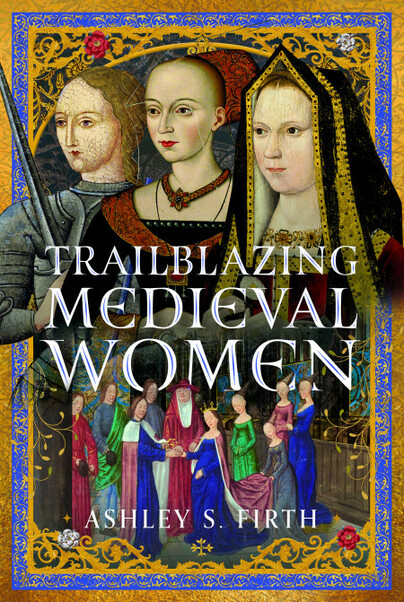
These women did not simply live through history; they shaped it. These women challenged not only the established gender hierarchy but also the men who occupied the English throne. Trailblazing Medieval Women explores these lives in greater depth, bringing their remarkable stories to a wider audience.
Ashley Sarah Firth is a medieval historian, author, and former university lecturer. She has published a range of academic work on medieval history and gender, and also runs the popular history blog https://manchistorian.com.
Order your copy here.