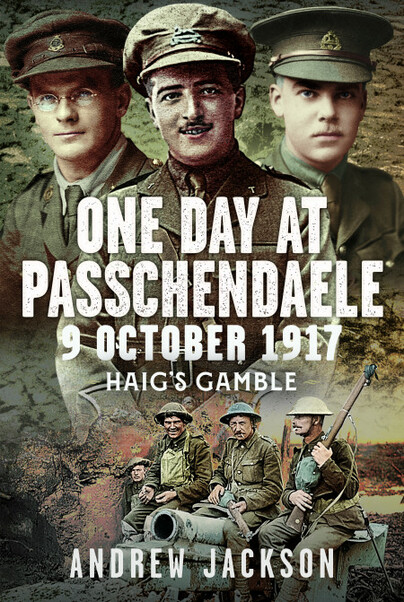
One Day at Passchendaele – a Vignette
Author guest post from Andrew Jackson.
After writing Accrington’s Pals: The Full Story (Pen & Sword, 2013), I looked for a fresh topic to research which had been relatively neglected by the history books but which also had a strong connection to the East Lancashire area where I lived until work took me away.
It was on reading David Martin’s Death of a Division (Pen & Sword, 2018) that I was reminded of the attack made by 66th (2nd East Lancashire) Division below the Passchendaele Ridge on 9 October 1917, more than two months into the Third Battle of Ypres. Fighting alongside the 66th on that day was 49th (West Riding) Division, a division raised from the area where I live today. The attack has been recorded as having formed part of the battle of Poelcappelle; sandwiched between the battles of Broodseinde on 4 October and First Passchendaele on 12 October – both chiefly remembered for attacks made by Australian and New Zealand divisions – it has been relatively neglected by historians and little attention had been given to German sources. It would prove to be a story of remarkable feats of heroism and endurance under the most appalling conditions. Here was the topic that I was looking for.
Less than a month after the opening of the Third Battle of Ypres on 31 July 1917, responsibility for reinvigorating the offensive had been transferred by Haig to the Second Army under Plumer. Plumer’s approach was gradually to force back the enemy through consecutive attacks, each with strictly limited objectives, in which the infantry would be protected by a deep belt of a creeping barrage made up of successive waves fired from heavy guns and howitzers, machine guns and field guns. The interval between each attack was governed by the time required to bring forward the artillery and range the guns on their new targets. During the generally fair weather of early autumn, this ‘bite-and-hold’ approach succeeded at the battles of Menin Road (20 September), Polygon Wood (26 September) and Broodseinde. Haig – beguiled by reports that German resistance was near breaking point – now envisioned that the objectives of a fourth attack (on 9 October) might be less constrained and could even take in the village of Passchendaele.
But then the weather changed: showers on 4-6 October were followed by torrential rain on the 7th and throughout the evening and night of the 8th: the ground turned into thick, glutinous mud, shell holes filled with water and streams overflowed to leave the valley floors waterlogged. Of the guns that had been so crucial to the success of each of Plumer’s attacks, many had been unable to move up at all, others were bogged down while attempting to reach their new positions.
Haig met with his army commanders in the afternoon of 8 October when the fateful decision was taken to go ahead with the attack on the following morning. It was a desperate gamble to maintain the momentum of the offensive.
Into the battleground below the Passchendaele ridge were fed the 49th and 66th Divisions, as fresh replacements for the Australian and New Zealand divisions of the Second Army. Both divisions had been brought down from the Belgian coast only a few days previously and had had scant opportunity to train for the attack. The infantry brigades chosen to make the attack at 5.20am (Zero hour) on the 9th – 146 and 148 Brigades from 49th Division, 198 and 197 Brigades from 66th Division – were sent to follow tracks up to their jumping-off positions only on the preceding evening under heavy rain and strong winds. 197 Brigade fared worst of all: none of its battalions were able to reach the assembly position by Zero, despite being on the march for more than eleven hours and having the use of two tracks; by the time the brigade advanced from the jumping-off line at about 6.45am, the barrage was almost half a mile in the distance.
Exhausted, wet through, chilled to the bone and, to a large extent, bereft of an effective protective barrage, the infantry of the two divisions never had a realistic chance of success against the German 195th Division entrenched on the Passchendaele ridge and on the Bellevue spur which dominated its approaches. And so it proved, with minimal gains across the front of the two divisions coming at a cost of more than 5,700 casualties.
Yet there were moments when concern had grown within the command of the 195th that a breakthrough of its lines was threatened, particularly along the higher and drier ground around the road leading into Passchendaele village. It is here that perhaps the most intriguing exploit of the day took place. 197 Brigade, made up of four Lancashire Fusilier battalions, had against all odds fought its way 1,500 yards up to its final objective, from where the ruins of Passchendaele church lay just 800 yards in the distance. In the late afternoon, 49th Division Headquarters received a report that one officer and sixty other ranks of 66th Division had entered Passchendaele and stayed there for a short time before withdrawing to high ground about 60 yards west of the village where they had consolidated. 66th Division’s own account of the day’s fighting noted that patrols led by Captain Philip Townley Millers, 2/8th Lancashire Fusiliers, and Captain Frank Mercer Bentley, 3/5th Lancashire Fusiliers, were reported to have entered the village. A colourful account of the escapade was eagerly fed to the press and was widely published in British newspapers before two days had passed:
Another English section, about 60 strong, commanded by four officers, had attained their objective earlier in the battle. A detachment of the advance guard, whose share in the battle was over, became bored by inaction, and the officers asked their men whether they were not curious to know what was happening further on. They entered Passchendaele, cleared out the western boundary of the ruined hamlet, held up two forts of machine guns with their garrisons, and maintained their position for nearly an hour, during which time they broke up a furious attack by a Bavarian battalion. A liaison officer ran to inform the brigade commander of this unexpected success. A great piece of work had been done, he said, so why throw away such a chance. Orders, however, were given to the last surviving officer and his handful of men to leave the village and take up a position a short distance from the ruins. It was thus before Passchendaele that the advance exceeded for a time its objective. (Yorkshire Evening Post, 11 October 1917)
If any of those who took part in the patrols left accounts of their experiences, none have come to light. 197 Brigade, with both of its flanks exposed, was compelled to fall back. Bentley, wounded by a rifle bullet in the thigh during the action, was killed by enemy shellfire only days after returning to France in October 1918. The citation for his award of the Military Cross recognised that he had ‘got well in advance of the final objective [on 9 October], but had to withdraw, being unsupported on the flanks.’ Millers, shot through the neck by a sniper on 9 October, saw no further active service.
Order your copy here.