Constantine V and the Plague of 747: How an Emperor Governed Through Disaster
Author guest post from Leslie Ivings.
When the plague returned to the Byzantine world in 746–747, it marked one of the most devastating outbreaks since the first wave of the Justinianic Plague two centuries earlier. Entire districts were depopulated, trade faltered, agricultural production collapsed, and the capital itself, already strained by war, migration, and administrative change, experienced a mortality crisis on a scale its historians struggled to capture. Into this moment stepped Constantine V, a ruler whose reputation has long been buried beneath layers of iconophile polemic. Yet in the context of the 747 plague, the surviving evidence allows us to glimpse a very different ruler: pragmatic, active, and acutely aware that imperial authority meant little if the population itself was dying.
Our principal narrative sources for the outbreak, Theophanes the Confessor and Patriarch Nikephoros, were both hostile to Constantine’s iconoclast policies, but even they could not ignore the scale of the disaster. Theophanes writes that the plague “ravaged the entire inhabited world” and hit Constantinople with particular ferocity, reducing the capital to a shadow of its former size (Theophanes, Chronographia, AM 6238). Nikephoros echoes this, describing a “death of multitudes” so overwhelming that the city became “a wilderness” (Breviarium, 81). While these accounts exaggerate in the way all medieval chroniclers do when describing catastrophe, modern demographic analysis agrees that the outbreak was severe, widespread, and destabilising.
This context matters because it helps explain the unusual actions Constantine V took in its aftermath and measures that reveal how the emperor understood governance during crisis.
According to both Theophanes and Nikephoros, Constantine responded decisively by ordering a large-scale evacuation of Constantinople. He compelled surviving inhabitants to leave the capital and disperse into healthier rural districts of Thrace and Bithynia, thereby reducing population density and halting the cycle of reinfection (Theophanes, AM 6239). This was not a symbolic gesture but a genuine public-health intervention: with no medical cures available, dispersal was one of the few strategies that could interrupt epidemic transmission. It echoes earlier Roman and Near Eastern practices in times of plague, yet Constantine’s measures are among the most explicitly documented in Byzantine history.
The emperor did not remain idle in the palace while the city emptied. Instead, he travelled extensively through the affected provinces, coordinating relief, encouraging repopulation of abandoned villages, and supervising the reorganisation of fiscal districts. Nikephoros, no admirer of Constantine, admits that the emperor “visited the countryside” and “saw to its needs” (Breviarium, 82). This is remarkably high praise from an iconophile patriarch writing within the ideological environment of the early ninth century. It suggests that Constantine’s activity was so significant that even hostile sources could not omit it.
One of his most noteworthy responses came after the immediate crisis had passed. With Constantinople drained of people, markets, and manpower, Constantine initiated a large-scale repopulation programme. He ordered the transfer of families from Greece and the Aegean islands, including the Cyclades and possibly the Thracesian coast, into the capital to restore its workforce and revive its economy (Theophanes, AM 6240). This policy had long-term consequences: it introduced new regional populations into the Constantinopolitan demographic mix and helped stabilise the urban tax base.
This same period saw measures that, in hostile sources, became part of the emperor’s supposed “anti-monastic” agenda. But in the context of the plague recovery, they appear less ideological than administrative. Theophanes claims that Constantine resettled monks and seized some monastic properties, but when viewed within the post-epidemic environment of depopulated farms and abandoned estates, these actions align with longstanding imperial priorities: restoring agriculture, ensuring taxable land was worked, and preventing the accumulation of vast estates that lay outside fiscal control. Whether one approves of the policies or not, they were natural extensions of a ruler attempting to rebuild an empire whose labour supply had collapsed.
The plague also played a significant role in the restructuring of the imperial military. Constantine V’s later creation and expansion of the tagmata, the elite central field army, is often interpreted purely through ideological or political lenses. But the plague of 747 had inflicted heavy losses on the thematic armies of Anatolia and Thrace, forcing the emperor to rethink how manpower was recruited, trained, and distributed. By concentrating professional soldiers closer to the capital, Constantine ensured that the army could function despite fluctuating provincial populations. The founding of the tagmata is thus not merely a military reform but a direct response to demographic instability created by the epidemic.
It is important to acknowledge that much of our narrative comes from authors committed to undermining Constantine’s legacy. Theophanes and Nikephoros rarely miss an opportunity to attribute misfortune to divine punishment for iconoclasm. Yet even within their hostile framing, Constantine emerges as a ruler who acted swiftly and energetically in the face of demographic collapse. They criticise his theology, not his competence. Theophanes grudgingly admits that Constantine “took thought for the cities” and restored life to the capital (AM 6241). This kind of acknowledgement, coming from a source designed to discredit him, is extraordinarily telling.
Modern scholarship likewise treats Constantine’s response with seriousness. John Haldon has argued that the 746–747 plague triggered a broader restructuring of the empire’s fiscal and military systems, and that Constantine’s policies should be understood as rational adaptations to post-epidemic conditions. Leslie Brubaker, analysing iconoclast ideology and administration, notes that Constantine’s reign reveals “an unusually active, interventionist ruler” whose decisions were shaped by material and demographic realities, not simply theological positions (Byzantium in the Iconoclast Era, 2001).
Seen in this light, the emperor’s response to the plague becomes one of the clearest windows into his style of rule. He confronted demographic disaster with movement, inspection, resettlement, and reform. He saw the connection between population and power. And he understood that an emperor’s responsibilities extended beyond the palace walls and into the fields, ports, and devastated homes of his subjects.
The plague of 747 remains understudied compared to the first and second pandemics, but its impact on the Byzantine Empire was profound. It altered settlement patterns, reshaped the army, transformed landholding, and forced the government to intervene in daily life at a scale seldom seen since Justinian. At the centre of this response stood Constantine V, so often remembered as a caricature in later iconophile polemic, yet revealed through this crisis as a capable and engaged ruler who governed not merely through ideology but through action.
If we wish to understand Constantine V as he was, rather than as later generations imagined him, there are few better places to begin than his handling of the plague. In a moment of fear and mortality, the emperor did not retreat. He governed.
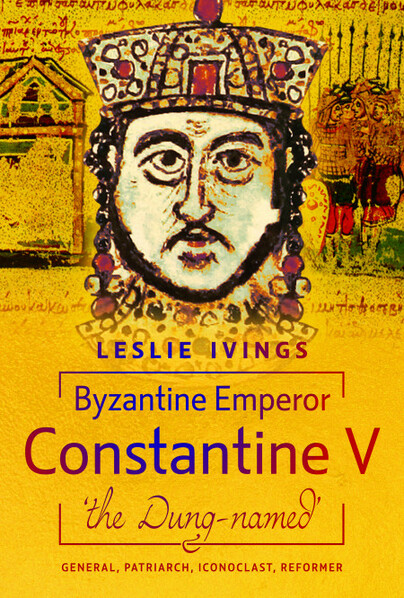
Order your copy here.