The Gestapo’s Most Wanted: The White Mouse – Refusing to look away from the crisis
Guest post by Ali Sharman.
It was 2020 when I first read about SOE Agent Nancy Wake. It was during the first Covid lockdown, at a time when I found myself thinking more and more about crisis: what it does to us, what it reveals, and how easily so many of us can be persuaded to look the other away. Those early days of the pandemic were saturated with fear and uncertainty and I remember noticing how quickly the idea of responsibility became negotiable; how tempting it was to retreat into the private sphere and decide that the world’s problems were simply too large, too complex, too exhausting to engage with. It was within this context that I was drawn to Nancy’s extraordinary story.
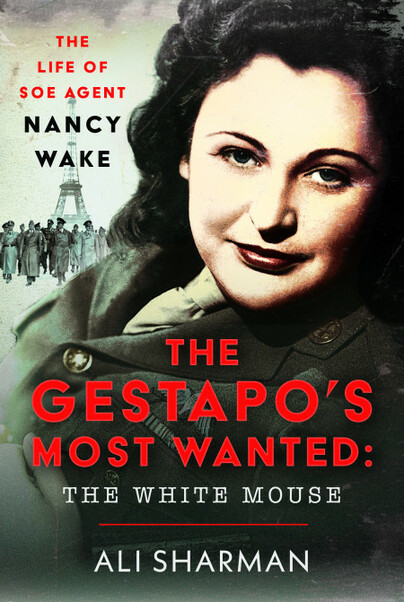
Nancy Wake is best known by her reputation as a decorated SOE (Special Operations Executive) agent and her codename, The White Mouse, bestowed upon her by the Gestapo when she topped their ‘most wanted’ list in 1943. But to define her solely in this way risks distancing us from who Nancy really was, as though her actions belonged to a different type of human courage, one unrelated to the choices faced by ordinary people in a period of crisis.
Because what struck me the most, when I began researching her life and exploits more closely, was her starting point. Nancy ran away from home when she was just a teenager, then lied about her age and experience to secure a role as a nurse. She later talked her way into a journalism job in Paris that she was woefully underqualified for. She was fun and confident and outspoken. She had strong opinions and a clear sense of right and wrong. She could also be brash and precocious and – as she readily admitted herself – drank, smoke, and swore too much. And she threw herself wholeheartedly into danger: first as a volunteer ambulance driver on the front lines, then working with the French Resistance, and finally as an SOE agent. She chose to return to occupied territory from Britain despite being the most wanted woman in France, becoming the de fatco leader of thousands of maquis fighters in the Vichy countryside. During the war, she risked her life countless times for other, for the good of the war effort, and for her adopted country.
But what set her apart was not fearlessness – it was a refusal to avert her gaze, despite her fear, once she had seen injustice clearly. She chose to fight when she could so easily have turned away.
For Nancy, it all started in the 1930s, when she witnessed the early brutalities of Nazism firsthand in her role as a journalist. She knew the horror of watching the crowds swept into a frenzy at a rally by Hitler. She saw a Jewish man being beaten on the street by SS agents whilst bystanders stood by and did nothing. She understood where such violence was heading and she did not treat such knowledge as abstract or regrettable. It demanded her response; she refused to look away from the crisis she knew was coming.
This became the heart of The Gestapo’s Most Wanted: The White Mouse because Nancy’s story is not just about daring escapes and dangerous escapades. After her marriage to wealthy French industrialist Henri Fiocca, she became someone who could, quite plausibly, have stepped back from danger altogether. But those early encounters with Nazi brutality stayed with her. So, time and again, she acted in defence of the vow she had made when witnessing those horrors firsthand: cruelty must be resisted; injustice must be named; responsibility does not evaporate because circumstances are frightening. She endured violence, betrayal and unimaginable personal loss. She operated under constant threat of capture and execution. She acted because, for Nancy, not acting would have meant complicity.
In this way, the process of researching and writing this book forced me to sit with an uncomfortable question: why do some people, when surrounded by darkness, choose action over withdrawal? And why do some look away whilst others refuse to?
It is the awful truth that the world is, once again, in crisis. And, if anything, the crisis has only sharpened since I first began the project. Political volatility and increasingly divisive rhetoric, violence and war on our social media feeds, the accelerating threat of climate change – we are living in a time defined by the impact of these overlapping crises, and a general sense that the ground beneath our assumptions is less stable than it may once have seemed. The scale is overwhelming; the language often numbing. It can be tempting to ration our attention, and it is not always clear what responsibility looks like in these moments, or on this scale. Many of us oscillate between outrage and fatigue. Disengagement can seem like a form of self-preservation.
But Nancy’s story reminds us how important it is for individuals to navigate this world of darkness and crisis with action and a sense of justice and responsibility. In 2026, this is the part of her story that feels most resonant.
The Gestapo’s Most Wanted: The White Mouse is available now.