When Vikings Conquered England
Author guest post from Brandon Michael Bender.
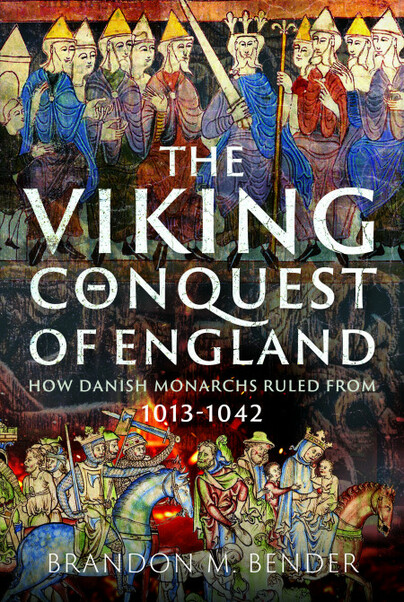
The Danish Conquest of England is one of the darkest yet most exciting periods in English history. It’s the story of how Vikings violently overthrew the existing English monarchy just fifty years before the Norman Conquest and stayed on the throne for a generation. My new book, The Viking Conquest of England, covers three main aspects of the conquest: its background, the warfare between English and Danish armies in the early 11th century, and how the Danish kings established control after their conquest was complete. In total, four Danish kings sat on the throne of England from 1013 to 1042.
Aside from the legend of King Cnut and the tide, not much from the era of the Danish Conquest has stayed in the popular imagination. This is a shame because the Danish Conquest was just as tumultuous and exciting as Alfred versus the Great Army or the Norman Conquest. It just isn’t as well known.
Viking attacks on England (and Europe in general) began long before Danish kings toppled the English dynasty. As early as the eighth century, Vikings pillaged throughout the British Isles. The ninth century saw many of the smaller English kingdoms fall to Vikings, but this wasn’t the Danish Conquest. The English kingdom of Wessex survived and gradually became the dominant player in southern Britain, amassing land and wealth. As Wessex grew more powerful, its rulers began calling themselves King of the Anglo-Saxons and, by the tenth century, King of the English. By that time, something resembling “England” had formed.
Meanwhile, a similar process was happening in Denmark. The Scandinavian warlord Harald Bluetooth muscled his way to power, and the Kingdom of Denmark began to take shape. These two nascent kingdoms would soon collide in a fierce struggle.
Harald Bluetooth’s son, Swein Forkbeard, overthrew him to become the new King of Denmark in the 980s. Swein, like his father, was not just a king. He was a Viking. He personally led raiding armies far and wide, plundering everywhere from the Isle of Man to southern England, collecting tribute and riches. He and other powerful Viking leaders like Thorkell the Tall kept their armies in England for years at a time, gradually wearing down English defences.
The final Viking invasions of Thorkell (1009-1012) and Swein (1013) pushed England to its breaking point. After decades of weathering everything from intermittent raiding to full-scale invasions, the English kingdom finally collapsed in 1013. Its hardworking but unlucky king, Æthelred the Unready, went into exile and Swein was acknowledged as the new English king. England had fallen to a Danish conqueror.
But the Danish Conquest was not to be so simple. Just a few months later, England’s conqueror, Swein, died. The English nobles were thrown into confusion, with some supporting Swein’s son, Cnut, who was present in England. Others wanted to recall Æthelred the Unready, their anointed king.
Æthelred returned to England with a show of force. The old king personally marched north, where he swiftly defeated Cnut’s Viking army in Lindsey (modern day Lincolnshire). Cnut went back to Denmark licking his wounds, but he would not so easily forget his claim to England. The Danish Conquest had been undone – for the moment, at least.
The next year, 1015, saw Cnut return to England with a fresh invading force, ready for his revenge against Æthelred. The next two years saw some of the fiercest fighting of the entire era. Æthelred fell ill and passed along the struggle to his impetuous son, Edmund Ironside, who repeatedly brought Cnut to battle. Neither side could land a knockout blow until the Battle of Assandun in October 1016, when Cnut annihilated Edmund’s army. By the end of 1016, both Æthelred and Edmund were dead. Cnut had conquered England.
Cnut’s conquest was more permanent than his father’s, but he began in a precarious position. Over the next few years, Cnut replaced and assassinated leading figures. He ordered tribute payments to buy off his massive invading force, which was no longer needed. He even married Emma of Normandy, Æthelred’s widow, linking him to the old dynasty.
As he tightened his grip on England, Cnut inherited Denmark from his brother in 1018. Now England was not just ruled by a Dane, but united to Denmark itself. Cnut’s reign in England eventually grew more stable, allowing him to seize control of Norway as well. By about 1030, the Danish dynasty had reached its zenith. Cnut ruled England, Denmark, and Norway simultaneously. He even dabbled in papal and imperial politics in continental Europe.
However, when Cnut died in 1035, his network of kingdoms was already coming apart. Norway broke free that same year, while England divided itself into factions during a messy succession dispute. The northern and central parts of England supported Cnut’s older surviving son, Harold Harefoot, while Wessex held out for the younger Harthacnut, who was already King of Denmark.
Each side plotted and schemed against the other. Harthacnut’s faction spread rumors that Harold was not really Cnut’s son. Harold’s faction held lavish banquets, allegedly trying to buy support. The succession dispute was not resolved until 1037, when Harold was finally consecrated.
Harold had bested his half-brother to become the third English king from the House of Denmark. He also represented the third generation of the dynasty to rule England. However, Harold’s reign was short, and he died in 1040, allowing Harthacnut to take the English throne.
Harthacnut was the fourth and final Danish king of England. His reign was short and brutal, mainly remembered for high taxes, rebellion, and a smear campaign against his predecessor Harold. Harthacnut even had Harold’s body disinterred, executed, and thrown into the Thames. The action disgusted his new subjects, who only became more alienated as the reign progressed.
Harthacnut died just two years into his reign, in 1042, and the direct Danish line ended. A son of the long-dead Æthelred, Edward the Confessor, ruled England from 1042-1066, right up to the doorstep of the Norman Conquest. In 1066, the Normans took over for good, and soon the Danish Conquest was a distant memory. The Danish kings were predecessors of predecessors, and their time in charge of England was largely forgotten.
However, the Danish dynasty accomplished something truly remarkable. Fifty years before the Norman Conquest, they had conquered England and then held it for nearly three decades. Their house took the form of four kings from three different generations. Their reigns were among the most dramatic and tumultuous in all of English history, and The Viking Conquest has been written to shed some much-needed light on them.
Order your copy here.