Five Things You May Not Know About Nancy Wake
Women’s History Month guest post from Ali Sharman.
The name Nancy Wake might conjure up images of daring exploits behind enemy lines – exploits that earned her the codename ‘the White Mouse’ and a position at the top of the Gestapo’s Most Wanted list during World War Two. Yet behind the most celebrated moments of Nancy’s life lies many more intriguing and surprising incidents. Here are five things you may not know about her.
1. She was born in New Zealand
Nancy Wake is often thought to be Australian so it may come as a surprise to learn that she was actually born in Wellington, New Zealand, in 1912. However, her family moved to Sydney when she was just a small child for her father’s career, and it was there that she was raised.
The Antipodean confusion is understandable: she spent her childhood in Australia as well as subsequently returning after the war had ended to settle there with her second husband. She even stood for election to political office twice, although she was narrowly beaten both times, but her story began on the other side of the Tasman Sea.
Despite not returning to New Zealand, she maintained a passport in recognition of her roots and birth nationality.
2. She came into the world under a Kahu
Nancy’s life began with could be interpreted as an omen. She was born with a fold of the amniotic sac still covering her head – a rare phenomenon often called being ‘born with a caul.’ Medically, it is harmless to both mother and child. Statistically, it is extraordinarily uncommon, occurring in fewer than one in 80,000 births.
Across different cultures, such births have long been associated with good fortune. In Māori belief, this is known as a kahu, signifying that the child will be especially lucky. Given her astonishing ability to evade capture in occupied France, we must wonder if there is some truth to this superstition!
3. She talked her way into a job she was not qualified for
Nancy’s first career was as a journalist. She had travelled to London, and her funds had begun to run low, so she took a journalism course on a whim. Soon after, she applied for a job with Hearst, the American media empire, which would take her to Paris. There was just one problem: she was not qualified for the role.
The editor revealed in her interview that he sought a correspondent with knowledge and experience of the Middle East. Undeterred, Nancy claimed she could speak and write Egyptian – a language she did not, in fact, know. He read aloud a passage from a book in his office and Nancy pretended to copy it down in hieroglyphs and then read it back to him perfectly from her notes. What she had actually done was use the shorthand she had just learned during her course, but writing right to left to make it look as if she was using an Egyptian script. It was an audacious bluff, but it succeeded and she was rewarded with the job, despite the fact that hieroglyphs had not been used in Egypt for centuries.
This was typical of Nancy’s career, both in journalism and as a secret agent: her confidence, her readiness to seize opportunity, and a brazen refusal to be intimidated by convention, all served her well in far more dangerous circumstances.
4. She may have interviewed Hitler
Nancy’s career as a journalist grew and she reported first-hand on the rise of Nazism from across Europe. There was a rumour that she even had the opportunity to interview Adolf Hitler himself!
Frustratingly, verifying this isn’t possible. At the time, it was common practice for newspapers to publish the work of female journalists (particularly those working freelance) under a male editor’s byline. As a result, it is not possible to locate this piece in surviving archives.
The possibility is tantalising though: a future resistance fighter sitting face to face with the man whose regime she would later combat with such ferocity.
5. She cycle 500 miles in less than 72 hours
When Nancy was working alongside the Maquis as an agent of the Special Operations Executive (SOE), their communication device was destroyed during a German raid on their stronghold. Without the radio, coordination with SOE headquarters would be impossible. Nancy volunteered to fix the problem.
She set off on a bicycle and rode approximately 500 miles through occupied territory in less than 72 hours to find another operator and re-establish communication with London. The journey took her along roads patrolled by German forces and past multiple checkpoints. Alone, she faced these dangers head on. And the sheer physical endurance it required to cycle that many miles as quickly as possible.
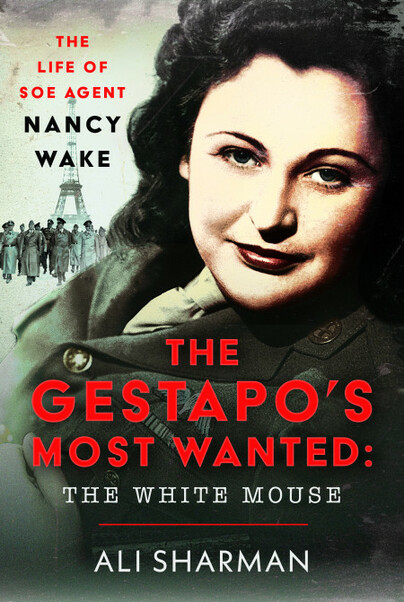
You can explore her story in full in The Gestapo’s Most Wanted: The White Mouse.