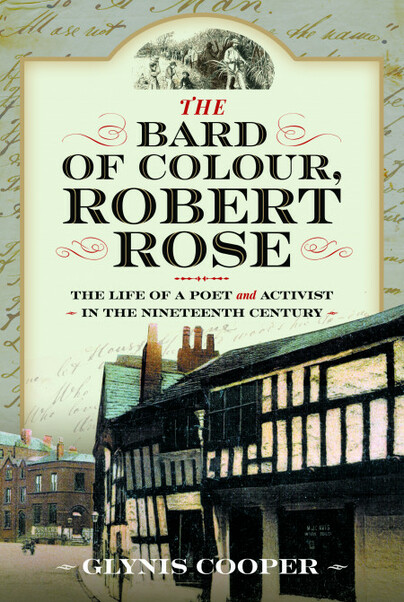
The Bard of Colour, Robert Rose
Author guest post from Glynis Cooper.
Writing this book about an unknown poet was educational; both a work of detection and a lesson on how to navigate the modern minefield of taking offence. The subject was a man of mixed race (white father, black mother). Robert Rose, Manchester’s first black poet, came to Britain from the Caribbean in the first decades of the 19th century and far less is known about him than the Classical and Chinese poets of 2,000 years ago. Rose said he came from Berbice, now part of Guiana, but there is there is no information on when or where he was born; who his parents were; where he lived in Berbice; when he came to England; what school he attended; where he lived and worked in Liverpool; or who provided his generous annual allowance. There is no dedicated publication of his poetry; no personal correspondence; no image or drawing of him; no archive of papers. All that really remains of the man himself is a half-buried tombstone in a Manchester cemetery and a notebook dating from c1840-1845 held by Chetham’s Library together with three of his loose leaf poems.
So, like any good television detective, I asked myself what do we actually know about Robert Rose?
He came from Berbice in the Caribbean.
He knew Classical literature, evident from his poetry, so he had a decent education.
He gave a powerful and emotive speech about the abolition of slavery and the emancipation of slaves at a Liverpool dinner in 1835 but there is no copy of this speech available on public access in Britain.
He wrote poetry; much of it exclusively in rhyming couplets.
He was a prominent member of the Manchester Sun Inn poets based on Long Millgate.
He was robbed late at night on a Manchester street in 1841
He lived in a Salford lodging house c1841-1849
He died in 1849 and the doctor who attended him stated he was aged about 43 at the time of his death. This would give a date of birth of around 1805/6.
He was buried in a Manchester cemetery although he died in Salford.
He left one notebook of poems and jottings which covered the years c1840-1845
Not much on which to build a biography. Robert Rose himself was very coy about his background. He never talked about his family. He never said how or when he came to England. He never revealed his mysterious benefactor. He never said what sort of work he did, or where, before becoming a poet. He never published a collection of his poems. In some ways he seemed terrifyingly alone. A man from nowhere.
Most of what is known about him comes from contemporary newspapers of the time, so a major stumbling block turned out to be language, because he was often described in terms unacceptable today. However, if you are quoting from work written 200 years ago.
it may include terms which are now considered offensive. History cannot be re-written. It happened. It has gone. You can change the present but you cannot change the past.
Unfortunately considerable numbers of people seem to have a total inability to recognise that history cannot be re-written and we live in a supersensitive age when it comes to taking offence. Recently a person attending a talk on the Classics given by a prominent Classicist accused the speaker of promoting fascism and presenting racist caricatures. This person just could not understand that an actual episode from history was simply being retold by the speaker and, of course, quotes were used. Many regimes of Classical times would certainly meet the current dictionary classification of fascism and there were indeed racist issues then as now. The problem, apparently, was the language and attitudes quoted from Classical times
This innate inability to understand the concept of telling history as it actually was presents a huge difficulty for writers of history, biography, archaeology, anything which relies, wholly or partly, on the past. The point is certain things were done or said. They are history. They cannot be re-written any more than the words of Caesar, Napoleon or Hitler could be re-written. This is a conversation which needs to be had, especially in the light of the US President’s recent descriptions of Iran and its people and the threats he has made. Whatever happens now, his words, although grossly offensive to many people, cannot be changed. They have become a part of US history.
Back to Robert Rose and disclaimers have been added within the text apologising for the use of certain terms but explaining that they are quotes from a given person at a given moment in time, and the way in which they were used may have affected their subject’s reactions adversely. Robert Rose himself did not care for some of the terms and dealt with them in his own way; one of which was his insistence on being known as ‘The Bard of Colour’ to emphasize his difference. To understand his reactions, it is necessary to understand the details, and this is done largely through his poetry, published almost exclusively in contemporary 19th century newspapers, together with contemporary 19th century newspaper articles and the report of his inquest in 1849.
A copy of the powerful emotive speech, anti-slavery and pro-emancipation, given by Rose, was published in Liverpool in 1835 and reprinted four times, which makes it more surprising that there was no copy held on public access in Britain. However, the National Library of Australia in Canberra has come to the rescue and allowed its own copy to be reproduced as an appendix in this new book telling the story of Robert Rose. It is worth noting that the speech was well received by its audience in 1835 except for the jeering of a few American members. Uncomfortable echoes perhaps of 21st century America? Maybe another conversation that needs to be had.
Order your copy here.