Five Things that Made the Battle of Dupplin Moor (1332) Truly Extraordinary
Author guest post from James Turner.
- It was not a simple matter of Scots vs English
While much of the rank and file of the invading army were recruited from northern England their leaders, the Disinherited, were a cabal of closely related Anglo-Scottish nobles. The Disinherited were the sons and grandsons of Scottish nobles whose once vast estates had been confiscated as a result of their refusal to recognise Robert Bruce’s right to the Scottish crown. Most of them were relatives of the once powerful Comyn family and John Comyn III of Badenoch, a rival claimant who Bruce murdered during a truce at Greyfriars Church. The Disinherited planned to place Edward Balliol, the son of the deposed John Balliol, onto the Scottish throne and reclaim their lost ancestral lands and titles.
Edward III of England had given the scheme his tacit approval and secretly aided them in financing the campaign. Publicly however he vociferously denied all knowledge of the upcoming invasion. To preserve an element of plausible deniability he had forbidden the Disinherited army to march directly out of England, necessitating the assembling of a fleet.
- There was a vast numerical disparity between the two armies
The Bruce loyalists brought somewhere around 15,000 to the Battle of Dupplin Moo, a force which outnumbered the tiny Disinherited army by close to 10 to 1. Scotland nominally operated a system of knight’s fees which nominally denoted the number of knights a landowner was expected to raise for military service. This system raised a significant portion of well-equipped and trained soldiers in the form of the combined military households and immediate retainers of the participating aristocrats. Armies raised in this way, temporary military coalitions of aristocrats gathered together for a single campaign or objective, had carried out the majority of the everyday fighting in the Bruce’s war to claim the throne of Scotland.
By tradition the King, or in this case his Guardian, could also summon every able-bodied man in the kingdom to military service. Such musters were usually called only on a regional level to support ongoing campaigns being fought by more traditionally raised troops. While capable of raising formidable amounts of troops, their usefulness was invariably curtailed by their lack of equipment and military training. Because the Bruce loyalists did not know exactly where the Disinherited would land, they also fielded a second army of comparable size under the commander of Earl Patrick of March. The initial plan being that both armies would screen the coastline, converging upon the enemy as soon as they revealed themselves.
- The Leaders of the Scottish army were Bitter Rivals
The commander of the Bruce army at Dupplin Moor was Earl Domhnall of Mar, the Guardian of Scotland and regent of David II. A maternal nephew of the late king Robert Domnhall had only recently been elected as Guardian following the death of his cousin he highly capable Earld Thomas Randoph of Moray. His primary rival for the Guardianship was another of his cousin Lord Robert Bruce of Liddesdale, the illegitimate eldest son of the late King Robert. In order to appease Roberts many supporters and keep a close eye on him Mar granted him command of half of the army at Dupplin Moor. Upon locating the enemy and Domhnall wished to play for time and await the arrival of the second Scottish army commanded by the Earl of March. The bellicose Robert however publicly accused the Guardian of first cowardice and then plotting with the enemy.
The result of the blazing row that followed was that both Scottish commanders became determined to prove their loyalty and worthiness to lead by being the first to crush the Disinherited. The army had been divided into two massive Schiltrons, commanded by Mar and Bruce respectively. With their commanders desperate to outdo one another, the two halves of the Scottish army began racing each other across the Moor, abandoning any hope of a coordinated attack. This haste, combined with the rough and uneven terrain of the Moor, saw both formations become increasingly disorganised and deformed. Rather than delivering a concerted hammer blow to shatter the enemy line, the now out of formation Scottish troops reached their foes piecemeal.
- The devastating use of the longbow foreshadows English success in the Hundred Years War
The Disinherited took up a strong defensive position at the bottom of a depression on the edge of the moor, the flanks of which were guarded by two small hills. They strung their men at arms out in a thin line across this depression while the archers arrayed themselves upon the slopes of the two overlooking hills. The English archers positioned on the two hills on either side of this melee began raining arrows down upon Bruce’s troops. As the Disinherited line was pushed back by the weight of enemy numbers, it began to expose the sides of the Scottish army to greater volumes of enfilade fire.
The Scottish army was, due to the mechanisms through which it was raised, composed of both hastily raised levies and the battle-hardened retainers and warbands of the nobility. Naturally enough, both Robert Bruce and Earl Domhnall had packed their best equipped and trained troops in the front of their formations. After all, it was these men who were most capable of going toe to toe with their similarly equipped and trained equivalents in the Disinherited army. Of course, this meant that the formations more numerous and less well armoured and disciplined troops were left as the English archers’ only real target. While the Disinherited’s men stubbornly held in the centre, the archers systemically whittled away at the Schiltron’s poorly protected flanks. As the men on the flanks began to panic, they tried to press inwards into the formation in their desperation to seek shelter from the arrows.
This caused a dangerous crush which greatly impeded the combat effectiveness of the formation, the constant pressure and churn of men not only preventing fresh soldiers from reaching the front line but began to pin fighters against the enemy without the space necessarily to fight effectively. Perhaps as many as a thousand of Mar’s soldiers died in the crush, suffocated, or trod under heel by their fellows as they passed out or lost their footing. In the end, the army was routed leaving behind heaps of the dead and broken.
- It kickstarted the Second War of Independence
Amongst the Scottish casualties were the Guardian of Scotland, Earl Domhnall of Mar, his rival Robert Bruce of Liddesdale, Earl Muireadhach Stewart of Menteith and Earl Thomas Randolph of Moray, the son of the previous Guardian. Earl Donnchadh of Fife, surrendered and formally swore loyalty to Edward Balliol. In contrast, we are told only thirty-five of the Disinherited’s men at arms were killed. Through canny positioning, the power of the longbow and a healthy dose of hubris on their enemy’s part, the Disinherited had triumphed over almost impossible odds.
The Disinherited moved quickly to besiege Perth whose commanders surrendered the city in short order. On the 18th of August, a full week after the Battle of Dupplin Moor, Earl Patrick of Dunbar’s army finally arrived and attempted to place Perth under siege. Patrick was immediately confronted with a problem. The number of archers now positioned on the walls of Perth would make any attempt to storm the city unimaginably bloody, if not outrightly suicidal. On the other hand, Perth was full of provisions, while Dunbar’s large army was filled with hungry mouths, useless to the operation of a prolonged siege. Should he attempt to besiege the city, it was likely that his forces would starve long before the Disinherited. Patrick’s final gambit was to attempt to blockade Perth from further resupply with an improvised Scottish fleet. This failed decisively when the Disinherited’s own fleet smashed the blockade, sinking or driving off Dunbar’s ships. Feeling he had no other option, Patrick withdrew before dissolving his army, sending most its troops home to Bruce aligned territories.
At Scone, on the 24th of September, before his fellow Disinherited, the assembled Scottish prelates and a smattering of local defectors, Edward Balliol was crowned King of Scotland. Earl Donnchadh performed his family’s traditional role in the coronation by placing the crown upon Edward’s head while the ceremony itself was presided over by Bishop William Sinclair of Dunkeld. Scotland now had one king too many. The result would be decades of renewed warfare that spared no corner of Scotland.
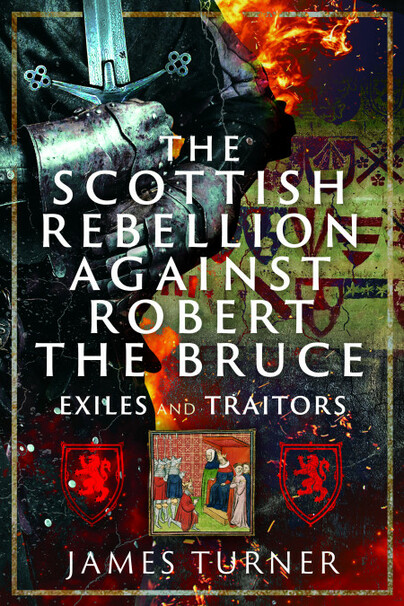
Order your copy here.