No Foos Without Fire? The Strange Legend of Nazi UFOs
Author guest post from S D Tucker.
Today, the legend of Nazi UFOs is big business; books, films, videogames and websites are obsessed with spreading the myth that Adolf Hitler invented flying saucers during the 1930s and ‘40s, but was defeated by the victorious Allies just in time to prevent him from deploying these marvellous, war-winning Wunderwaffen, or ‘Wonder-Weapons’. All those strange lights and craft witnesses report having seen whizzing through the world’s skies over the following post-war decades were not alien beings at all, goes this idea, but the technological result of top-secret Nazi aerospace experiments which had since been back-engineered by the Americans, British and Russians, after their troops had captured the Luftwaffe’s blueprints for themselves in 1945.
There is one small problem with this idea, however: during the Second World War itself, nobody ever reported seeing any Nazi flying saucers at all. How could they, if the war ended in 1945 and the whole concept of a flying saucer itself only came into being in 1947, when a commercial pilot named Kenneth Arnold supposedly saw a bunch of such things flying in formation over America’s cascade mountains?
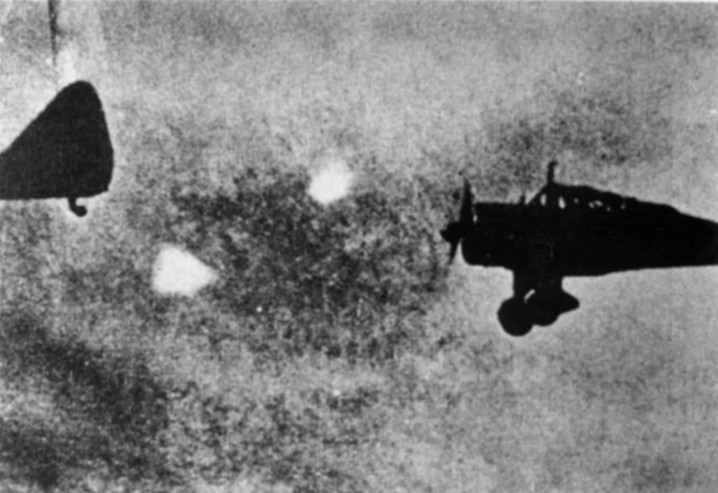
Nonetheless, once the initial imaginative seed had been planted, researchers combed through wartime records to see if they could unearth a pre-history for the subject. This proved easy enough, and the notion of the so-called ‘foo-fighter’, a mysterious bright aerial light reputedly witnessed during the war years over occupied Europe by US and British pilots, was born and subsumed effortlessly into the new and growing post-war field of ufology. These foos were initially painted as being Nazi secret weapons, although others soon guessed they may have been extraterrestrial in origin. Foo-fighters did definitely exist, yet these glowing, globular foos were most likely a bundle of potentially somewhat unrelated aerial and meteorological phenomena, later gathered together under the same conceptual canvas to give people an intelligible way to think about such things.
The term is usually traced back to the US comic-strip star Smokey Stover, whose adventures appeared daily in the Chicago Times from 1938 onwards, Smokey having first blazed a trail through its Sunday edition in 1935. Stover, created by cartoonist Bill Holman (1903-87), was a madcap fire-fighter who, prone to comic malapropism, gormlessly described himself as a ‘foo-fighter’ instead, when out quenching blazes in his impossible two-wheeled ‘Foo-Mobile’. Holman’s creation proved highly popular Stateside, with fan-led ‘Foo Clubs’ being founded, and Smokey later being painted as amateur nose-art on US bombers by troops.
Quite what ‘foo’ itself actually means is debatable. It could be a silly mispronunciation of the French word ‘feu’, meaning fire, or it may be a verbal slip for ‘faux’, meaning ‘fake’, or ‘fou’, meaning ‘mad’. It could mean ‘fuel’, with Smokey thought daft enough to try and extinguish a fire with petrol. Bill Holman himself said he found the word written on the bottom of a Chinese figurine one day, liked the sound of it, and obsessively kept writing it everywhere in his strip, not only in speech-bubbles but on signs, menus and car-registration plates.
Some Allied combatants later called Japanese fighter-pilots ‘foo-fighters’, on account of their kamikaze-like manoeuvres, this term then being extended towards the similarly erratically-moving luminous sky-balls. Others said it was used by sceptics simply to mean ‘phooey!’ in relation to reports of proto-UFOs, thus to dismiss their alleged witnesses as ‘foo-ls’. Then again, British troops reportedly used the term ‘FOO WAS HERE’ as a graffiti-tag, equivalent to the more famous ‘KILROY WAS HERE’ meme, ‘FOO’ perhaps meaning ‘Forward Observation Officer’. It could also have become mixed-up with the sweary military acronym FUBAR, as in ‘F***ed Up Beyond All Recognition/Repair’, itself possibly derived from the German ‘furchtbar’, or ‘terrible’.
Yet most such explanations are clearly just what lexicographers term ‘back-formations’, or retrospective guesses about the precise nature and history of the word, performed some time after the fact of its actual appearance. The same thing would soon happen with foo-fighters themselves, when people began using hindsight to deduce they were Nazi secret saucer-weapons or Martian mini-probes after the war.
Stereotypically, foos were unusual balls of light or other fiery shapes encountered by Allied aircrews in the skies over German-occupied Europe, singularly or in formation, generally nocturnally. During the day, they could appear more like silvery spheres. Possibly these were two separate phenomena, or possibly they were metallic by day, luminous by night, like certain atmospheric plasmas. Occasionally, foos possessed both metallic and luminous qualities simultaneously, as with the ‘shiny silver ball of several feet in diameter and shining by its own incandescence’ reported by one astonished crew on a raid over Frankfurt on 4 February 1944.
They often came across as seeming as though they were intelligently controlled, mirroring planes’ movements perfectly, something potentially explained by them being an electromagnetic phenomenon attracted towards an aircraft’s metal bodywork. Or were foos early remote-controlled drones? Whilst the Nazis did make substantial advances in guided rockets and glider-bombs, 1940s radio-control techniques of the sort which would have been needed to steer full-blown drones depended on a clear line of sight being maintained between operator and device, impossible in high-altitude night-flying conditions in which bomber-crews most frequently sighted foos.
When RAF pilots reported them back to the Air Ministry, officials logged and labelled them in neutral tones simply as ‘night phenomena’ and ‘balls of fire’. British crews themselves preferred to call them ‘The Light’ or ‘The Thing’, or else improvised labels randomly; the 1943 log-book entry of an RAF Squadron Leader P. H. V. Wells told only of a ‘screaming dog-fight with the Light’. One RAF Squadron newsletter spoke more whimsically of ‘weird and wonderful apparitions’, ‘the latest species of wizardry’ and ‘this Loch Ness Monster’ of the skies. A 1942 British intelligence report dismissed them as ‘freaks’ of a one-off nature, being ‘only reported on isolated occasions’. Canadian fliers sometimes called them ‘scarecrows’ as, whilst they looked threatening, in actuality they seemed harmless enough. Unlike a fire, a foo did not kill.
If you had asked most Allied pilots during the war if they had seen a foo-fighter, they would no more have known what you were talking about than if you had asked someone as late as 1946 if they had ever seen a flying saucer, prior to Kenneth Arnold’s first ever report of such hitherto-unimaginable things. For non-Americans, the lights only gained their now familiar label after the conflict was over and people were on the hunt for earlier, pre-Kenneth Arnold evidence of UFOs in the archives. Yet, once the idea was launched in the public mind, it would never die.
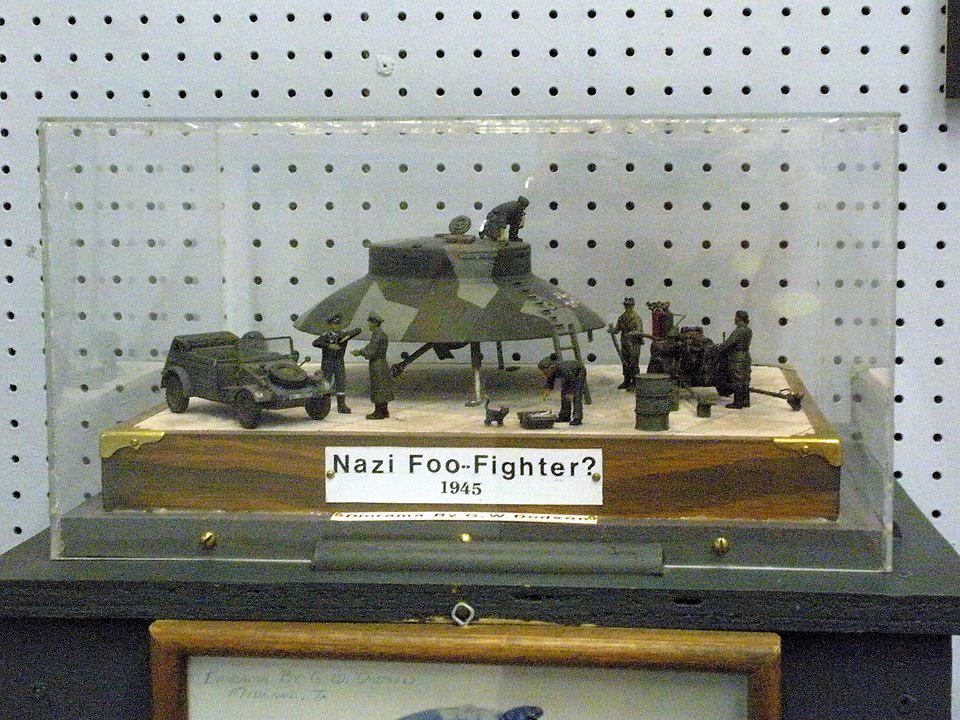
Today, the most famous UFO-related story concocted by the media is that of the alleged Roswell saucer-crash said to have occurred in New Mexico in 1947. Today, a non-museum stands near the site of this non-event, commemorating its non-occurrence with a series of curious non-exhibits – one of which is a plastic, camouflage-painted model of a gun-toting Nazi flying saucer within a glass display case, surrounded by toy German soldiers, the whole diorama bearing the label ‘Nazi Foo-Fighter? (1945)’. Please do note the large question mark there – because the true answer to that query is obviously ‘NO’. Appropriately enough, Roswell’s International UFO Museum and Research Centre is located inside an old cinema: but, as my book Nazi UFOs shows, the wholly fictional narrative of Hitler’s saucers is one movie whose reel will never stop running nonetheless.
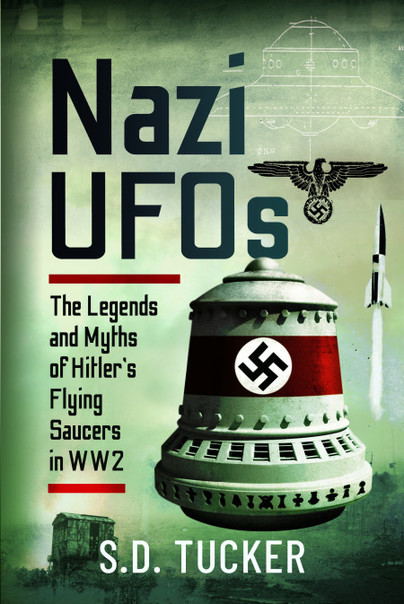
Extracted and adapted from Nazi UFOs: The Legends and Myths of Hitler’s Flying Saucers in WW2, available now from Pen & Sword Books.