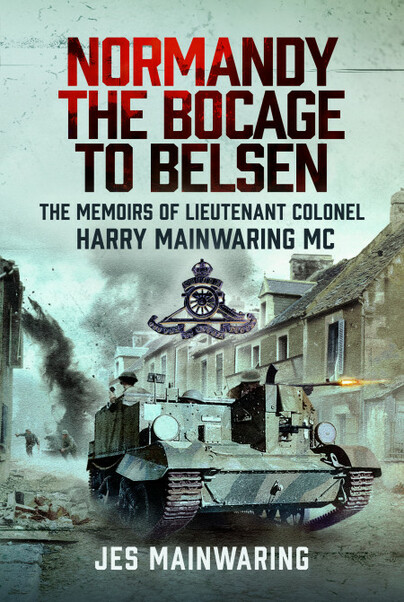
Normandy, the Bocage to Belsen: The Memoirs of Lieutenant Colonel Harry Mainwaring MC
Author guest post from Jes Mainwaring.
On first encounter Normandy, the Bocage to Belsen could seem to be simply a military history: a chronicle of campaigns, battlefields, rivers crossed and advances made across Europe after D-Day. In many ways, it is exactly that. The book follows the long road from Normandy through Holland and Germany to the liberation of Bergen-Belsen, tracing the experiences of a British artillery officer through some of the defining events of the Second World War.
But the story is also something far more personal.
At its heart, this is one man’s account of what was, in effect, everyman’s war- a conflict that reached into every household and every corner of life in Britain for six unpredictable years. The Second World War transformed the extraordinary into the ordinary. Courage and loss, fear, endurance and exhaustion became part of daily life leaving no one untouched, only firmly resolved to confront the unforgivable until its defeat.
The man at the centre of this story, Harry Mainwaring, had expected a very different future. In 1939 he was preparing to return to Queens’ College, Cambridge, to complete his Theology degree before ordination into the Church, and to teach of heaven. Instead, like so many of his generation, history intervened. Deeply disturbed by the rise of Nazi aggression in Germany, Harry volunteered on hearing of the German invasion of Poland. Six years later, at Bergen-Belsen, Harry learnt of hell.
His early war was one familiar to many young British soldiers: long periods of preparation, uncertainty and vigilance. Stationed in East Anglia with the Royal Artillery, he found himself defending Fortress Britain’s vulnerable coastline against the ever-present threat of imminent German invasion. Armed to the teeth with precious little and weapons that were often obsolete, much depended on determination and improvisation. With a watchful eye and a handful of guns along the coasts of Suffolk, Essex and Norfolk, soldiers trained relentlessly as weapon technology and mobility improved while Britain adapted itself to wartime existence.
Yet even amid the threat of invasion, ordinary life somehow continued. Towns and villages carried on. Fields were ploughed. Tennis was played. Pubs remained busy. Dances were held.
At one such dance in Maldon, Essex, Harry met Peggy in late 1941. In wartime, where tomorrow could simply be wishful thinking, courtship moved quickly. They married soon afterwards, and built the best life together that the disruptions of wartime and army duties would allow. Their first son, Simon, was born while the war still raged.
I was born more than five years later, but throughout my life I heard their stories- Harry’s, Peggy’s and family beyond. What struck me was not so much the scale of events, but the way ordinary people absorbed the unimaginable into everyday life. This was simply how life was: the Doodlebug V1 flight path between the tall and ancient chimneys of Peggy’s cottage, the air battles overhead, the snatched moments together, the downed enemy bombers spiraling to destruction, the mounting tension as D-Day approached.
As the war moved into Europe, Harry’s recollections changed in tone and texture. Normandy brought the memories of combat into the sharp focus of ash and dust, of the sounds and smells of battle, of people, and of frontline observation duties deep beyond shifting lines. As Battery Captain, his responsibilities were wide-ranging and often perilous. On little Simon’s first birthday he was directing massed artillery fire onto a large concentration of enemy tanks he had hunted down, from an observation point barely 300 yards away, or another time taking out dug-in Tiger tanks forming the perimeter of Carpiquet airfield by pinpoint targeting from observation in a nearby ditch. Other times he worked with Montgomery’s ‘Phantom’ unit, coordinating heavy artillery into the constantly updating battlefield intelligence during the advance across Europe.
The regiment fought its way from the bocage of Normandy to clear Boulogne and Calais with their E-boat bases and V1 launch sites, across Holland and Belgium in action after action, to the hard-fought Battle of the Reichwald and finally across the Rhine into the German heartland and the beautiful medieval town of Celle. Nearby was Bergen-Belsen.
The concentration camp of Belsen revealed a vision of hell on earth with terrible clarity, where every British soldier who entered the camp learnt why the war had been fought, who they were fighting, and what they were fighting for.
Fighting ended soon after with the surrender of Germany. Here Harry remained for almost a year undertaking tasks that fell to the occupying army confronted with the return of the thousands liberated from labour camps to their homes all over Europe. Eventually Harry too returned home to Simon and Peggy, and back to Cambridge to complete his degree, although he no longer felt it right to pursue the path of ordination.
I came to realise these stories painted a real picture formed from the living history of their entire generation, the unfiltered recollections of ordinary people who had endured extraordinary circumstances.
Aware that such memories disappear with those who carry them, I gave Harry a cassette recorder for his seventieth birthday and asked him to piece together the fragments to complete his story. Using little more than his war diaries, a few notes and an astonishing clarity of memory, he dictated six hours of recollections- candid, immediate and deeply human.
Normandy, the Bocage to Belsen grew from those recordings.
The spoken word does not always translate naturally onto the page, so I edited the transcripts carefully for readability while preserving Harry’s voice and experiences as faithfully as possible. The result is not only a wartime narrative, but a record of a generation whose experiences shaped the modern world.
These stories matter because they remind us not only of the horrors humanity is capable of inflicting, but also of the resilience, humour, decency and courage with which ordinary people endured them.
And because, amidst everything else, it remains one hell of a story.
Order your copy here.