What Lurks Beneath The Waves
Author Guest Post by Lorraine Evans
As I began editing this written piece, in preparation for publication, news began filtering through regarding the discovery of the final resting place of Pan Am 526A, a
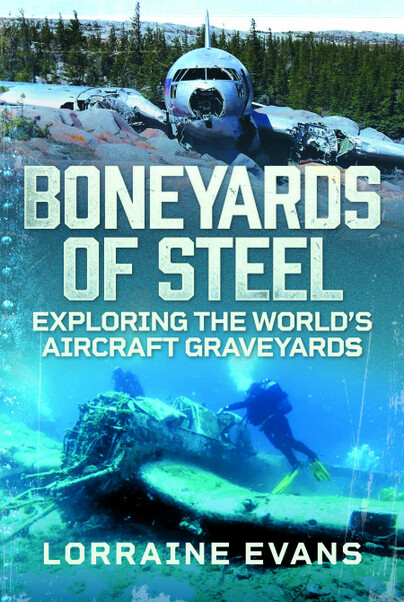
Douglas DC-4 airliner, known as the Clipper Endeavor, which plunged into the ocean in 1952, shortly after take off from Puerto Rico, killing fifty-two people aboard. Lying some 2000 metres below the ocean waves, it had taken a staggering seventy-four years to finally uncover the wreckage site, which is not a surprise to yours truly. At the outset of my research into the subject matter it quickly became apparent that one of the largest aviation burial grounds in the world is also the least explored. Water covers more than seventy percent of the earth’s surface yet the subject of water-based graveyards for aircraft is an area of history very little studied, unlike its ship/boat counterpart, which is hardly surprising when you consider that its fluid-like nature often renders the fate of the dead, organic or otherwise, unknown. With the exception of ‘flying boats’, and the deliberate dumping of aircraft into the sea, to be discussed shortly, aircraft are not obviously designed to operate within a liquid environment. There do exist, however, clusters of ‘dead aircraft,’ under the sea, in a singular defined locale, that have established an undeniable aviation cemetery in their own right. Each are related to arenas of conflict, predominantly dating to the Second World War, but the reasoning behind how they came to be differs significantly. For the purposes of this piece, I have chosen two examples from Boneyards of Steel – Exploring The World’s Aviation Graveyards to illustrate.
The waters around Malta, a small cluster of islands located just fifty miles south of Italy, are beset with underwater aviation wrecks, due in part to the strategic importance of the area for Allied forces during the Second World War, both as a fortress for their military campaigns in North Africa, and as a base from which to launch their mapped-out invasion of mainland Italy. At the outbreak of hostilities in the area, Malta’s air force, if you can call it that, was virtually non-existent, consisting of just four ageing Gloster Gladiator biplanes. Yet despite concerns that Malta was located too far from Britain to be defended, from July 1939 the British began to send increasing numbers of anti-aircraft guns and fighter aircraft to the island. By July 1943, it had become an official base for more than 600 Allied fighters and bombers. Now deemed a legitimate war target, the island was subjected to constant aerial bombardment by both German and Italian air forces. So much so that between June 1940 and November 1942, a timeframe often referred to as the Siege of Malta, it is estimated that 6,700 tonnes of bombs were dropped on the island, and surrounding seas, in a single 154 day period. Records show that in 1942 Malta was the most heavily bombed place on earth, receiving a higher tonnage weight of bombs in March and April 1942 than London did in a twelve month period, a timeline that includes the Blitz.
It is nigh on impossible to fully quantify just how many aircraft crashed into the vast seascape surrounding the Maltese island chain during this period. For Axis aircraft estimates vary from 1,252 to 860, whilst for the Allies estimates range from 840 aircraft lost to 707. Surviving evidence suggests that the majority of Axis aircraft were shot down and thus sustained significant damage. This, combined with the velocity in which they plummeted into the water, means that the chances of finding any intact Axis aircraft in the immediate waters surrounding Malta are slim. Whereas, for Allied aircraft the situation is somewhat reversed, with those damaged in the skies above Italy or Malta undertaking an often slower ditching into the sea. This goes some way to explaining the higher concentration of intact Allied aircraft wrecks found in Maltese waters.
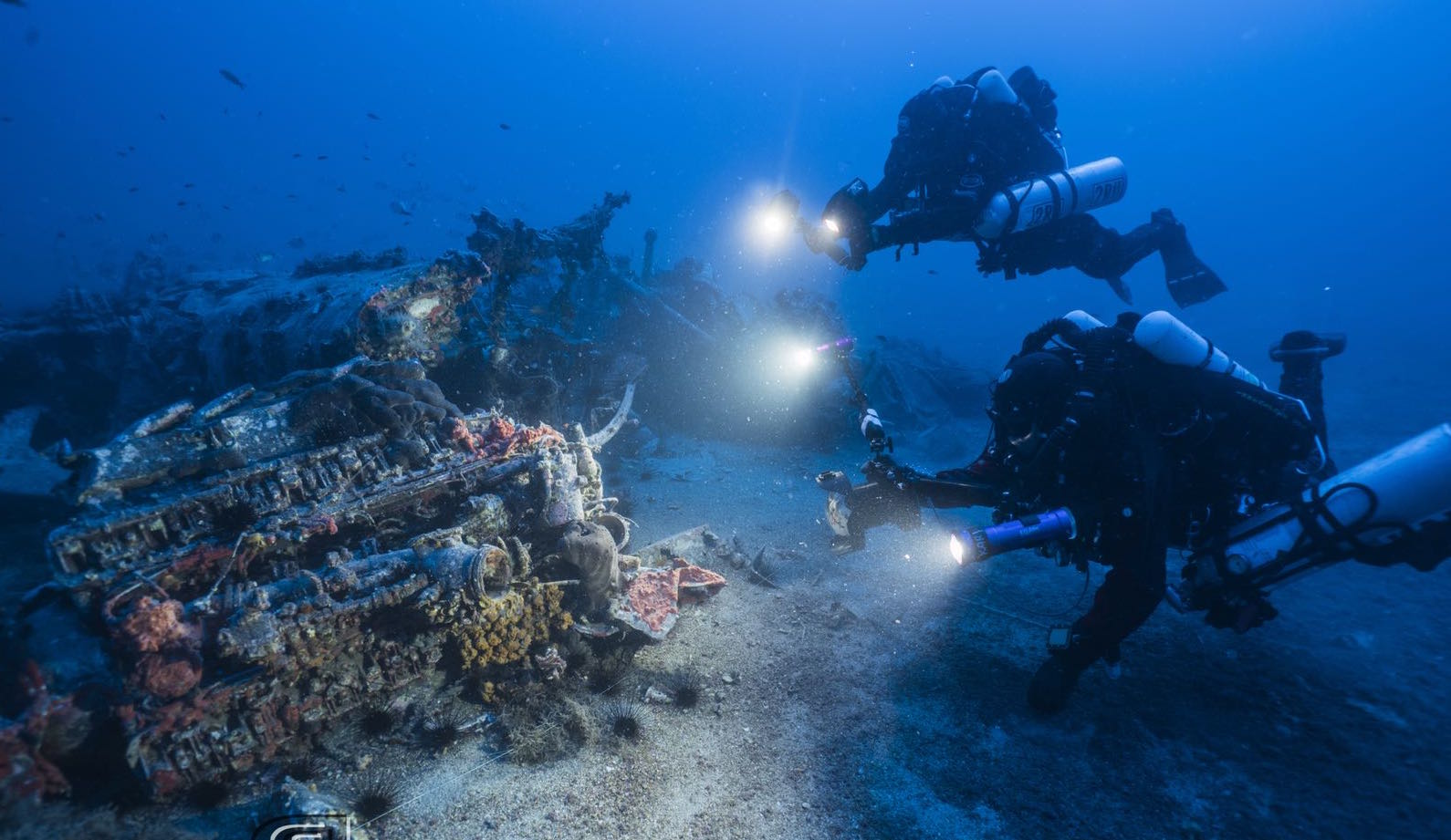
A number of these aircraft wreck sites are today under the protection of Heritage Malta’s Underwater Cultural Heritage Unit, preserved in-situ and recorded in minute detail, with the aim of protecting their structural integrity and their authenticity as historical sites. Heritage Malta has since launched a virtual underwater museum entitled ‘Underwater Malta’ where, through the creation of high-tech digital records, the public can explore the aircraft wrecks for themselves, using virtual-reality models with 360-degree rotation and zoom options. There are seventeen different graveyard sites, which comprise, for example, a German Junkers Ju 88 (1941), an aircraft that the Luftwaffe relied on to inflict devastation upon the Maltese archipelago, particularly during the Siege of Malta. This particular Ju 88 aircraft was discovered in 2019, by a remote-sensing survey carried out by the University of Malta. The wreck sits at a depth of 348 feet, lying upright on the sandy seabed, approximately 3.75 nautical miles northwest of Marsaskala, a seaside town in the southern region of Malta. Then there is a Hawker Hurricane, discovered in 2020 as part of the Malta Shipwreck Survey Project, that currently rests upright on the seafloor at a depth of seventy metres. There is also a wreck of a Supermarine Spitfire, which was discovered during a side-scan sonar survey in April 2021, just off the coast of Gozo, and is linked to ‘Operation Husky,’ the Allied invasion of Sicily, Italy (10 July 1943 -17 August 1943) The aircraft is located upright on a sandy seabed also at a depth of seventy metres, the folded rear fuselage easily identifiable as it ditched into the sea. A German Stuka Ju87, that formed a crucial part of Axis air-ground offensive tactics, was discovered in 2015 off the north-east coast of Malta, at a depth of 100 metres, again by the Malta Shipwreck Survey Project, whereas the rarest graveyard exhibit is the wreckage of a Fairey Swordfish, a biplane torpedo bomber, developed by the Fairey Aviation Company in the early 1930s. The remains are located off the coast of Sliema, in eastern Malta, at a depth of approximately seventy metres, and comprise the steel skeleton, along with the engine, propeller and cowling. The result of a catastrophic engine failure, whereby the pilot was forced to ditch the aircraft into the sea, only thirteen such Fairey Swordfish aircraft exist today, therefore this particular wreck is of global significance. Further information about the aviation graveyard can be found at www.underwatermalta.org.
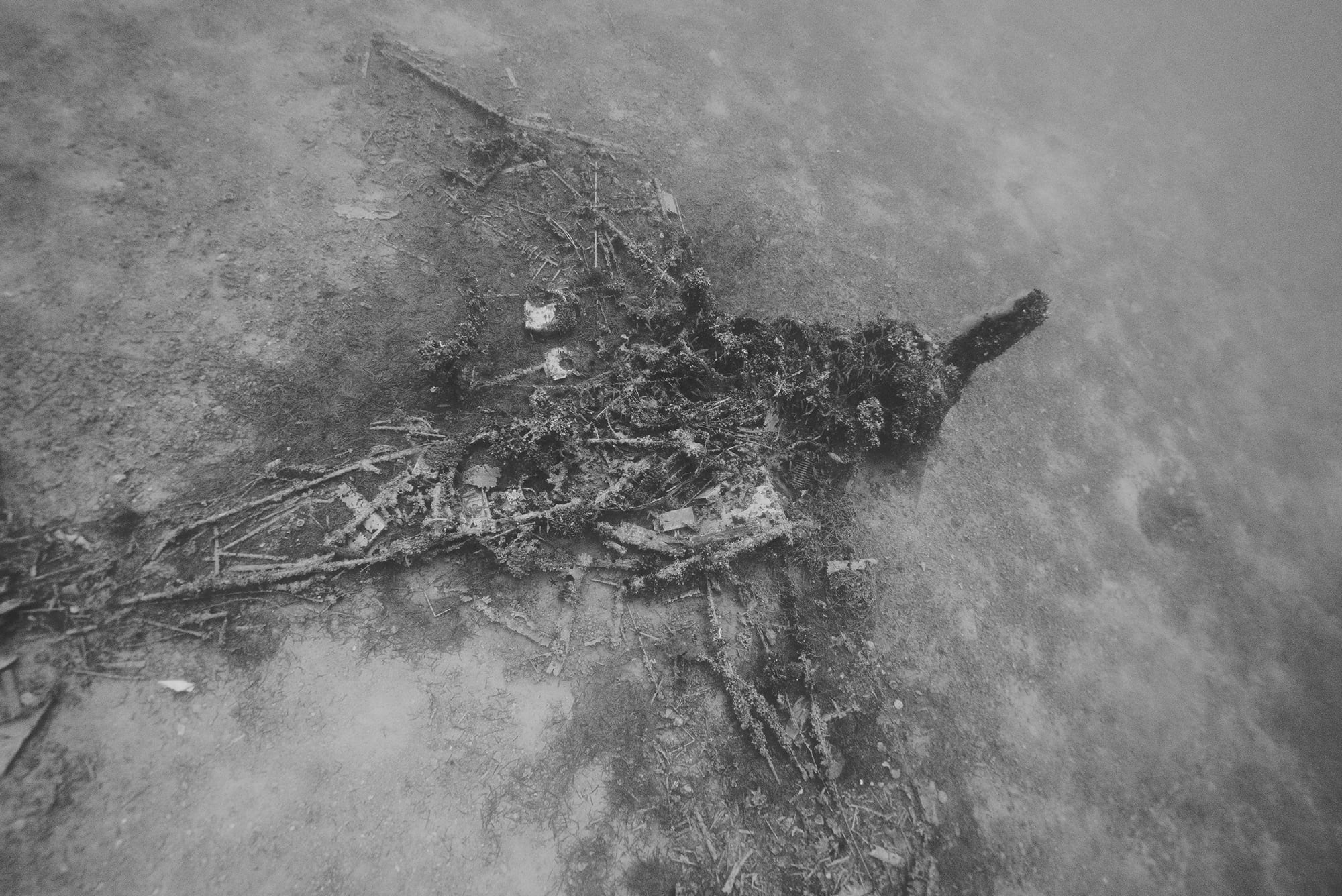
The second category of underwater aviation graveyard, and one which receives a lot of attention, on account of the incredible photos of sunken aircraft captured by Brandi Mueller, a photographer, writer and Merchant Mariner licensed by the U.S. Coastguard, is sited in the Kwajalein atoll, a coral formation in the Ralik (western) chain of the Republic of the Marshall Islands, in the west-central Pacific Ocean. This string of some ninety islets surrounds the world’s largest lagoon, which in itself stretches for some 655 square miles (1,722 square km). During the Second World War this particular area was a significant base of operations for the Imperial Japanese fleet, housing a force of approximately 5,000 Japanese spread out over a very wide area, with significant naval-air bases located on five separate islands. Its primary objective was to protect the gateway to the Japanese empire. On 31 December 1944, a combined force of U.S. Marine and Army troops launched an amphibious assault on three islets in the Kwajalein Atoll. Comprising some 46,000 U.S. military personnel, the upcoming Battle of Kwajalein was an overwhelming victory for the Americans, unbeknownst to the Japanese, U.S. amphibious vehicles could easily cross coral reefs and thus land on the lagoon side of an atoll. Reportedly only 153 Japanese soldiers survived the onslaught.
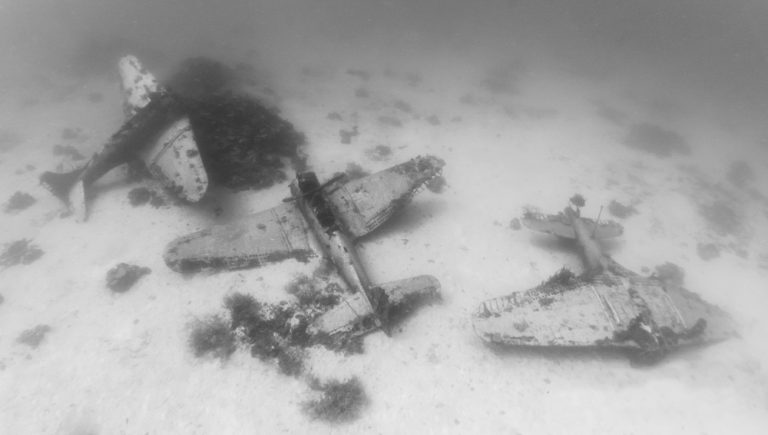
Whilst a few aircraft casualties did sink into the lagoon, during the conflict, this is not the reason as to why the atoll has become such a famed aircraft graveyard. In 1945, after the cessation of hostilities, rather than ship surplus aircraft back home to the U.S., the authorities decided that it was far cheaper to dispose of said aircraft in situ. Thereupon, in September 1945, the United States Navy jettisoned approximately 150 military aircraft, off the side of their respective carrier, into the waters of the Kwajalein atoll. The list of aircraft that were dumped into the sea include Chance Vought F4U Corsairs, Grumman F4F Wildcats fighters, Douglas SBD Dauntless dive bombers, Curtiss SB2C Helldivers, naval bombers Grumman TBF Avengers, eleven patrol bombers North American PBJ-1 Mitchells (the naval version of the B-25) and transport aircrafts Curtiss C-46 Commandos.
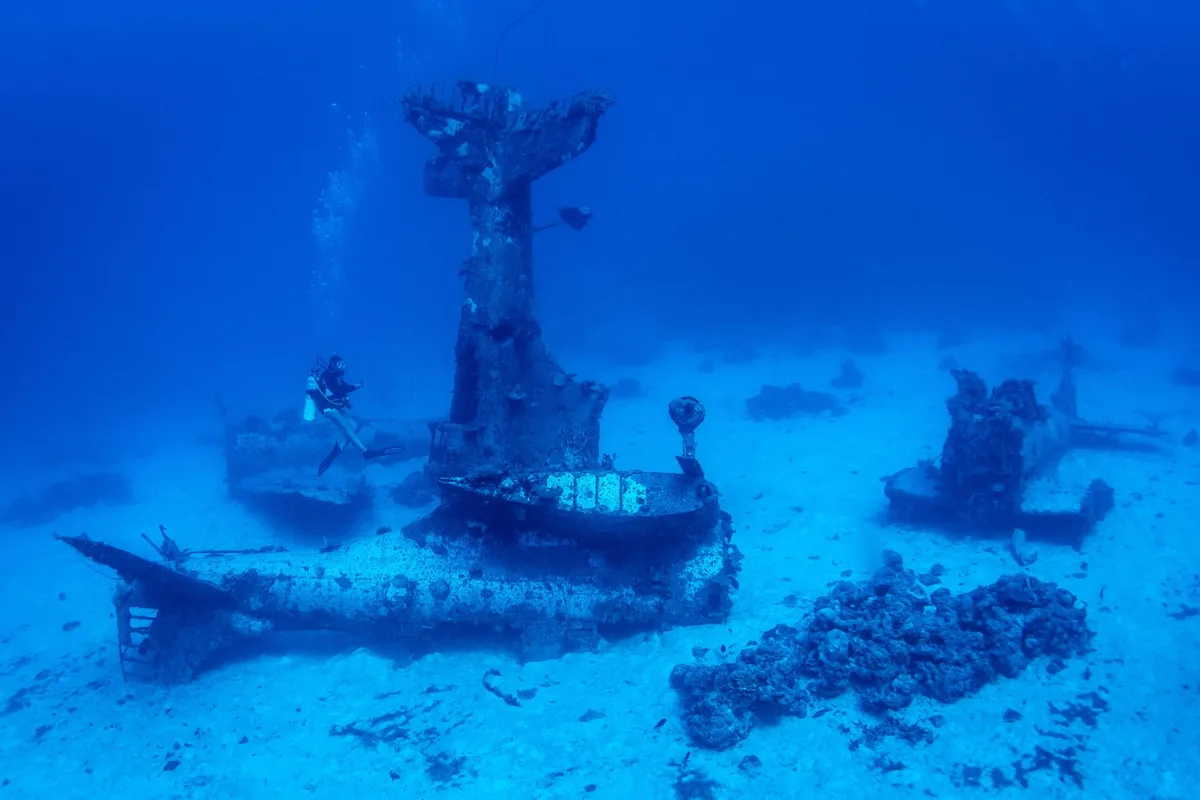
Today, these nostalgic aircraft have become a divers paradise, and home to a colourful array of tropical Pacific marine life. ‘They call it the Airplane Graveyard,’ stated photographer Brandi Mueller. ‘They aren’t war graves or planes that crashed. They were planes that were taken out over the reef and pushed off intact after the war ended. They should have flown more, lived longer, but they were sunk in perfect condition.’ The Kwajalein atoll is acknowledged as one of the largest aircraft graveyards of the Second World War.
Order your copy here.