Dramatis Personae – the people you meet along the way
Author guest post from David Craddock.
In writing about Admiral Bacon – or any historical figure – it is impossible to isolate either the man himself, or the circumstance in which he played such a pivotal role in the Royal Navy, from the extraordinary mix of people who populate the hinterland of his story. For that reason I have included a Dramatis Personae at the beginning of the book to introduce some of the two hundred or so figures, many familiar, some obscure, that all in their own spheres impacted or were impacted by the dramatic changes in naval technology in the first two decades of the last century.
The list includes, in no particular order of precedence, except perhaps to place naval officers at the front, scientists, politicians, journalists, press barons, historians, soldiers, engineers and provocateurs. Towering among the first category, for this story is, at heart, about the transformation of the Royal Navy, is Admiral of the Fleet, Lord Fisher of Kilverstone. Better known throughout the Service as Jacky Fisher, he led the complete re-shaping of the Navy to meet the changed circumstances of the new century. Bacon, who first served as a midshipman in the flagship of Admiral Sir Geoffrey Hornby, first met Fisher twenty years later when serving as XO in HMS Empress of India with the Mediterranean Fleet under Fisher as C-in-C in 1899. He was quickly drawn into the ‘Fishpond’ of young officers that Fisher cultivated to drive the changes he sought to make at the Admiralty. After three years pioneering the first boats that became Britain’s Submarine Service, Bacon who had been intimately involved in her design, went on to commission, as Captain, the most iconic statement of Fisher’s vision, the first all-big-gun battleship HMS Dreadnought. Here we meet many of Bacon’s first submarine commanders: John Moreton, who followed Bacon to Dreadnought as First Lieutenant, Stephen Bowles-Evans, Delafield Arnold-Forster, Loftus Mansergh and Murray Sueter who would later become the Navy’s first Inspecting Captain of Airships – another field that Bacon helped pioneer.
As is well known, Fisher made many enemies in his remorseless drive for change. Chief among them was Lord Charles Beresford, the figurehead of the ‘Syndicate of Discontent’, at the centre of which was Vice-Admiral Sir Reginald Custance who was vehemently opposed to Fisher’s reforms. In between were the civil servants and politicians of all stripes: Lord Esher, HO Arnold-Forster, Anthony Asquith, Arthur Balfour, David Lloyd George, Lord Selborne, Maurice Hankey, Winston Churchill and Reginald McKenna, among others met along the way. Bacon himself unwittingly became a participant in the Fisher-Beresford Saga when private letters, written by him to Jacky Fisher three years earlier, were portrayed as being disloyal to the Service and were leaked to a newspaper. The ensuing row, not of his making, led Bacon to step away from the Admiralty on the cusp of becoming Third Sea Lord and Controller of the Navy.
Scientists and engineers make a significant contribution to the story, first with the submarines, then the design and construction of HMS Dreadnought and later when Bacon became Controller of Munition Inventions during the final year of the war. Among them were Alexander Gracie, dubbed by Fisher as ‘the best marine engineer in the world’, William Gard, Eustace Tennyson d’Eyncourt, Lord Kelvin, Sir John Thomson, Sir John Thorneycroft, Sir Ernest Rutherford and Sir Charles Parson, whose turbine engines powered Dreadnought. With Bacon’s departure from the Admiralty to become Managing Director of Coventry Ordnance Works, we meet another engineer, his predecessor at Coventry, Herbert Mulliner who had been forced out by his board in controversial circumstances after presenting false evidence of increases in German armaments capacity to attract orders from the Admiralty. As an aside, Mulliner was also an authority on English furniture and the decorative arts! For most of the next six years, Bacon focused on re-building the fortunes of Coventry Ordnance Works and the development, when war broke out, of a modular design 15-inch howitzer capable of transport by road. The search for suitable tracked vehicles to deal with the Flanders mud led him to meet an agricultural engineer from Lincolnshire, William Tritton. It was Tritton with whom Bacon collaborated on the invention of a self-propelled trench-crossing bridge in the winter of 1914/15 – a pre-cursor of the tank.
Recalled by the First Lord of the Admiralty, Winston Churchill in April 1915, Bacon was placed in command of the Dover Patrol, with responsibility for securing Britain’s vital trade routes through the Dover Straits to the east coast ports, while closing them to enemy submarines; protecting the continuous flow of men and supplies to the BEF and providing gunfire support to the left flank of the Allied armies in France and Belgium. It is here we meet Captain Bird and the skippers of the net drifters that laid and manned the anti-submarine barrage in all weathers year-round. Here we also meet Field Marshals French and Haig and their Chiefs of Staff with whom Bacon liaised closely in planning shore bombardments and amphibious operations.
Though not directly part of the story, historians have inevitably shaped the way we see the past and provide waymarks towards a fresh look at events and connections between them. The works of Sir Julian Corbett, Arthur Marder and, more recently, Andrew Gordon and Professor Jon T Sumida are all acknowledged in that capacity, the latter particularly in the controversy over the rival fire-control systems of Arthur Pollen and Frederic Dreyer that embroiled Bacon when Director of Naval Ordnance. Then there were the naval correspondents – James Thursfield and Archibald Hurd, best known among them – whose almost daily reports give us a contemporaneous view of events that often escape the formal record.
After his second retirement from the navy in 1919, Bacon reinvented himself as a writer, dividing his time, with his wife Cicely (née Surtees), between their home in Hampshire and a villa they built in the hills above La Spezia. He is best known for his two-volume biography of Jacky Fisher which he followed with an acclaimed biography of Earl Jellicoe. It was with a powerful defence of Jellicoe’s handling of the Grand Fleet at Jutland that Bacon reluctantly joined the bitter fray over who controlled the official narrative of the battle throughout the 1920s. This is the context in which we meet the arch provocateur, Carlyon Bellairs MP and the naval journalist and novice pilot Filson Young who sued Bacon for daring to quote his work in order to counter his arguments. Life was simpler in the olive groves of Pugliola amid the company of Bacon’s cousin and near neighbour, the artist Helen Lavinia Cochrane, and a small coterie of English residents which included Baroness Emmuska ‘Emma’ Orczy, better known as the author of The Scarlet Pimpernel. It was several worlds away from the corrosive rivalries of the Jutland Scandal. Yet everyone mentioned here, and many more besides, were connected through the life and career of Reginald Bacon whose story touched them all in so many different ways.
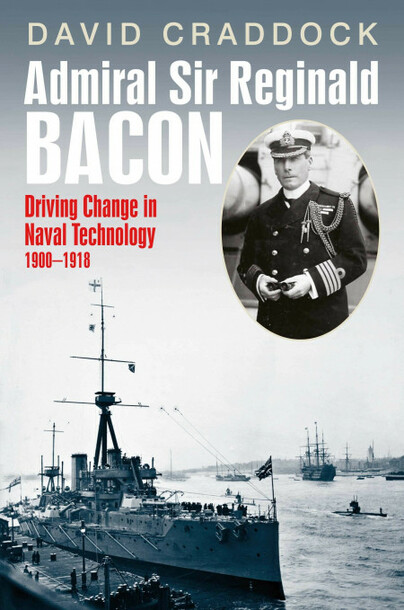
Order your copy here.