Rethinking the Legacy of Saint Olga of Kyiv: The woman who taught a kingdom to fear her
Women’s History Month guest post from Abigail Rebecca Williams.
What does it mean to be remembered as both brutally vengeful and profoundly pious? Saint Olga of Kyiv presents precisely this paradox. For many readers, the violence associated with her rise to power sits uneasily beside her later veneration as a Christian saint. Yet it is precisely this tension, rather than any attempt to resolve it, that makes Olga such a compelling figure for reconsideration – particularly in the context of International Women’s Day, and our thinking around female figures this month.
Olga’s legacy has too often been flattened into a singular narrative: either as a legendary agent of vengeance or as the pious harbinger of Christianity in Rus’. Such one-dimensional portrayals obscure the complexity of her rule. To rethink Olga is to recognise her as a ruler who navigated power through a convergence of violence, political strategy, diplomacy, and faith. She was neither an anomaly nor a contradiction, but rather a reflection of the multifaceted nature of authority in the medieval world.
Olga first emerges in the historical record following the murder of her husband, Grand Prince Igor, who was killed by the Drevlians during a dispute over tribute. One could say that she was left to be regent for her young son, Svyatoslav, but this would be a disservice to Olga who acted to consolidate her place as regent for her son, time and time again. At the beginning of her regency, Olga faced an immediate political crisis. The Drevlian prince – Prince Mal – proposed marriage, likely an attempt to absorb Kyiv under Drevlian control by claiming the legitimacy Olga and her son would grant them.
Olga’s response would become one of the most infamous revenge sequences in medieval Eastern European history. According to the Tale of Bygone Years, Drevlian envoys were buried alive, others burned, and thousands killed during a funeral feast held in Igor’s honour. The campaign culminated in the siege of Iskorosten, where Olga reportedly used incendiary tactics, attaching sulphur to legs of birds offered as tribute in exchange for Olga’s mercy, to devastate the city.
These episodes are often retold as spectacles of cruelty, or dismissed as legend. Yet they can also be understood as deliberate acts of political theatre. Olga’s actions communicated a clear and calculated message: the death of Igor had not weakened Kyiv, and its ruler, female though she was, would respond with decisive and calculated force. In this light, her violence was not merely reactive or emotional, but instrumental in establishing legitimacy.
To interpret Olga’s actions solely as personal vengeance, risks overlooking their cultural and symbolic dimensions. She ruled at a crossroads of Slavic and Scandinavian traditions, where funerary practices could involve the ritual death of a spouse or companion. Accounts such as those of Ibn Fadlan describe evolving practices among the Rus’, in which volunteers might take the place of a deceased man’s wife in burial rites. Olga’s infamous act of burying Drevlian envoys alive, in what would be known as a Ship Burial, may therefore be read not only as brutality, but as a calculated inversion of ritual expectation. Rather than becoming the sacrificed widow, she repositioned her enemies within that role, demonstrating a sophisticated command of the symbolic language of power.
The narrative of these events, preserved in the Tale of Bygone Years, also reflects the interpretive lens of later Christian compilers. There are subtle attempts to distance Olga from direct culpability: her son is credited with initiating campaigns, while she is portrayed as advising (or “egging on” as one translation of the Tale of Bygone Years notes) rather than acting. Such narrative choices likely reveal the discomfort of chroniclers seeking to reconcile her violent past with her spiritual standing that would eventually culminate in sainthood.
Yet there is little reason to imagine Olga as a passive figure. She operated within a political culture in which elite women could wield authority and, at times, participate directly in warfare. Byzantine accounts place women amongst the slain left on battlefields after conflicts with Rus’. Far from retreating from power, Olga appears to have stood at the centre of efforts to secure and stabilise her son’s rule.
Following the suppression of the Drevlians, Olga turned from retribution to governance. She implemented administrative reforms that restructured the collection of tribute, establishing centres known as pogosty, creating a more regularised system of control across Rus’ which lessened the taxational burden of the Rurikid princely line. These measures contributed to the consolidation of princely authority and the development of a more centralised political structure.
Olga’s reign was also marked by notable diplomatic engagement. Her journey to Constantinople and subsequent baptism into Christianity, taking the name Helena, represented both a spiritual and political transformation. Alignment with the Byzantine Empire acted as a safeguard against external threat of Pecheneg mercenaries and the forced assimilation into the Christian empires on the periphery of Rus borders. While her son remained pagan, Olga’s conversion established a precedent that would later culminate in the Christianisation of Rus’.
Olga’s canonisation invites a somewhat unsettling question for those who struggle to reconcile Olga’s sainthood: what does it mean for the Church to elevate a figure so closely associated with calculated and bloodthirsty vengeance? To recognise Saint Olga of Kyiv as ‘Equal to the Apostles’ is not simply to celebrate her conversion, but to selectively interpret her life within a framework of redemption, providence, and political utility. Her sanctity was not constructed in spite of her earlier violence, but alongside it. This raises important questions about how sanctity itself is defined: is it rooted in moral transformation, in political legacy, or in the long-term outcomes of a ruler’s actions? Olga’s canonisation suggests that the boundaries between these categories were far more fluid than modern readers might expect, challenging us to reconsider how the Church has historically accommodated power, pragmatism, and even brutality within its models of holiness, especially when it serves its own agenda.
Olga’s eventual canonisation as Saint Olga of Kyiv, honoured as ‘Equal to the Apostles,’ formalised her place within Christian tradition. Yet sainthood did not erase the earlier chapters of her life. Instead, it preserved a legacy defined by coexistence rather than contradiction. Violence, diplomacy, and faith were not separate phases of Olga’s life, but interconnected strategies through which she exercised power. In the context of International Women’s Day, Olga invites us to reconsider how female authority is remembered and interpreted. Her story resists the expectation that women in history must be either virtuous or nurturing, sanitising any traces of transgression or ruthlessness. Instead, Olga embodies a form of leadership that is politically astute, symbolically aware, and unflinchingly pragmatic.
To rethink Olga is not to reconcile her brutality with her sanctity, but to accept that both were integral to her rule. She was a woman who taught a kingdom to fear her, and in doing so, secured its future. Her legacy challenges us to move beyond simplified narratives and to recognise that female power in the medieval world could be as complex, formidable, and morally ambiguous as that of any king.
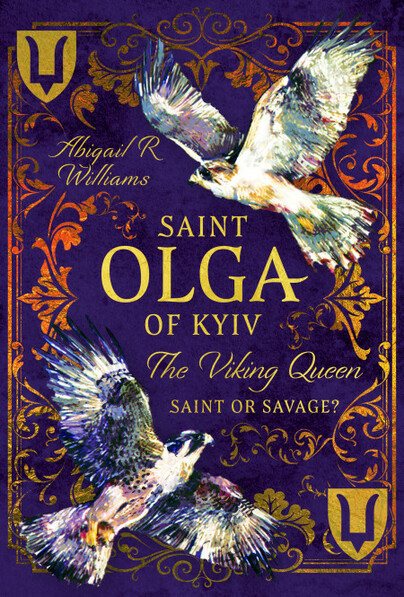
Order your copy here.