The Real Story of the American Revolution
Author guest post from Mike Wells.
All countries have national myths, received ideas about the past which are often reinforced by media and difficult to challenge. For Britain it is probably the Second World War. There are many accepted ideas about the British experience that have not been changed by historical reality. Sunday afternoon showings of the Dam Busters constantly defy the realities of a partially successful mission with limited lasting effects commanded by a disturbed and obnoxious leader. The heroic image of Richard Todd blots out the real Guy Gibson. The Blitz Spirit is in our national collective memory. We compare the stoicism and heroism of the wartime generation with the less glorious way we might have behaved. In fact the reaction to bombing, shortages and an eccentric, discredited old fashioned aristocratic leader was not so different! Those who were not impressed by the heroic speeches of 1940 – and there were many of them – are still lost voices
In my book on America I wanted to look at some of the lost voices of what many Americans see as a similarly heroic generation. History as has so often been said is written by the victors. What Russians learnt about their Revolution for 70 years was the version concocted by the victorious revolutionaries. People in China learnt about the heroism and wisdom of Mao. TV sets in the Cuban countryside show children today the virtues of Fidel Castro and the revolutionaries of 1959. The sordid backstage intrigues that brought Hitler to power were rewritten as a national uprising.
The American Revolution has usually not been seen in this light. Historians use terms like ‘The Glorious Cause’ or ‘The Empire of Liberty’. The men of 1776 and the Founding Fathers of the new United States remain heroes. Washington has huge memorials celebrating them. Jefferson’s house at Monticello and Washington’s home at Mount |Vernon, Liberty Hall in Philadelphia are hallowed ground. Colonial America is celebrated as wholesome, virtuous and worthy of respect. The preservation of a colonial town at Williamsburg is a tribute to simple virtues. The way that British snobbery, tyranny and oppression was ended and a new republic which grew into a democratic world power is the staple narrative.
But what of those elements which disturbed all this? They are often mentioned but not dwelt upon. I wanted to give them an airing, to bring them to the surface, to let them have their day in court. The view of colonial America as an ordered and free society is challenged by the amount of violence and disorder that anticipated the protests against British rule. This violence was a feature of the build up to the war of independence and was intense in aspects of the war which made it more of a civil war than many people realise. This was seen in a large scale genocidal campaign against native Americans, the intimidation and persecution of those loyal to Britain and in the brutal campaigns in the southern states which get far less coverage than they deserve.
As for freedom, while colonists did fight for it in terms of being free from interference by Britain and to rule themselves, they did not always practise it. Indentured labour remained a key way of securing labour, as did slavery. Key players in the fight for freedom were slave-owners. The new Republic was not eager to extent political rights to women and saw independence as an opportunity to take Indian lands and to build slavery into the constitution.
Many were driven by principles of liberty and many showed huge heroism in resisting a great world power but for many there were concerns about legality and about losing the benefits of being part of Britain. Many too though not necessarily pro-British were worried by examples of mob activity and disorder. As history is usually written by the victors, their arguments and fears tended to be neglected. The dissenters unlike the victors are not household names and do not have rap musicals written about them. My book tries to redress the balance.
Concerns about the new nation were felt even by those who were not loyalists and did not join the substantial exodus after the war. Many had fought against British rule and for the interests of their states. The desire of an elite for a stronger united nation with a constitution setting up a federal government and a powerful head of state was not universally shared. Given the subsequent rise of the US as a great power, these dissenting voices are often just seen as unrealistic or backward looking. Faced with a powerful president not always bound by laws and conventions and facing widespread opposition as a new king, these voices, too, deserve a hearing and reappraisal.
The book also takes another look at the reputations of some of the leading figures of the Revolutionary period. Did Washington really have the attributes of a great commander? Was Jefferson the intellectual mastermind of legend? Did the British commanders really act as stupidly as is sometimes thought.
My aim was not to repeat accepted versions of a highly interesting story but as with my companion book on the French Revolution to test some assumptions and to look again at some of the evidence.
In the course of the writing, America has undergone some seismic changes which put the arguments and attitudes of the conservative critics of the Revolution and its aftermath into a sharper focus as their fears seem more and more pertinent. The concept widely held in the Enlightenment that constitutions drawn up at a specific time and in specific conditions can act like a machine to guarantee the freedoms they are designed to protect has been shown repeatedly in history to be a fallacy. But America held fast to its belief in the Constitution. This involved constructing a historical narrative which supported the growth of freedom. It will be upto future historians to decide how much that faith was justified and how compelling that narrative really was.
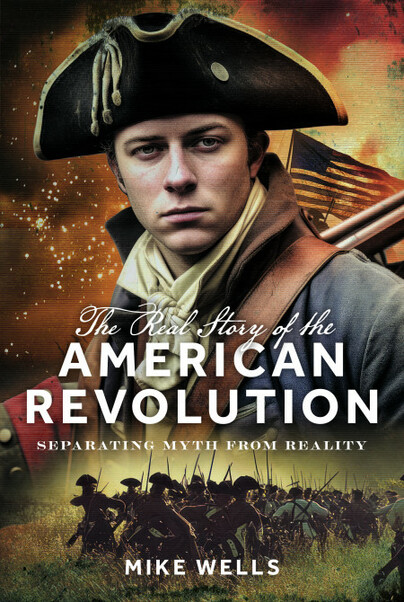
Order your copy here.