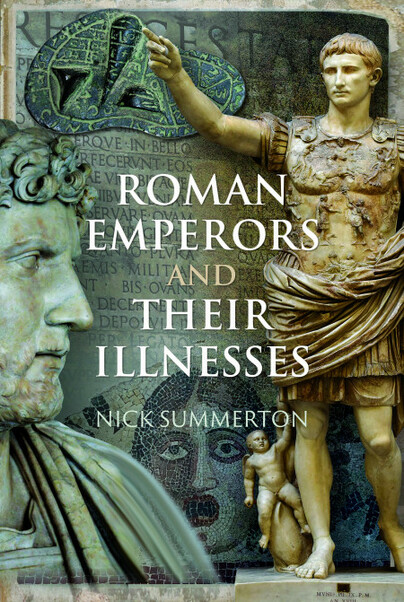
Roman Emperors and Their Illnesses
Author guest post from Nick Summerton.
Modern doctors have been particularly cruel to some historical figures. The, so-called, `mad` Roman emperor Caligula cannot question his various psychiatric diagnoses or request a second opinion. Neither can Nero demand further testing to refute the suggestion that he suffered from a hormonal disorder.
Last year I travelled to Florence to check a diagnosis. The destination was the Uffizi Gallery, and my patient was the former Roman Emperor Hadrian who had died in 138 CE. It is believed that he had died in 138 CE from a narrowing of the arteries supplying blood to the heart – termed coronary artery disease.
Hadrian`s retrospective diagnosis was based on a combination of information provided by the Roman historian Cassius Dio – wasting and swelling – together with the discovery of diagonal earlobe creases on several sculptural representations of the emperor. Earlobe creases are supposedly linked with coronary artery disease, an association termed `Frank`s Sign`.
When I came face-to-face with Hadrian`s statue in Florence it was obvious that the ears did have creases. But Hadrian was particularly careful about this official image, commissioning a least seven distinct representations during his lifetime. Every detail would have been carefully considered, and nowadays it is challenging to distinguish clinical data – useful to me as a medical doctor – from any subtle political messaging or artistic stylization. Something as seemingly innocuous as an ear crease might well have been carved to suggest wisdom, knowledge or experience. Also, Cassius Dio`s surviving description of Hadrian`s condition – written around 70 years later – needs to be approached with caution given his less-than-positive views about the emperor. In the ancient world the type and nature of an individual`s symptoms often served as metaphors for their behaviours and actions as a ruler.
A near neighbour of Hadrian within the Uffizi Gallery, the Emperor Nero, has been retrospectively diagnosed as suffering from modern-day Cushing`s syndrome based on his coin images. This condition is caused by having too much of the steroid hormone cortisol in the blood, resulting in a fat neck, thin arms, skin problems and mood swings in some people. Undoubtedly the portraits on Nero`s gold aurei changed significantly throughout his reign with an emphasis on a gradually thickening neck. The Roman biographer Suetonius – who was no great fan of Nero – also commented on his large neck and thin legs.
For Nero the broader historical record paints a picture of an individual who had little interest in ruling an Empire. He preferred to delegate authority to others while he focused on music, drama, gladiatorial combat and chariot racing. Chariot driving was not a sport for the faint hearted with significant strength, weight and endurance being required to control the speeding horses around tight bends. Both charioteers and gladiators underwent strict physical training to hone their skills, and it seems likely that Nero would have taken matters equally seriously too. A strong neck is linked to upper body strength and stability improving mobility, posture as well as reducing the likelihood of injuries such as concussion. Perhaps Nero`s later coin images simply depict an individual who was hefty and strong enough to drive chariots, a portrait that would undoubtedly have found favour with Nero himself.
Several Roman emperors and members of the Roman elite are said to have suffered from gout. The Greek word that is translated as gout is `ποδάγρα` (Latin: `podagra`) but the literal meaning is `foot trap`, emphasising the sudden and severe pain affecting the great toe. When confronted with a modern-day patient with such symptoms I would consider gout but alternatives such as arthritis, infection or a stress fracture too. The Emperors Vespasian and Septimius Severus may well have suffered from a condition akin to our modern-day gout but, after a life involving heavy military marching, they could have also developed stress fractures in their feet.
Diagnosing the illnesses of Roman emperors might not be viewed as an appropriate line of enquiry given the enormous gulf that separates ancient and modern medicine. Physicians – like me – engaged in uncovering historical diseases have – somewhat disparagingly – been categorized as hobbyists simply dabbling in the medical past. But, although there are certainly some major challenges in using present medical knowledge to identify past diseases, there are potential opportunities too in augmenting – or even correcting – the historical record.
Traditionally the Roman emperor Augustus has been labelled as having an acute liver disorder that nearly killed him in 23 BCE. However, by undertaking a detailed evaluation of the ancient sources, he has been re-characterised as an individual surviving to the age of 75 years with a long-term lung condition. Perhaps some of his enigmatic behaviours and actions represented a reaction to developing a chronic disease at a young age. As he began to come to terms with his predicament some initial distress and anger were replaced by acceptance, adjustment and adaptation.
The Emperor Claudius suffered from a movement disorder that affected his mobility and speech. He was troubled by some uncontrolled movements and balance problems too. Although Claudius was highly intelligent, the response of the Imperial family to his disability was to keep him in the shadows, out of politics and public affairs. He became of figure of fun, ridiculed within Roman high society and subjected to insults and cruel tricks. The stresses, indignities and hardships that Claudius experienced in his youth and as a young man probably had an impact on his character, health and behaviour. Also, it seems much more likely that he died due to a stroke or a heart attack rather than from consuming poisoned mushrooms.
Order your copy here.