Hallowe’en Party
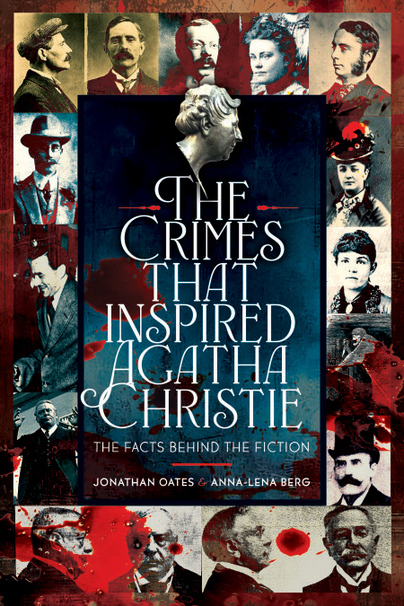
Author guest post from Dr Anna-Lena Berg and Dr Jonathan Oates.

It seems appropriate to discuss this, one of Agatha Christie’s later novels, at this time of year. The book was published in 1969 and so was the penultimate Poirot novel ever written. It is certainly very different from the earlier ones such as The Murder of Roger Ackroyd or Death on the Nile. The novel begins with what seems like innocent fun; a children’s party supervised by adults and older teenagers at the house of a prominent local resident. It soon becomes more sinister.
Two children are murdered in Hallowe’en Party, both by drowning. These are thirteen-year-old Joyce Reynolds (drowned in an apple bobbing tub) and Leopold, her younger brother (drowned in a stream). A third child is targeted but saved at the last minute.
As far removed from the genteel world of Miss Marple as can be imagined, you might think. But this was a seemingly darker age, the fall out of the apparently more liberated era of the 1960s, with more socially progressive attitudes. To some, who had grown up in a more stable social era, these were very much an anathema.
There were two recent real-life cases which may well have fed into this story. The first concerned a young couple, Ian Brady and Myra Hindley. They were known as the Moors Murderers as they killed four children and one youth for sexual and sadistic pleasure between July 1963 and October 1965, in and around Manchester.
The first three victims were taken by car or van to Saddleworth Moor to be abused, killed and buried. These were Pauline Reade, aged 16, John Kilbride, aged 12, Keith Bennett, also aged 12, ten-year-old Lesley Ann Downey and Edward Evans, aged 17.
What made these crimes even worse was that the children had been assaulted and tortured and the sadistic Brady recorded Lesley’s piteous pleas on tape. Jurors at their trial were forced to listen to such, lasting as it does, 16 minutes. It was also seen as even more heinous in that a young woman was involved in the crimes; although Brady did the killing, they could not have been kidnapped without Hindley as she was a driver, and he was not. She was perhaps the most hated woman in Britain.
Three years later there was the equally disturbing case of 11-year-old Mary Bell in Newcastle upon Tyne. On 25 May 1968, four-year-old Martin Brown was found dead outside some derelict houses. There was no apparent cause of death but on the next day a nearby day nursery was broken into and found scribbled in notebooks were the phrases ‘We did murder Martain brown’ and We murdered Martain Go Brown’.
On 31 July of that year, Brian Howe, aged three, was playing outside the home, unsupervised by adults or anyone else. He went missing that afternoon. In the evening his body was found near Scotswood Road. He had been strangled. The evidence was that another child was responsible. Mary was found guilty at Newcastle Assizes of double manslaughter.
The inspiration for Hallowe’en Party may well have been the Moors case and that of Mary Bell. Ariadne Oliver states ‘children do queer things sometimes. I mean there are queer children about…and then they go about and do something like this’. The suspicion is that the killings may be the work of teenagers.
The prevalence of violent crime committed by or to children is commented on several times throughout the book. Poirot replies to Mrs Oliver thus, ‘It is the kind of crime…of which one reads every day in the paper. A girl who is attacked, a school child who is assaulted – yes every day’. He later muses
‘It was not unknown in the present age for children to commit crimes, quite young children. Children of seven, or nine and so on and it was often difficult to know how to dispose of these natural young criminals’.
Superintendent Spence states ‘There doesn’t seem to have been any evidence of any sexual assault or anything of that kind, which would be the first thing one looks for. Plenty of that sort of thing in every small town or village’. Dr Ferguson agrees, ‘Mind you, doing in a child isn’t anything to be startled about nowadays. I ‘ve been called out to look at too many murdered children in the last seven to ten years – far too many’.
References to a ’sexually disturbed personality’ and that there was ‘no evidence of sexual assault’ are very contemporary terms. There is mention twice of children getting into someone’s car and never seen alive again and this chimes in with the Moors murders.
As to the perpetrators, Dr Ferguson tells Poirot, ‘The reason’s in the killer’s mind. His disturbed mind or his evil mind or his kinky mind. Any kind of mind you like to call him…Take your man or boy. He wants to kill someone. Not at all unusual. Over in Medchester we had a case of that. Came to light after about six or seven years. Boy of thirteen. Wanted to kill someone, so he killed a child of nine, pinched a car, drove it seven or eight miles into a copse, burned her there…he may have gone on doing it. Probably did. Found he liked killing people’.
His comments certainly align with the motivation of Ian Brady whose reasoning was internal to him, as opposed to any conventional and rational reason such a greed or revenge. As to the reasons for such crimes, ‘Broken homes. Negligent and unsuitable parents’ are blamed and that was exactly what was said, broadly speaking, about Mary Bell. Maybe the author had her in mind when she has a female character say ‘I knew a little girl once. Seven years old. Killed her little brother and sister – twins they were – five or six months old. Beautiful little creature she was, too. Rotten on the inside’. This occurred in Yorkshire.
Several characters in Hallowe’en Party refer to crimes committed by and against the young, and by the mentally ill as being on the increase compared with the past. There is no statistical evidence given and whether this is the commonplace harking back to a golden age that never was is another question. It is also worth noting that in none of these fictional crimes there is a sexual motive, but it is a red herring that the author uses to conceal the true culprits. The reader may fall for such a deception device because Agatha Christie is using themes taken from contemporary true crimes that readers at the time would have been fully aware of.
Order your copy here.