SAS South Georgia Boating Club
Author guest post from Tony Shaw.
The Falklands War in 1982 was a unique period during which the British people were given one last opportunity to enhance their reputation on the world stage. The Falklands War was different in so many ways, especially when Britain’s war-fighting capability was totally focused on the Cold War. The Falklands War may be long gone, but it will always be in my thoughts every day for the rest of my life. Surprisingly, despite this, I have never suffered from Post Traumatic Stress Disorder (PTSD) and the same is true for most former Special Forces (SF) operatives. Why is this? Well, perhaps because the training and subsequent operational deployments are so intense that an SF operative simply doesn’t have time to dwell on dark thoughts. That means that I live my life for today while always trying to honour my former colleagues.
I’m often asked why did I write the book? There is no simple answer, but I kept a war diary during the Falklands War which was updated whenever I got the chance. On return to the UK, I transferred the diary into a scrap book and added a few photos and items of printed memorabilia recovered from the enemy trenches. In 2019, my son read the scrap book and suggested that it would make a great book. After due consideration I decided to write the book. While the scrap book provided me with sufficient material for the four chapters covering the period of the Falklands War, I quickly realised that this wasn’t enough material to complete writing the book. This deficit was overcome by writing about my childhood and how I came to join the army as a 15-year-old on a technical apprenticeship with Royal Signals. I also wrote about my formative years before arriving in Hereford as a signaller in 264 (SAS) Signal Squadron. Four years later I was ready to attempt SAS Selection and this approach added several chapters to the book before continuing with a few chapters to chronicle the rest of my life after the Falklands War. The draft manuscript took me five months, working five days a week. Once this process was complete, I submitted the manuscript to the MOD Disclosure Committee. Finally, after a year of negotiations, during which I had to consider safeguarding the tactics, techniques and procedures of UKSF, together with national security, operational capability, intelligence matters and personal security, I was granted Express Prior Authority in Writing (EPAW) to go ahead and publish. Another consideration was to seek someone of good standing to write the Foreword. After much thought I got in touch with Mark Palios, the chairman and owner of Tranmere Rovers, my local football club. Mark was a former player and also attended the same school as me. As a lifelong supporter of Tranmere, I felt privileged to have Mark’s support.
I have often been asked just how tough Selection really is? I was already very fit before starting Selection training which for me lasted a whole year. I put together my own training schedule, but gratefully accepted tips and words of advice from those who had gone before me. I continued with running and gym work, but went tabbing in the mountains most weekends carrying a fair bit of weight. You must be mentally prepared to expect the unexpected. This means you must be mentally tough and able to take setbacks along the way. I saw many men fitter than me who were unable to bear the mental stress of simply not knowing what time we would finish, having poor navigational skills or simply someone who couldn’t get out of bed when it was 4 a.m. on a winter’s day and the wind was howling outside. There was never any praise or criticism of a candidate’s efforts. You just had to give your very best performance on each and every day. The most important question asked of himself by each instructor was “Would I be prepared to go to war with this man in my patrol?” A negative response from one or more instructors was enough for you to be cast aside. Selection is conducted in a series of phases with the navigation, fitness and tabbing being ramped up in the first four weeks, prior to “Test Week”. If a candidate has prepared well enough to get through this phase there are several more hurdles to overcome, including jungle training, field firing and combat survival. At every phase, you are being constantly being evaluated, with little or no feedback as to your prospects of surviving another day. The whole Selection process actually takes about six months and is followed by a military parachuting course if not already qualified. If you manage to pass all that you are then SAS “badged”. You then spend the rest of your time in the SAS undertaking courses at patrol level (signaller, medic, demolitionist and linguist), troop level (in my case kayaking, small boats and diving), theatre or terrain (desert, arctic, jungle and temperate zones), conventional warfare (infantry minor tactics), counter-terrorist (CQB and sniping) and close protection, NATO operations, irregular warfare and so on.
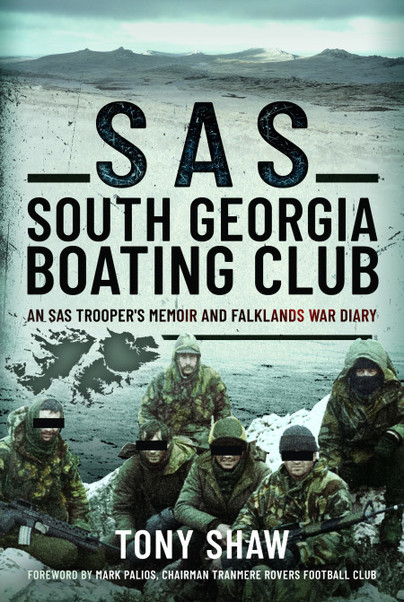
The question of why did I choose the title “SAS South Georgia Boating Club” for the book? Well, the publisher asked me to include SAS in the title as this would obviously help to sell the book. During the Falklands War we began to call Boat Troop the South Georgia Boating Club and this continued afterwards. I suppose this made light of South Georgia being a seriously difficult island to infiltrate, in our case using small boats with suspect outboard motors. The weather was constantly changing, usually for the worse and it paid to have a sense of humour.
When asked was I a little apprehensive on the journey south? The simple answer is yes of course. However, the British Army constantly trains for war, even more so when you happen to be in the SAS. If you are not prepared to do what it takes to win the firefight, or the battle, or the war, you shouldn’t be there in the first place. Once the adrenaline kicks in, it is too late to be afraid. You simply have to endure all hardships and crack on. Peer pressure is a vital aspect to all this.
The Sea King crash on the 19th May was a tragic event, killing 22 of whom 18 were in the SAS. This was the largest loss of life for the SAS since the Second World War. The next morning, D Squadron gathered together on HMS Intrepid and the definitive list of those who had lost their lives was read out. Then we had a short pep-talk from the Squadron Commander about getting on with the job and leaving the grieving process until the war was over.
I had a very full career, rising up through the ranks and leaving the Army as a Major. This has made me consider is it easier as an officer or soldier? My reply would be a soldier doesn’t always appreciate how much planning and preparation the officers have to put into any operational or training activity. When I was an operations officer, I would often burn the midnight oil putting together training programmes or operational orders. Meanwhile, junior officers often fail to realise how much bullshit, and changes to the plan, that a soldier has to endure on a regular basis. This is far less of a problem in the SAS as the officers are expected to match the soldiers in all aspects of soldiering and then add their leadership qualities to the mix. When asked how much has my life been influenced by my time in the SAS, I would reply by saying that is why the SAS devote so much time to train and develop a man who already has the physical and mental resilience to start the journey. That is why never a day goes by without thinking of fallen comrades. Never a day goes by without thinking would this attitude or this performance be good enough for the SAS? The SAS instilled in me the pursuit for excellence in all that I do.
Order your copy here.