The War Movie that Changed War Movies
Author guest post from Joseph Houlihan.
Marc Leepson wasn’t expecting much when he walked into the old MacArthur movie theatre in Washington DC on a January evening in 1987.
He and colleagues from the Vietnam Veterans of America were among the invitees to a screening of a recently released movie about the war they fought in more than a decade earlier.
The film was Platoon and, though Leepson and his friends had no idea as they took their seats, it was about to fundamentally transform the way war films are made.
The lights went down and the movie’s opening credits rolled over scenes of bustling activity at an airfield in Vietnam in 1967 as American involvement in southeast Asia was ramping up (almost half a million US servicemen and some women were deployed in 1967). On the screen a troop transport aeroplane lands and newly arrived soldiers descend the ramp, wide-eyed at their first glimpse of Vietnam.
The action cuts hard to those same troopers on patrol in the jungle. They’re sweating, disorientated, exhausted, stumbling. The joking in the movie theatre stopped and the veterans, a substantial portion of the audience, fell silent.
Leepson is now 80 and works as arts editor of the VVA Veteran magazine. Speaking from his home in Virginia he told me: ‘My body went rigid. If my jaw didn’t actually drop, it metaphorically did. I was mesmerised from that very first scene.’
It was the authenticity that did it. The veterans had seen Vietnam movies before, including the blockbusters The Deer Hunter (1978) and Apocalypse Now (1979), but Platoon was different. It was the first film that made them feel they were back in the jungle.
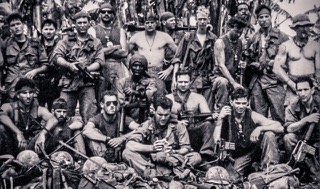
And if it was different from those Oscar-garlanded smash hits, it was even further removed from the war movies that came out of the Second World War during the 1940s, ’50s and ’60s, films in which Americans were always the good guys, nobody died a gory death and there was no moral ambivalence about the purpose of the conflict.
Leepson says: ‘Two hours later the lights came on, and not one soul said a word. To a person, we stood up and silently filed out into the cold, stunned at what we had just seen. In too many previous… Vietnam War films the actors playing the GIs look like pampered actors. But man, those guys in Platoon: they had a battle-hardened look on their face and that was new and realistic. And then there were the little details: the uniforms didn’t look like they were brand new, they were dirty, they were wrinkled,
whatever they had written on their helmets looked right. Each GI presented himself just like I remembered it from being there.’
The on-screen troopers were, in fact, ‘pampered actors’ including Charlie Sheen and Johnny Depp. The story of how they came to so convincingly portray genuine soldiers starts with a five-minute meeting between two men, both veterans of the war.
Oliver Stone was in the edit with Salvador, a movie about an American journalist covering the civil war in El Salvador. It would go on to gain two Oscars nominations but at the time Stone was an unknown quantity as a director (although he’d won a writing Oscar for Midnight Express).
Captain Dale Dye, meanwhile, was a Marine veteran of three tours in Vietnam. He’d left the Corps to move to Hollywood with a goal of persuading the movie industry that it was doing war films all wrong. He hated the inauthenticity of the way combat was depicted on screen and had a crazy idea that the only way to solve the problem was to put actors through a tortuous experience that would be as close to warfare as it was possible to get.
After a year of trying without getting a single meeting, he read a snippet in one of the Hollywood trade magazines that a Vietnam veteran called Oliver Stone was planning to make a movie about the war.
Dye thought a fellow veteran – one who had seen combat and even been awarded a Bronze Star for valour – might understand his idea. He pulled some strings to get a five minute chat with Stone and decided that if it didn’t work out he would drop his idea and look for a real job.
In the event, Stone was intrigued enough to ask for a second meeting, after which he agreed to give Dye’s idea a try. Before filming for Platoon started in the Philippines, Dye was given three weeks to take thirty-three members of the cast into the jungle with the aim of turning them into something resembling a genuine group of soldiers.
Dye’s approach was to give the actors a shock-and-awe introduction to the experience of jungle warfare. They were not allowed to use their real names, only the names of the characters they were due to play; they were marched for hours on end through steaming jungle; they were ambushed with fake explosives from time to time by Dye’s assistants (all veterans); they slept in holes; they ate the hated MREs (Meals Ready to Eat) and they were never allowed more than two hours sleep at a time. When Willem Dafoe, one of the lead actors, became seriously ill after drinking water from a stream, another of the cast, Paul Sanchez, who played the platoon medic, went to Dye for help.
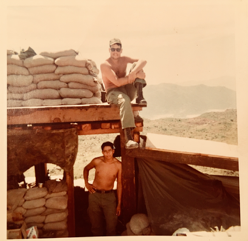
Sanchez told me: ‘I go over to (Dale Dye) and say: “Listen, Willem has a really high fever, he looks like he’s going to die. I don’t know what to do.” (Dye) looks at me and he goes: “Do your best. We’re hours away from any kind of medical facilities and we’ve got a job to do.”
There were no real enemies in the jungle; no Viet Cong ambushes, tripwire bombs or booby traps, but the cast really suffered, especially at first. By the end of three weeks however, they had hardened and bonded. They emerged from the jungle as close to a real military unit as it was possible to get without being in a combat zone.
The scene near the start of the movie where the men are patrolling in the jungle had such a profound effect on veterans like Leepson because the men looked like the real thing. They were exhausted, sweating, dishevelled and irritable. In fact, the scene was shot the morning after the last night of boot camp, when the actors celebrated the end of their ordeal by getting plastered on lambanog, a local moonshine liquor made from palm sap. Deeply hungover, they were roughly woken the next morning and told: ‘On your feet, we’re filming.’ They were hungover as well as exhausted from their three weeks of roughing it.
Platoon went on to win four Academy Awards and the idea of striving for authenticity in war films became standard thereafter. Dale Dye’s infant company, Warriors Inc., went from strength to strength and brought its immersive approach to movies and TV series ranging from Saving Private Ryan and Band of Brothers to Forrest Gump, The Pacific and even period films like Last of the Mohicans and Alexander.
Dye told me: We’ve done Starship Troopers, which is the twenty-fifth century, and
we’ve done Alexander, which is ancient history. And the key element, the common denominator, is that the spirit of a warrior doesn’t change, it doesn’t make any difference what era he’s in, what uniform he’s in, what nation he’s fighting for. It’s the same. And we can make people understand that if I can make the performers understand that and that message comes through.’
Just about every major combat film and TV series that’s been made since Platoon has taken that lesson on board. Something to think about when you next watch a war movie at to the cinema or on your streaming service.
Order your copy here.