Naval History under the Byzantine Empire
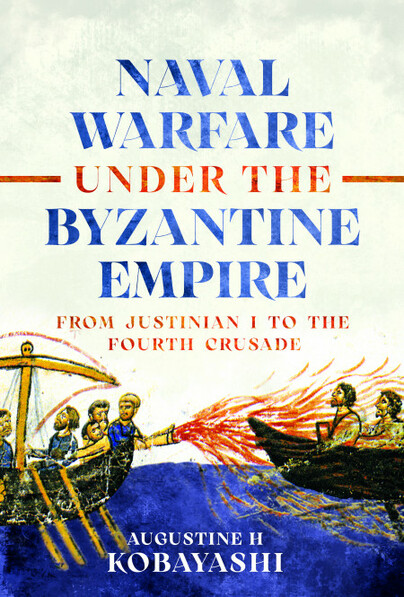
Guest post from Augustine H Kobayashi.
The naval history of the Byzantine Empire is often neglected for three reasons. First, the Byzantine Empire is a sideshow in our mainstream historical narratives. The Roman Empire is considered one of Europe’s birthplaces. By the end of the 5th century CE, however, it had become geographically Near Eastern rather than European (hence the new name, ‘Byzantine’), and it was pushed out of the history textbook. Second, relatively few naval battles took place during the Byzantine period, so there is little to discuss. Third, there is a lack of historical sources. Some argue that this was a sign we can ignore this empire, as the lack of written sources itself was proof that it was nothing but a decaying and decadent civilisation, with its society increasingly losing its dynamism and its people illiterate.
When I was a history student in the 1990s, some historians were eager to revise history from a non-Eurocentric standpoint. They encouraged me to focus on East Asia, but I discovered Byzantium instead! Here, I thought, you could find the missing link of history connecting antiquity with the medieval and early modern worlds.
Also, I have always been interested in naval warfare in the Mediterranean. Perhaps I was influenced by war films from the 1960s and 1970s that depicted battles in North Africa. The story is fascinating, as the naval forces of Britain, Italy, and Germany were still experimenting with new technologies and tactics. Each naval battle was unique and interesting.
As I got older, however, my understanding of naval warfare also matured. Naval war is not just about ironclad battleships with big guns. Actually, the whole point of battleships (and other classes of combat ships) was to protect maritime communications, so that men and supplies could be transported safely over long distances. The British won WW2 essentially because they were successful in doing this, even though few decisive naval engagements occurred, to the frustration of Churchill and the British public, who eagerly awaited the news of a Trafalgar-style naval victory. But what really mattered was that cargo ships, tankers and merchantmen arrived safely at their destinations, bringing men and materials so the army could fight on.
The Byzantines did not have to fight many naval battles, as they often successfully held naval supremacy. Their merchant and cargo ships crisscrossed the Mediterranean and the Black Sea, ensuring that the imperial subjects were fed and enriched by maritime trade. It was this ability of the empire to expand its economic activities and maintain the sea mobility of its armies that made it a cut above other states of the ancient world.
Byzantine ‘naval strategy’ is a tricky subject, as the Byzantines themselves left little in writing. As historians love to point out, their concept and understanding of ‘strategy’ differed from that of modern times. In writing this book, I try to reconstruct a strategy, or, shall I say, any consistent military policies involving sea warfare that guided the course of Byzantine wars throughout the empire’s long existence. I focused on the period from Justinian to the Fourth Crusade, as the most interesting naval activity occurred here, and its successes and failures help us understand what the Byzantines were trying to achieve with their naval and maritime assets.
Another problem is that the Romans and Byzantines, especially those who recorded history, were not interested in naval warfare. Their accounts were often uninformative and sometimes misleading, just as today’s journalists and politicians are not precise with naval terminology. As I write this, during the Venezuelan crisis, the USS Iwo Jima, an amphibious assault ship, was described by a UK reporter as an ‘aircraft carrier’! The most famous Byzantine warship was the dromon – a Greek word meaning chaser or fast runner. (In today’s Greek, ‘dromo‘ means road or street.) But we don’t know precisely what these dromons were, and their changing technical specifications and roles in the Byzantine fleet over time added another layer of complexity. Well, today’s frigates are a radically different kind of ship from those of the sailing-ship era, too.
Byzantine chroniclers were thus not very helpful in providing reliable information about warships. Like the case of Greek fire, the most famous invention of the Byzantine navy, what they were really like, how they were used in combat, and how effective they actually were require lots of detective work.
My book addresses these issues in Byzantine history. Of course, I do not pretend to be able to answer all these questions. However, this neglected chapter of world history is certainly intriguing and full of lessons from the past that can teach us much about how our human society functions. Working on this book has been a process of discovery for me. In the end, it was satisfying to write a seamless narrative of Byzantine history from the 6th century onward. The Empire’s maritime geography made it, by nature, a maritime state, and its naval history is its history. At least I hope I was successful in illustrating this point.
When I am not writing, I am reading! I love visiting bookshops, and whenever I travel, the first thing to do is find local bookshops. And warships – museum ships (and those still in active service, if possible). When I was a kid, I was excited about battleships and aircraft carriers, but these days, I’m more interested in transport ships. Recently, I had the chance to visit San Francisco, USA, and tour the Liberty Ship, the transport ship, without which the Allied victory in WW2 would have been unthinkable.
Order your copy here.