Mary Read: The Pirate Who Refused to Surrender
Women’s History Month guest post from Roxanne Gregory.
Mary Read was a remarkable woman, who lived all but two years of her life as a man. Today, we would call her transgendered. If you were a fan of the Starz series Black Sails you would have seen her belatedly portrayed during their final episode.
October 1720, Dry-Harbour Bay, Jamaica — Blustery, humid autumn winds eased just before midnight when Captain (John) Jack Rackham, a.k.a ‘Calico Jack’ and his motley crew aboard the sleek twelve-gun sloop William dropped anchor in Dry Harbour Bayon the leeward side of Jamaica.
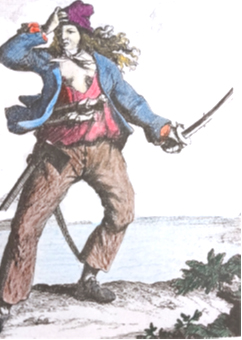
Born in Jamaica in 1682, Rackham had been celebrated pirate Charles Vance’s quarter master. This night, everyone aboard Captain Jack’s vessel was sloshed. All had been drinking gunpowder-rum, a potent brew designed to keep barreled water stores on board pure and the crew’s spirits high. They were celebrating their most recent victory against pirate-hunter Jean Bonadvis. They had beaten Bonadvis into a hasty retreat but the encounter had been costly, as the William now had no cannon balls left for the gunners.
But Rackham and crew were fearless when pirate-hunter Captain Jonathan Barnet’s square-rigged merchantman with a dozen British Army troops and Royal Navy sailors sailed into view.
Barnet hailed the William. “Who are you and where are you bound?” he shouted into the darkness.
Across the bay a drunken voice echoed. “John Rackham out of Cuba”.
“In the name of the King of England, strike your colours!” Boomed Barnet.
Striking the colours was a demand to lower the flag a ship sailed under. It was universally recognized as surrender.
“We will strike no strikes,” came the jocular reply, followed immediately by raking fire from Rackham’s swivel gun, which peppered Barnet’s decks, injuring his crewmen.
Barnet immediately ordered a broadside of cannon-fire followed by volleys of small shot, which destroyed the William’s sloop boom. Out-gunned, Rackham’s crew begged for quarter, as they had no cannon shot left.
Barnet’s broadside ignited a fire below decks on the William, and Rackham’s crew descended to extinguish it, while a handful of his crew still atop deck prepared to resist Barnet’s boarding party.
A General History of Pyrates claims that Mary Read fearlessly remained on deck, refusing to surrender. Anne Bonny and Read with a few others faced Barnet’s men, firing their pistols, swearing like madmen and boldly swinging their cutlasses.
Disgusted, Mary stopped fighting and raced to the hold crying, “If there’s a man among ye, ye’ll come up and fight like the man ye are to be!”
When not a single crewman responded, she fired a shot into the hold, killing a man.
Barnet offered quarter, but when Barnet’s men boarded the William, they were surprised to find two crewmen, were not men at all, but women.
Mary Read and Anne Bonny were incarcerated and tried separately from Rackham and his crew. Convened in Spanish Towne, during their Admiralty court trial Nov. 16, 1720 Dorothy Thomas, a fisherwoman whom Rackham and crew had robbed earlier, testified she recognized Mary Read and Anne Bonny as part of Rackham’s crew, robbing and threatening her with death.
“The two women at the bar… Wore Men’s jackets and long Trousers and Handkerchiefs tied round their heads; and each of them had a Machet and Pistol in their hands; and cursed and swore at the Men to murder her [the despondent]; and that they would kill her to keep her from coming against them; and the Despondent further said the reason for her knowing them to be Women then was, by the largess of their Breasts,” reads their transcripts.
According to Nigel Cawthorne’s, A History of Pirates Blood and Thunder on the High Seas, after Anne Bonny gave birth to Jack Rackham’s child in Cuba, leaving their child for safekeeping, Rackham and company took a Dutch ship where they forced some of the crew to accept pirate articles and join them.
In Cawthorne’s account, Anne was attracted to a good-looking Dutch boy and began a relationship with him. Read revealed her sex to Bonny and the two became lovers but Captain Jack smitten with jealousy, threatened to slice Read’s throat, until she revealed her breasts, ‘which were quite white’. Not only was Mary Read not a man, she wasn’t Dutch either, but English.
Her date of birth and her early years remain shrouded in mystery. What is known is that Mary’s mother lived in an English port town when she married a sailor and became pregnant by him, but he disappeared at sea.
Mary’s mother petitioned her husband’s mother for child support for their son. And she agreed. However, Mary’s mother soon became pregnant with another man’s child and surreptitiously, she gave birth to Mary at a country residence, but after returning, her son abruptly died.
Unable to live without her mother-in-law’s financial support for a son, she substituted Mary, and dressed her as a son. This duplicitous deception lasted more than a decade.
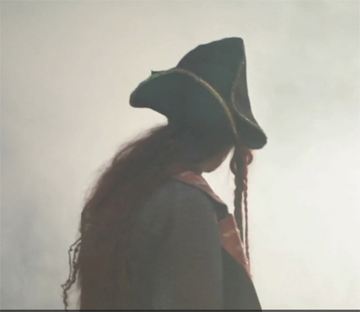
At thirteen, Mary was a foot-boy in an aristocratic household. She was later recommended by them as a cabin boy and she signed on with the brutal British Navy. For several years she served as a crewman aboard a British Man-of-War. After the war ended, she left England and joined the Dutch military serving with distinction as a dragoon infantryman in Flanders during the Spanish War of Succession.
But while serving in the Dutch Army, she was struck by cupid’s arrow and unmasked as a woman, her Flemish tent mates supported the lovers and insisted they marry.
Some historians claim Mary and her husband retired with both military pensions and with gifts from supportive brothers-in-arms, they opened an inn—The Three Horseshoes—near Breda Castle in the Netherlands.
For the first time in her life, Mary wore women’s clothing, but their happy-ever-after nuptials didn’t last, as he died suddenly less than two years later.
Mary cut her hair and donned her trousers once more. She tried rejoining the Dutch military, but as the war had ended, there wasn’t much opportunity. Mary boarded a ship bound for the West Indies. It was while aboard this ship that Rackham attacked them off the coast of Cuba.
During the Golden Age of Piracy, pirates often offered to spare death for captured crewmen if they would join them, which is how Mary joined Rackham’s crew.
Anne Bonny and Mary Read offered no substantive defence at trial, but as the Admiralty Court Magistrate was about to pass sentence, both women ‘pled their bellies’. Under English law at the time, any woman convicted of a capital crime like piracy, who was pregnant would be spared until her delivery, as English law deemed the child ‘in carry’ innocent.
The magistrate ordered an examination to be made and when the court reconvened both women were found to be pregnant.
While Anne Bonny may have been freed months later by a bribe paid by her father, Mary Read reportedly died while in prison of ‘white fever’ another name for smallpox at the time.
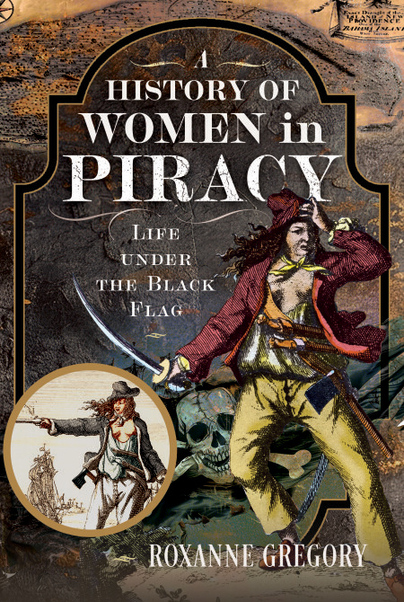
Order your copy here.