Constantine V and the Ambush at Rishki Pass: The Emperor Who Outwitted the Bulgars
Author guest post from Leslie Ivings.
The narrow defile of Rishki Pass winds through the eastern Balkan Mountains of modern Bulgaria, a place of steep ridges and sudden mists. In the summer of 759 CE, it was the setting for one of the most striking Byzantine victories of the early medieval world. There, amid the pine forests and rocky slopes, Emperor Constantine V surprised and crushed a Bulgar ambush, an encounter that revealed the strategic brilliance of a ruler better known to history for his religious fanaticism than his generalship.
An Emperor Reviled and Feared
Few emperors divide opinion like Constantine V. To the Byzantine Church, he was Kopronymos, the “dung-named,” a blasphemer and heretic who persecuted those who venerated icons. To his soldiers, however, he was the emperor who restored Roman power and pride on the northern frontier. In an age when Byzantium’s survival seemed uncertain, Constantine’s relentless campaigns projected strength and order from the Aegean to the Danube.
By 759, he had been on the throne for more than twenty years. His rule had begun in turmoil, his father Leo III’s iconoclastic reforms had provoked unrest, and Constantine himself had faced rebellion early on. But through ruthless discipline and a near-fanatical dedication to his vision of imperial renewal, he had stabilized the empire, strengthened its finances, and reformed its army. The professionalization of the tagmata, the elite field regiments stationed around Constantinople, gave him a reliable striking force independent of provincial politics. It would be this army, loyal and lethal, that marched into the Balkans to confront the Bulgars.
The Balkan Frontier
Since the days of Constantine IV and the treaty of 681, the Bulgars had been both neighbours and nemeses of Byzantium. The empire’s grip north of the Haemus Mountains (the Balkan range) had long been tenuous, with local Slavic tribes shifting allegiance between the khans of Pliska and the emperors of Constantinople. The frontier was porous, marked not by walls but by rivers, passes, and the shifting loyalties of tribal chieftains.
The Bulgarian khan at the time, Vinekh, had inherited a delicate position. The Bulgars were powerful but divided, their aristocracy suspicious of Byzantine power yet wary of another destructive war. Constantine’s own ambitions made peace impossible for long. Determined to reassert imperial authority and curb Bulgar raids into Thrace, he launched a major campaign in 759, his fifth against the Bulgars in less than a decade.
March to the Pass
The emperor’s objective was clear: penetrate the Haemus Mountains, destroy Bulgar strongholds, and reassert control over the region’s key passes. Among these, Rishki Pass was particularly treacherous, a winding corridor hemmed in by steep ridges, ideal terrain for an ambush. It was here that Vinekh chose to make his stand. Confident in the terrain and perhaps misjudging Constantine’s caution, the Bulgars laid a trap, blocking the pass with felled trees and hidden troops poised to strike from above once the Byzantine column entered the defile.
Yet Constantine was no novice. His intelligence network, refined through years of campaigning, warned him of the ambush. The emperor’s response was masterful. Instead of advancing blindly into the pass, he divided his army, sending a strong detachment to flank the Bulgar positions via a little-known mountain path. With the element of surprise reversed, the trap was sprung, not on the Byzantines, but on the Bulgars themselves.
The Ambush Reversed
The battle that followed was short, brutal, and decisive. As Constantine’s vanguard feigned retreat, the Bulgars poured down from the heights to attack what they thought was a fleeing enemy. In that moment, the flanking detachment struck from behind, cutting off their escape. Caught between two Byzantine forces in the confined terrain, the Bulgar warriors were slaughtered in the narrow valley they had chosen for their victory.
The chronicler Theophanes the Confessor, no admirer of Constantine’s religious policies, nevertheless recorded the outcome with unmistakable respect: “The emperor slew many of them and took many captives.” Among those captured were several of the khan’s leading nobles, a humiliation that shook the Bulgar elite. The army of Constantinople returned to the capital laden with prisoners and trophies, their emperor hailed as a new Trajan crossing the mountains of the north.
Propaganda and Power
For Constantine V, Rishki Pass was more than a battlefield triumph, it was a statement of imperial supremacy. The victory was proclaimed throughout the empire as proof that God favoured his iconoclastic ruler. Coins struck in the following years emphasised military imagery: the emperor on horseback, the labarum in hand, or the cross-tipped spear triumphant.
In Constantinople, the triumphal entry of the army reinforced Constantine’s image as a warrior-emperor in the mould of Heraclius or even of the great emperors of old. The tagmata, whose loyalty had been tested in this campaign, were rewarded lavishly, cementing their role as the backbone of the imperial state.
The Bulgars, for their part, reeled from the defeat. Vinekh was overthrown shortly afterwards, perhaps as a result of his failure at Rishki Pass, and was eventually murdered by his own nobles. The ensuing instability within Bulgaria allowed Constantine to conduct further punitive expeditions in 761 and 763, pressing his advantage and devastating the Bulgar heartland.
The Dark Side of Glory
Yet victory came at a cost. Constantine’s growing sense of divine favour and military infallibility deepened his authoritarian tendencies. His persecution of monks and iconophiles intensified; the councils of Hieria (754) and subsequent decrees against images were enforced with renewed zeal. In the capital, his enemies whispered that the emperor cared more for war than for God, while his soldiers believed he was chosen by heaven to purify both Church and empire.
The duality of Constantine’s reign, pious heretic, military genius, and merciless ruler, has haunted his legacy ever since. The same energy that led him to outmanoeuvre the Bulgars at Rishki Pass also drove him to crush dissent with equal precision. Theophanes and later Byzantine writers vilified him as a tyrant, but the archaeological and administrative record suggests a ruler of remarkable efficiency and vision. Under Constantine, the empire’s frontiers were secure, the treasury full, and the army unmatched in the Mediterranean world.
A Legacy of Iron
When Constantine V died in 775 after another campaign against the Bulgars, his soldiers mourned him deeply. Their chants at his funeral: “You lived victorious, you died victorious!” echoed through the streets of Constantinople. It is a telling tribute. For the men who followed him, the emperor who had marched through the mountain passes of the Balkans and broken the power of the Bulgars was not a heretic but a hero.
Modern historians have begun to reassess him in that light. Far from the one-dimensional despot of medieval polemic, Constantine emerges as one of Byzantium’s most formidable strategists. His victories in the Balkans anticipated the military reforms that would later underpin the empire’s survival into the ninth and tenth centuries. The reorganization of the army, the focus on logistics, and the use of intelligence, all visible at Rishki Pass, set patterns that endured long after his death.
The Emperor Who Outwitted the Bulgars
Rishki Pass may not rank alongside the great set-piece battles of antiquity, but in its drama and precision it reveals the essence of Byzantine warfare: adaptability, intelligence, and ruthless execution. The terrain that should have doomed Constantine became the stage of his triumph.
Standing amid the mountains today, one can almost picture the scene, the mists parting as the emperor’s standards emerged from the pass, the cries of routed Bulgars echoing through the valleys, and the Roman eagle once again triumphant north of the Haemus. In that moment, Constantine V had not only outwitted his enemies; he had vindicated his claim to be the heir of Rome’s military genius.
For an emperor long remembered for his heresy, the victory at Rishki Pass reminds us that history is rarely simple. Behind the shadows of religious controversy stands a man of steel, an emperor who restored the sword of Byzantium and proved, for a generation at least, that the empire of the Romans still had teeth.
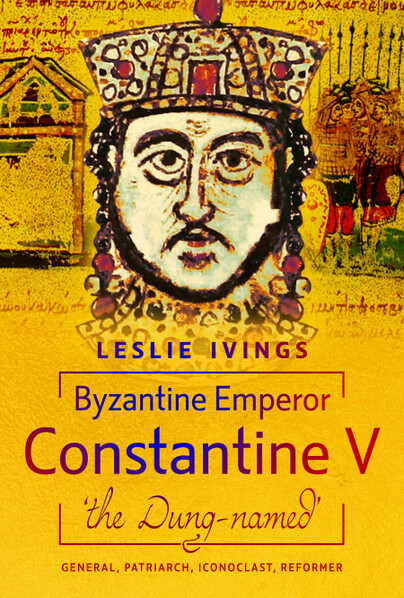
Order your copy here.