Five ways to be a Victorian Feminist
Women’s History Month guest post from Rebecca Wilson.
Be strong like Sal Madge.
She was a non-conformist West Cumbrian. Sal was a formidable woman, who wore a man’s waistcoat, cut her hair short, and smoked a pipe. She braved the depths of the coal mines of Whitehaven for as long as the law allowed. After the 1842 Mines and Colliery Act, she was no longer allowed to work down the pit, but because she was well-loved, she was kept on at the pit and worked on the surface of the mine, driving the horses to take coal from the top of the shaft to the wagons.
When she wasn’t working, she volunteered with the Rocket Brigade, an early precursor to the Royal National Lifeboat Institution. She sailed out with a small team and pulled the injured and dying from the water. She was a tough cookie, who would wrestle competitively, drink hard liquor and was genuinely loved in a time where gender roles were so ingrained in society. She was treated like ‘one of the lads’ and often mistaken for one whilst shovelling coal into the carts. When she passed away, the whole of the town of Whitehaven lined the streets, and placed her favourite flowers, daffodils, on her coffin. She is still loved in the town.
Be passionate like Christina Rossetti.
She was a wonderful writer who is widely celebrated today for her mastery of language. In her work, she delved into devotional, romantic and mournful themes. She came from a prominent artistic family, so it was almost inevitable that she would also make her mark. She was consistently a muse for her brother, Dante Gabriel Rossetti, and her likeness can be seen in many of his paintings.
Rossetti is arguably best known for two key pieces. The Goblin Market, a collection of poems that speak of sinister worlds and temptation on a Biblical scale. Also, she wrote In the Bleak Midwinter, a well-loved Christmas Carol, and one which is deeply emotional and beautiful. She has been held up throughout the decades as a feminist icon and inspired the likes of Virginia Woolf and Germaine Greer.
Be Independent like Beatrix Potter.
Potter lived much of her adult life in the Lake District, and to do her justice, it is impossible to pigeon-hole her into one skill. She is famous of course for writing the much-loved children’s books and her creation of Peter Rabbit. These are stories and illustrations that have been made and remade many times over on TV and film. Potter was also much more. She devoted much of her time and energy to the study of natural sciences, such as geology, entomology, and her main passion mycology (the study of fungi). Many of her drawings have been preserved for scientific reference and study.
She was also a passionate gardener, a farmer, and is responsible for preserving 4000 acres of countryside for the National Trust after her death. She continues to be a childhood favourite and adored for generations, and her influence is still felt in her chosen home of the Lake District.
Be ambitious like Elizabeth Garrett Anderson.
She was the first English woman to become a doctor. She fought her way through the male monopoly on the profession. Despite being born one of twelve children to a pawnbroker family in Whitechapel in London. Meetings with Elizabeth Blackwell, the first Scottish women to become a doctor, persuaded Anderson to follow her dream. She was barred from attending various medical schools in England, so found an alternative. She taught herself French and attended medical school in Paris.
When she gained her medical degree, she came back to England, and set up New Hospital for Women in London, entirely staffed by women, and appointed her friend and mentor Elizabeth Blackwell, as her head of gynaecology.
Anderson proved that women had always been underestimated and we’re capable of achieving higher degrees and working in the medical field.
Be fierce like Emily Wilding Davison.
Davison was tenacious when it came to her beliefs. She was bold and sometimes controversial in her methods of grabbing attention in the headlines and bringing Votes for Women to the forefront of conversation.
She was considered by some to be militant, even an extremist, as she often set fire to post boxes and even once hit a Baptist minister in Aberdeen railway station, believing him to be then then Chancellor of the Exchequer, David Lloyd George.
She once snook into the Houses of Parliament in the dead of night to hide in a cleaners’ cupboard. She cleverly did this on the eve of the census so she could state on the official paperwork that her residence was the Houses of Parliament, a place she, as a woman, was not allowed to be. A plaque still exists in Parliament to commemorate her night there.
Davison’s death would mark her as infamous. She would step out in front of the king’s horse at the Derby in 1913, ultimately killing herself. To this day, historians, biographers, and contemporary news sources, cannot agree on her motives that day. Did she mean to die that day? Did she just mean to throw a WSPU (Women’s Social and Political Union) banner over the king’s horse and accidentally get trampled? Whether it was an unfortunate accident, or a meaningful act of defiance, Davison’s life and death led to real change in women’s rights.
So, now you know how to enact change and be a feminist, just like a Victorian. Be strong, passionate, independent, ambitious and fierce.
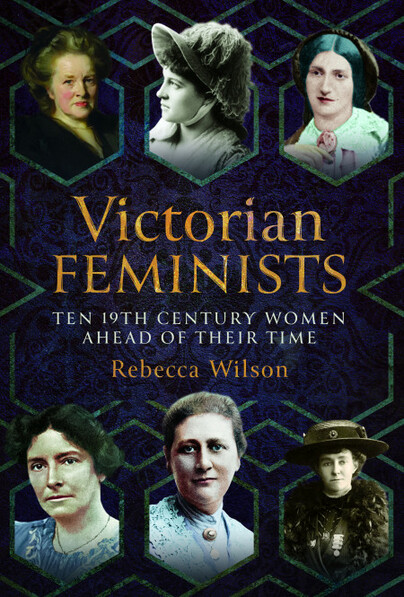
Order your copy here.