The Anglo-Scottish Origins of the Bruce Family
Author guest post from James Turner.
The Bruce family were, like their Balliol relatives and rivals, originally of Anglo-Norman extraction. However, their roots within the Scottish political community ran considerably deeper. The exact parentage and family background of the first Robert de Brus, or Bruce, is unknown. It is probable though that the family name is derived from the village of Brix in Normandy’s Cotentin Peninsula and that Robert was a member of the region’s lower nobility. King Henry I of England had a special association with the Cotentin, having purchased the lordship of the region from his cash strapped elder brother, Duke Robert of Normandy, shortly after their father’s death. Duke Robert eventually reneged on the deal and attempted to drive Henry out of the region in concert with their other brother, King William Rufus of England. Yet the local aristocracy remained surprisingly loyal to the prince who was able to repeatedly re-establish a base of operations within the Cotentin.
If Robert de Brus was indeed from the Cotentin, this royal connection would go a long way to explaining his sudden emergence in the aristocratic circles of Northern England shortly after Henry claimed the throne and the high degree of royal favour in which he was subsequently held. Robert first appears within records around 1100s as a retainer and vassal of Earl Ranulf of Chester but his presence within the witness lists of contemporary charters suggests he had a wide portfolio of landed interests across Northumbria. By the late 1120s he had built up a considerable conglomeration of lands in Yorkshire, much of which had been awarded to him directly by King Henry.
When King Edgar of Scotland died in 1107, the kingdom passed to his younger brother Alexander I but considerable aristocratic pressure led to a large swathe of the south of Scotland and the then ill-defined borders region being ear marked as the domain of the late king’s second surviving brother, David. Considering David’s still tender age and Alexander I’s considerable opposition to this division, it is unsurprising that most of the evidence for David’s trans-border pseudo principality only appears from the mid-1110s onwards. Prior to this, David had been living in the court of his brother-in-law, King Henry, who both supported him in establishing control over his inheritance and furnished David with estates throughout the north of England, including the Earldom of Huntingdon.
At some point during this period, David was granted lands in the north of the Cotentin, probably in recognition of his service in helping Henry secure control of Normandy. It is highly probable, given their shared connection to the Cotentin and the court of Henry I, that David and Robert’s friendship and association was forged during this formative period in David’s career. In 1124, shortly after the death of Alexander I and David’s own accession to throne the Scotland, David bestowed upon Robert the lordship of Annadale in the Scottish borders.
David’s simultaneous reign as King of Scotland and the English king’s chief deputy within Northumbria demonstrates a great deal about the porous nature of medieval polities and the highly personal, caveated, nature of power within them. As, of course, did David’s extensive efforts to increase his authority in Scotland through his sponsorship of Norman immigration, alongside the adaptation of Norman cultural trappings and administrative practices. Robert continued to cooperate closely with David within the north of England but does not seem to have spent a great deal of time within Scotland.
The fault lines in David and Robert’s tangled and overlapping loyalties were brought into sharp relief in 1138 with David’s invasion of northern England. Robert like the majority of English magnates at this juncture, supported, to one extent or another, King Stephen of England. Stephen, a nephew of Henry I, had more or less usurped the throne from his cousin, Matilda, having persuaded the Church to free the nobility from their oaths to Matilda by promising to do away with Church taxation. On the other hand, Matilda was David’s niece, and the Scottish King naturally favoured her claim to the English throne. Moreover, David saw the unfolding war as a chance to secure his extensive lands in northern England, probably hoping to incorporate them into the kingdom of Scotland outright.
Robert de Brus was a member of an embassy dispatched by King Stephen’s army on the eve of battle in an attempt to dissuade David’s invasion and reach some agreement with the Scottish king. Despite Robert’s impassioned plea and his invocation of the many times in which David had benefited from the cooperation of the Anglo-Norman aristocracy, the Scottish king was determined to press the issue. As a result, Robert angrily renounced his pledge of loyalty to David.
The ensuing Battle of the Standard was a bitter disappointment for the Scottish king who saw his forces routed with heavy casualties. The chronicler, John of Worcester, claims that of the two hundred knights that David fielded during the battle, only nineteen made it back to the Scottish base at Carlise with their mail hauberks, the others having all been killed, captured or compelled to discard their heavy armour during their headlong flight. One of these knights was Robert de Brus’ second son, the inventively named, Robert de Brus. While his father had denounced all loyalty to David, the young Robert had fought alongside the Scottish army, thereby protecting his personal claim to the Scottish estates he one day hoped to inherit.
This conspicuous display of loyalty turned out to be a wise strategy and the younger Robert inherited the Lordship of Annadale and the family’s Scottish lands upon his father’s death in 1141. Under Robert’s son William, the third Lord of Annadale, it becomes apparent that this branch of the Bruce family had once again acquired large amounts of land in Northern England, establishing their status as an Anglo-Scottish aristocratic family. William even possessed a license from King John to hold weekly markets in Hartlepool. The exact circumstances under which this new wealth of English territory was acquired are unclear but the very fact that the lords of Annadale were able to amass a considerable concentration of lands in northern England tells us a lot about the manner in which the Scottish and English aristocracy flowed seamlessly together in the early part of the thirteenth century.
William’s eldest son, somewhat wearingly and confusingly named Robert, became the fourth lord of Annadale upon his father’s death in 1212. This Robert, while a relatively minor figure within Scottish politics, opened the way for his family’s eventual rise to political prominence and kingship by marrying Isabel of Huntingdon, the daughter of Earl David of Huntingdon and the great-granddaughter of King David I. The family’s later claim to the Scottish throne originates from this marriage and their descent from Isabel and David. In addition to placing the family closer to the Scottish crown, marriage to one of the Earl of Huntingdon’s heirs brought the family further estates within England. Their son Robert, known as ‘Robert the Competitor’ because of his pursuit of the Scottish throne, was married to Isabella de Clare, the daughter of Earl Gilbert de Clare of Gloucester and Hereford and his wife Isabel Marshall.
This was a highly advantageous marriage which intimately connected the Bruces with one of England’s most powerful and influential aristocratic families. Robert’s collection of English estates, concentrated in County Durham and Essex, compelled him to take an active interest in the unfolding Second Barons Rebellion. A royalist supporter, Robert fought for the English king during both the disastrous defeat at the Battle of Lewes in 1264 and the dramatic reversal that brought the rebellion to a crashing halt at the Battle of Evesham in 1265. He was, like most of the royalist faction, rewarded for his loyalty with a gift of lands confiscated from rebel barons.
The family’s status was further enhanced in 1272 when Robert’s eldest son, the future king’s father, married Countess Majorie of Carrick, securing for the first time a committal rank for a member of the family. Control of both Carrick and Annadale made the Bruces a formidable presence in the southwest of Scotland, effectively encircling Balliol dominated Galloway. It appears that following this marriage, father and son worked closely together to maintain and advance their shared familial interests, with the elder Robert devolving much of his authority in the south of Scotland to his son.
Interestingly, all the members of the Bruce family we have just covered, up to and including Robert the Competitor, the Fifth Lord of Annadale, were buried in Gisborough Priory in Yorkshire. The Priory had been founded by the first Robert de Brus and its continued use as a burial site by the junior ‘Scottish’ branch of the family, across four generations, suggests that they maintained a strong association with the region and their Yorkshire cousins.
The Bruces were a family of Anglo-Norman origin whose possessions within England were as great or greater as those within Scotland. Its members had profitably engaged extensively in service to successive kings of England. Perhaps it is worth asking what then exactly made such families Scottish rather than English? The inherent difficulty in answering this question suggests that the line between English and Scottish aristocrats was so blurred as to have little or no meaning for contemporaries.
It is almost possible to speak in terms of a singular aristocracy that just so happened to spread over two separate kingdoms. This, of course, changed during the Wars of the Scottish Independence and the drawing of firm battlelines. The Bruces would eventually rise out of the chaos, unleashed by the war to claim the Scottish throne. However, their rise to power and position as the foremost defenders of Scottish independence was, like their ancestry, far from straightforward or clearcut.
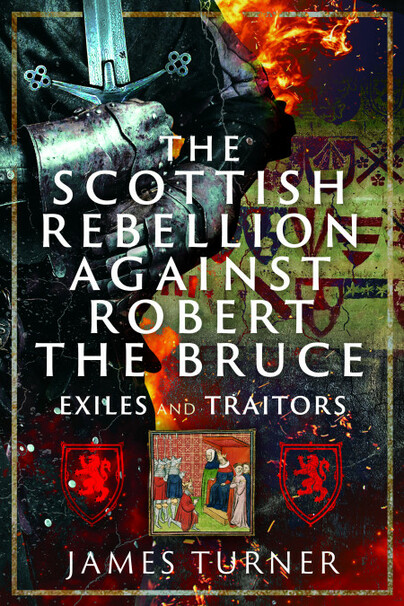
Order your copy here.