The Coterel Gang’s Reign of Terror
Author guest post from Ryan Cudworth.
My journey with the Coterel gang began almost eight years ago, when I stumbled across an article discussing real medieval outlaws who may have shaped the Robin Hood legend. I wasn’t looking for the “real” Robin Hood—far from it—but the Coterels caught my attention immediately. Their territory lay in the High Peak of Derbyshire, a landscape I know well, and their story unfolded in the turbulent fourteenth century, a period already rich with conflict, famine, and political upheaval.
That first spark led me to John Bellamy’s 1960s study—the only focused publication on the gang. Though brief, it was meticulous for its time, and every later reference to the Coterels leaned heavily on Bellamy’s work. Yet I sensed something missing. His article laid out the facts, but the human story behind those facts remained untouched. Were the records truly exhausted? Or had no one looked closely enough? Those questions became the starting point for my own research.
I began by retracing Bellamy’s steps, checking every reference, then diving deeper into the archives. I built a database of people, places, and events—not a narrative, just raw material. Bellamy had no space to explore the individuals the gang targeted, but I wanted to know who they were (sometimes elusive). Why did the Coterels choose them? Could understanding their victims reshape my view of the gang? Were they simply thugs, or was there a more complex social dynamic at play?
Working with medieval records brings its own challenges. Most surviving documents come from the legal system: structured, formulaic, and frustratingly silent on motive. They record the felony, not the story behind it. Reconstructing events requires weighing evidence, tracing patterns, and accepting that some conclusions must remain provisional. Much of the material is in Latin, and translating it reveals small details that bring the period to life—such as the gang member who escaped Newgate prison by waiting for twilight, breaking the lock of his cell, and slipping away while the guards were distracted.
I visited many of the places that appear in the narrative, and I’m grateful to the churchwardens who let me explore buildings whose stones still remember the Coterels’ world. Effigies of several figures connected to the story survive, and seeing them in person helped bridge the gap between archive and reality.
Writing about the Coterels also means grappling with the wider medieval world: feudal obligations, currency systems, military service, social hierarchy, and the machinery of medieval justice. None of these can be ignored if we want to understand how a family like the Coterels could rise, operate, and traverse their world.
What I hope emerges from this work is a narrative that reveals a remarkable family navigating a century defined by crisis. At its centre stands James Coterel—a man with striking leadership skills, able to build alliances across social boundaries while never abandoning the raw instinct for self preservation. Their story unfolds against a backdrop of political chaos, wars with Scotland and France, devastating famine, and the desolation left by the plague.
Two thoughts stay with me. The first is something I once read in another blog: is a project like this ever finished? The answer is no. I continue to research the Coterels and their associates, and there is always more to uncover.
The second is the question of representation. How should the Coterels appear in the narrative? Hilary Mantel once stated: “To retrieve history, we need rigour, integrity, unsparing devotion and an impulse to scepticism. To retrieve the past, we require all those virtues – and something more, putting the past back into process, into action, freeing the people from the archive.” She was speaking of historical fiction, but the principle applies equally to narrative non fiction. The task is to bring the past to life without distorting it—to make it accessible without diluting the evidence. That is what I have tried to achieve.
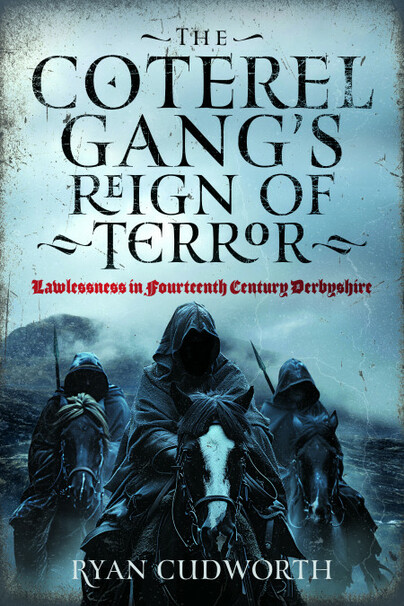
Order your copy here.