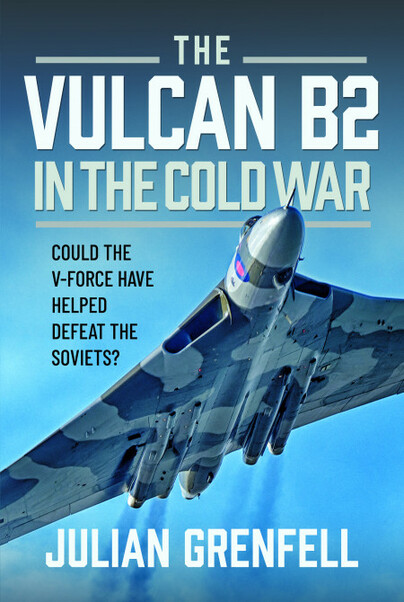
The Vulcan B2 in the Cold War
Author guest post from Julian Grenfell.
Those who were exhausted from building the aerial tools of WW II were once more being called to the anvil, and were tasked to design and build a miracle of air war, an aircraft so advanced that even those who wrought it were open mouthed when it first took to the air Julian Grenfell
At the end of WW II much of Europe lay in ruins, with countries bankrupt and their industries levelled by bombing. The end of WW II also brought about the end to the tenuous truce between capitalism of the west led by America, and the totalitarianism of the east in the form of the Soviet Union. The former WW II allies were now engaged in an ideological struggle; further, the west was disarming owing to the high costs to their taxpayers of maintaining large standing armies, navies, and air forces: not so much the Soviet Union with a total defence force of some six million men under arms. The major technological inventions and advances of WW II being the jet engine, the nuclear weapon, the aerodynamics of high-speed flight, and the development of the ballistic missile.
It was clear to the west that it possessed insufficient military assets to stop any Soviet attack, the only way to stop the westward movement of large numbers of men and armour moving westwards was by using nuclear weapons. The United States of America and the Soviet Union were developing and testing their own nuclear weapons. Britain was developing its own nuclear weapon, a fission device, with a nominal TNT equivalent yield of forty five kilotons, named under the Rainbow Code as Blue Danube. Later in the early 1960s the weapon fitted to the Vulcan was Red Snow, a one megaton fusion (hydrogen) weapon. There were two types of weapons, a free fall device being dropped in the classic aircraft bomb drop out of a bomb bay. Second, launching a rocket powered cruise missile called Blue Steel with a range of 110 nautical miles. But how was Britain to get its nuclear weapon to its target?
Much of eastern Europe lay behind what Winston Churchill called ‘The Iron Curtain’ lying under Soviet control, the curtain running for some eight hundred miles from Stettin in northern Poland to Trieste, a port in north eastern Italy abutting Yugoslavia. Berlin was controlled under a four power agreement of Britain, America, France, and the Soviet Union. Geographically, this represented what was to be called the ‘Cold War’ where nuclear weapons stayed war through deterrence, no side believing they could survive a nuclear exchange, this meant Britain’s nuclear capability had to be credible. From WW I through to WW II Britain’s air power philosophy was predicated on the belief that the bomber would always get through. What was not yet realised by Britain was that Germany had begun the era of the ballistic missile through its V-2 weapon. The technology of inertial guidance, rocket motors, and rocket motor fuel was not high on Britain’s research and development (R & D) list on the grounds of cost, it wanted the larger proportion of R & D for commercial programmes to bring in much needed money. Thus, the nuclear delivery platform chosen was an aircraft. In January 1947, the Ministry of Supply issued a specification B35/46 for a nuclear delivery platform resulting in selecting the Avro 698 and the Handley Page 80, the Vulcan and the Victor respectively. The Valiant was procured under a different specification.
The Vulcan was designed to deliver a nuclear weapon at 50,000 feet, and to cruise at speeds no less than 580 miles per hour at 50,000 feet (speeds in the high transonic region), and to have a range of some 3,500 nautical miles carrying a weapon weighing 10,000 lbs. The Vulcan B2 regularly carried out bomb runs at 56,000 feet. Aircraft survivability was increased by reducing vulnerability to aircraft damage from enemy attack, such as double or triple electrical wiring, three electrical power sources, the ability to manoeuvre with a release to service of a 3g capability, and electronic countermeasures to degrade enemy weapon systems guidance. The Vulcan up to late 1963, had a concept of operation of an attack, in force, at high altitude with all jammers radiating, this was called force protection. British attacks, being in accordance with US/UK joint target planning agreement, were against Soviet cities and would be made under the Supreme Allied Commander Europe’s (SACEUR) authority. The post late 1963 concept of operation was a low altitude attack, some 300 feet or lower, therebye remaining undetected by Soviet air defence ground radar until shortly before the target run. Electronic countermeasures were not needed until just before the target run. This concept was called platform, or individual aircraft, protection. Nuclear attacks were now against the Soviet military capability, not ‘city busting’. The low altitude delaying detection by Soviet air defence trade-off, was shorter range because of higher fuel consumption, lower speeds, and airframe fatigue in training. A free-fall bomb release from low altitude meant the aircraft climbing to 10,000 feet then releasing its nuclear weapon in an almost toss-bombing manoeuvre. For a Blue Steel launch at twenty nautical miles meant climbing to 2,000 feet, the low altitude range of the weapon now limited to 30 nautical miles. Four aircraft, per air base, would be armed and at 15 minutes notice of going to war, called quick reaction alert (QRA). All four QRA aircraft could be in the air within 2 minutes
The V-force crews expertise in executing their war mission was high through individual and crew continuous assessment of aircraft equipment, role knowledge, target knowledge, and flying capability. Crews were tested individually on the ground and in the air. Crews studied the modus operandi of the Soviet air defence of the homeland, and practised air-to-air-combat with fighters and target runs with electronic countermeasures in the UK, Canada, and the United States. The V-force crews believed in their ability to get through to their SACEUR allotted Soviet targets.
Order your copy here.