


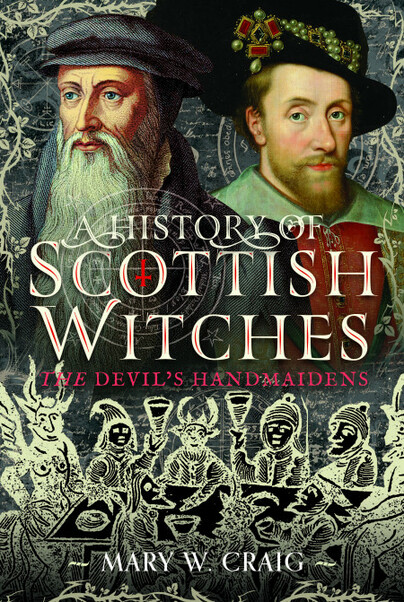
A History of Scottish Witches (Hardback)
The Devil's Handmaidens
Imprint: Pen & Sword History
Pages: 256
Illustrations: 30 mono illustrations
ISBN: 9781036106317
Published: 9th February 2026
Last Released: 7th May 2026
(click here for international delivery rates)
Order within the next 6 hours, 3 minutes to get your order processed the next working day!
Need a currency converter? Check XE.com for live rates
A History of Scottish Witches: The Devil's Handmaidens explores the phenomenon of witch persecution in Scotland between 1563 and 1736. Looking at the influence of the likes of John Knox and James VI of Scotland, this book examines the magic and fairy beliefs that underlay witchcraft and how this became twisted by the Scottish Kirk’s obsession with the Devil.
Using examples from actual trial records and so-called witch confessions, this book explores how societal norms surrounding women caused so many to face the rope and the flames and how those norms were exacerbated by the chaos of the reformation and the wars of the Three Kingdoms. How did the magical beliefs of ordinary people become twisted into Devil worship? And why did so many come to believe this? How did the Scottish church and the courts fall into a frenzy of belief that the Devil was around every corner, causing terror across Lowland Scotland, and how did they extract themselves from that frenzy?
Finally, the book looks at how this period of persecution affected the ordinary people of Scotland and what lessons it might hold for today.
Register or Login now to post a review!
Rating: 5 out of 5 stars
NetGalley, Siobhain McCormick
I have always had an interest in the persecution of women (and some men) for witchcraft throughout history. Now following a pagan path I also feel that it’s important to learn about the people who lost their lives to those who believed that the devil was bewitching and using people for their bidding. A History of Scottish Witches is a wonderful read for anyone interested in this intense and violent time in our history. Meticulously researched and presented in an easy to follow and organised fashion this is a must read.
A very interesting read. I'm not usually a non-fiction person, but decided to branch out of my comfort zone. I learned so much reading this book, and had no idea of the part Faerie/Fairy beliefs played in the history of witchcraft in Scotland, and how much complexities there were in the political and social history of the time.
NetGalley, Elfrida Milne
Rating: 5 out of 5 stars
NetGalley, Julie Sutherland
A thought-provoking investigation into the history of witchcraft in Scotland, where witch trials were considerably more frequent than in other parts of the UK. The complexities of governance, religion, monarchy and superstitions over a turbulent 200 year period are discussed as possible reasons as to why several intense episodes of accusations occurred, as well as the influence of 4 key books. Women from my neighbourhood are amongst those mentioned; arrested, tortured and, in some cases, killed as witches. I was most interested in the strong belief in fairies across Scotland and how that might have affected the abundance of accusations. My family in Angus have many fairy stories and beliefs, and some who made their living on the sea had strong views about not allowing an eggshell to remain intact "so the fairies can't use it for a boat", interesting to see a similar belief mentioned here (preventing a witch from using the shell pieces). Lastly I appreciated the discussion around PTSD for the people accused, their families and community - not forgetting the executioners who were often tasked with strangling their neighbours to death. The whole book is completely fascinating.
This is meticulously researched and quickly justifies its own existence by finding a peculiarly Scottish angle to the issue. Craig presents a lot of primary text, which requires a bit of Olde English (Scottish) to decipher, though quite fun to do when reading out loud. And there are some excellent anecdotes in here, not least the witch-hunt for the people who hexed the sea when James I and his Danish bride sailed back from their continental wedding.
NetGalley, Peter Baran
Rating: 5 out of 5 stars
NetGalley, Leona Armstrong
A history of Scottish Witches is such a fascinating look at the phenomenon that was Scottish Witches and why Scotland persecuted so many witches in the 16th and 17th century. This book is extremely well researched and examines historical records to understand why Scottish Witches and why the religious and political landscape of Scotland were consumed by their obsession with the devil, witches and all things supernatural. There was a belief that witches gained their power from the faeries. Scotland has a deep history of folkloric history concerning witches, fairies, changelings, and the supernatural. Similar to Ireland in this folklore history, which I love reading about!
The book especially looks at the influence of John Knox and James VI of Scotland influence on the witch trials. It uses actual trial records and witch confessions. Which I found so intriguing. The author links how skills such as healing were seen to have come from the fairies and in turn witchcraft. With some healers persecuted while others were not. These differing views of healers in different regions was very interesting including how different areas of Scotland also persecuted more witches. It really examined the historical, political, religious and societal circumstances that lead to witch hunting.
Overall a fantastic look at the trials of witches in Scotland during this time period. I'd definitely recommend it if it's an area of interest or even if you want to learn more about the witch trials, and laws in Scotland.
A History of Scottish Witches serves as an accessible introduction to a dark and unsettling chapter of Scottish history. It will likely appeal to readers with Scottish ancestry, those interested in the history of witch trials and anyone wanting a concise look at the social and cultural forces that contributed to the persecution of women during this period.
NetGalley, FaithfulReviewer 💙💙 Jacqueline M Hale
This is a thoroughly researched and documented story of witches in Scotland. While there are common denominators in all witch trials, the situation in Scotland had its own unique quirks. Religious beliefs coloured the stage for the abominations that were to come. It was not just the usual Catholic versus Protestant but the scrabbling for power within the various divisions within the Protestant faith. Add to that many factors, not the least being pestilence, famine and all the other ills rampant at the time. The Little Ice Age exacerbated it all and since times were tough, they needed scapegoats. And all through history, women have made easy targets for men.
NetGalley, Susan Johnston
It was not only men however who accused. Women were frequently behind the finger pointing. And, on occasion, men too were accused but not nearly as often. The actual numbers of victims will never be known. Records, if there were any were lost. Many victims never saw a trial. Some of those accused were the healers who helped the poorer elements of society. It was a black time.
The book is a heavy tome but well worth the effort. Four purrs and one paw up.
Rating: 5 out of 5 stars
NetGalley, Elizabeth Rose
A History of Scottish Witches: The Devil’s Handmaidens by Mary W. Craig is a masterful and meticulously researched exploration of Scotland’s dark and complex history of witch persecution. From the influence of John Knox and James VI to the upheaval of the Reformation and the wars of the Three Kingdoms, Craig traces how ordinary beliefs in magic and the supernatural were twisted into terrifying accusations of Devil worship, often with devastating consequences for women.
This book apart is grounding in actual trial records and confessions, paired with sharp cultural analysis. Craig does not just recount events; she examines how societal norms, religious fervour, and fear intertwined to create mass hysteria—and she thoughtfully reflects on the echoes of this history in today’s world.
This book will appeal to readers fascinated by history, social dynamics, gender studies, and the occult, as well as anyone intrigued by the intersections of belief, power, and persecution. It’s insightful, compelling, and deeply sobering—a must-read for anyone seeking to understand how fear and ideology can shape a society.
Highly recommended. 🕯️
‘A woman who denied being a witch was a liar and therefore was a witch. A woman who said she had not met the devil was a liar and had, obviously, met Auld Nick.’
NetGalley, Georgi Lvs Books
A great book on witches. I had a great interest as I am from Scotland ☺️
A must read for history lovers.
‘As men were considered more true and more steadfast in their faith, in most cases to think of a man as a witch was too awful, too shocking to contemplate.’
'A History of Scottish Witches' is a thought-provoking investigation into the socioeconomic, political, and interpersonal factors that lead a country to witch-hunting. I was fascinated by the focus on Scottish history, but this is certainly for any reader interested in the history of witchcraft and its famous persecution.
NetGalley, Brynn Cassidy
A book I immediately knew I wanted in on, this is a topic I hadn't known a lot about prior. The witch panic is honestly quite a fascinating mania that Europe seemed to latch onto. The book explores the history of famine they had during the period, along with a lot of political turbulence. I found it fascinating the span of history it all included, since it happened for such a long period of time in Scotland.
NetGalley, Clara Lash
Rating: 5 out of 5 stars
NetGalley, IAIN McCARTNEY
I obviously knew a little of the history, but this book filled in a lot of gaps and proved to be a really interesting read.
I found this a really interesting, Scotland-centric work on witchcraft and the witch hunts that made their way across Europe in the seventeenth century.
NetGalley, Krystelle Fitzpatrick
A thought provoking book about witches primarily in Scotland.
NetGalley, Anna Larsson
Great illustrations, well researched and written in an un-academic way which make it a book for everyone.
A well researched and informative but still accessible guide to an underrepresented topic! When it comes to stories of historical witchcraft Salem is the first word that springs to mind so it was fantastic to learn more about events equally as tragic and intriguing but so much closer to home.
NetGalley, Theo Hendrie
Rating: 5 out of 5 stars
NetGalley, Maggie Palner
A deep dive into the persecution of women considered witches in Scotland. Well researched and presented in a reader friendly way. This was intriguing to read.
Between the early sixteenth century and the mid-eighteenth century, Scotland, with a population of around one million, saw approximately 3,800–4,000 individuals accused of witchcraft. Around 85% of those accused were women, and an estimated 2,500 or more were executed. By this measure, Scotland had one of the highest rates of witch trials and executions per capita in Europe.
NetGalley, Kat M
Having recently read the excellent Agnes Finnie, also by Mary W. Craig, which gives a blow-by-blow account of a solitary case of a woman accused of witchcraft in central Edinburgh, I was looking forward to reading this book and was not disappointed.
In A History of Scottish Witches: The Devil’s Handmaidens, Craig examines the mania that gripped Scotland during this period. She begins by showing how the conditions and foundations of the hysteria were laid down a few decades earlier, most immediately by John Knox and later ignited by James VI.
Craig then explores the aspects of life that fuelled the national frenzy: the repeated poor harvests leading to famine, the chaotic political turmoil under Charles I — told from a rare perspective, which I found particularly engaging — and the persistence of pagan beliefs in rural areas, which a power-crazed and histrionic Church of Scotland was desperate to stamp out.
The accounts of accusations and the extraction of confessions are deeply depressing, agitating at best and infuriating at worst. I particularly appreciated Craig’s neutral and factual tone, avoiding baseless speculation that might have been easy to insert.
Overall, this was a superb read, and I would recommend it as an entry point for anyone wanting to learn more about Scotland’s witch hunts during this period. Highly recommended.
Rating: 5 out of 5 stars
NetGalley, Anita Wallas
This book is exceptional. If you’re interested in history, social history, myths and legends, you’ll find it filled with little known facts about….Scottish witches. Although part of the UK, Scotland, more so than any other country, remains fiercely independent and rooted in its culture, traditions and beliefs. It’s a surprising to learn that 45% of the population still believe in fairies but Mary Craig’s exploration of the witchunts helps us to understand why. I liked the layout of the book which starts with a timeline of major events and people from the 10th century to 1773. It’s interesting to note the latter date, some years into the Scottish Enlightenment and nearly 40 years after The Scottish Witchcraft Act was repealed. The Presbytery of Scotland passed a resolution affirming their continued belief in witches and witchcraft.
The Scottish Witchcraft Act if 1563 is quoted along with a Papal Bull and they make for electrifying reading. The period of persecution is given context in terms of the reasons for the influence of religion and the monarchy along with the way the population was concentrated in the Lowlands. I gained real insight into how these beliefs about women and witchcraft were so easy to exploit by the Kirk and a male dominated society. The final part of the book has some amazing reproductions of woodcuts with various examples of witches, trials, the devil and mire. The bibliography and source references are extensive and indicate a subject well researched. It doesn’t make for comfortable reading and the way in which so many women were harassed and killed is heartbreaking, but it’s all true and a salutary reminder of how easy it is for the church and state to control. One of the best non fiction titles I’ve ever read.
A wonderfully, thought provoking book on the history of witches primarily in Scotland but also its effects and roots from other countries. Brilliantly researched and written in a way that won't make you feel like you are sitting in some boring history class. As always, A bonus for me, it comes with pictures and some great illustrations.
NetGalley, Christine Cazeneuve
About Mary W Craig
Mary W. Craig is a Scottish writer and historian. She is a former Carnegie scholar and holds a Master’s degree in History from the University of Glasgow. Mary researches and writes about various aspects of the social history of Scotland as well as giving talks, lectures and hosting a podcast, Borders Bletherings, where she explores the history of the Scottish Borders. She has a particular interest in the ordinary Scots persecuted as witches in the late 16th and 17th centuries. Mary is a member of Scottish PEN and is the author of Borders Witch Hunt and Agnes Finnie: the Witch of the Potterrow Port.



Pen and Sword Books
About Us | Contact Us | Delivery Information | Privacy Policy | Cookies | Affiliates | Terms and Conditions | Backlist | Mailing List | Reward Scheme | Review Request
© Pen and Sword Books Limited 2026. Registered in England No. 2527258.
Registered Office: 47 Church Street, Barnsley, S70 2AS.