


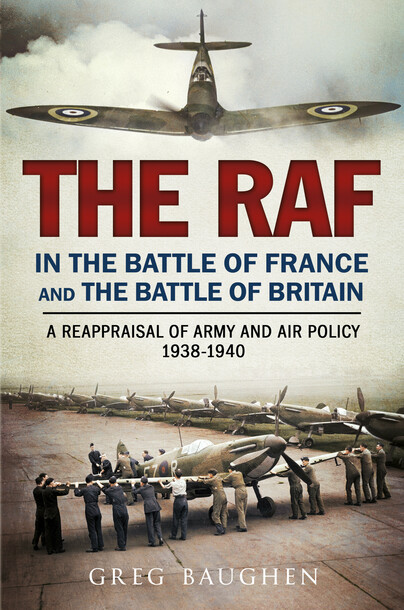
The RAF in the Battle of France and the Battle of Britain (Hardback)
A Reappraisal of Army and Air Policy 1938-1940
Pages: 272
Illustrations: 16 pages of b&w plates
ISBN: 9781781555255
Published: 30th October 2016
(click here for international delivery rates)
Order within the next 7 hours, 14 minutes to get your order processed the next working day!
Need a currency converter? Check XE.com for live rates
In May 1940, the German Army and the Allied forces they faced were fairly evenly matched. Two months later Britain was on her own, hopelessly outnumbered and facing imminent defeat. Should the RAF have done more to support the Allied armies in France? Could the RAF have protected the British Army better at Dunkirk? How narrow was the margin of victory in the Battle of Britain? Was the RAF ready to deal with an invasion? Why were hundreds of American combat planes and experienced Polish and Czech pilots never used? All these questions and more are answered in Greg Baughen's third book in the series. Baughen describes the furious battles between the RAF and the Luftwaffe and the equally bitter struggle between the Air Ministry and the War Office— and explains how close Britain really came to defeat in the summer of 1940.
Register or Login now to post a review!
This is a really good revisionist approach to the role of the RAF and its approach to cooperating with the army and Britains allies during the build up to war up to the end of 1940. It is certainly a more questioning approach to the RAF than you'll find in most other books on the subject. Even though the argument just falls short in my opinion, it is still a really well written book that flows well and isn't dry, with chapters that are just the right length, and a superb amount of photographs…..That said, it does make you think the RAF could have done more during the Battle of France. And if that is the authors aim, to make you think and ponder questions of your own, then he has succeeded well
Amazon Review
The RAF in the Battle of France and the Battle of Britain: A Reappraisal of Army and Air Policy 1938-1940”... is the third volume of Greg Baughen’s revisionist history of RAF air policy. I've just completed reading the volume and I can recommend it to anybody who is interested in the history of RAF air power theory in 1930's and early war period…There is much that is new in the book read it!
Amazon Review
“Baughen has conducted diligent archival research and writes authoritatively on RAF strategy, operations and the air support requirements of the British army…Overall there is much to recommend in this book as Baughen assesses the stated aims of the RAF senior command against the achieved outcome of their forces. The requirements of the army at the time were not met due to the RAFs inflexible dogma that strategic bombing was a war winner. One would have liked more analysis on the failure of the French Air Force for comparative purposes.”
Amazon Review
This book was one of those publications that are truly eye opening for military historians and students of warfare. I had no idea that the RAF was so dysfunctional during the "Phony War" preceding the German invasion of May 1940 as well as the Battle of France.
Amazon Review
In summarizing Baughen's literary and research efforts, I would say he has produced a ground breaking and objective account of RAF operations in France which is reason enough to buy this book. He uses archival sources for the most part and is a good enough author to make those often all too dry accounts much more readable. I finished this book with the belief that perhaps the Fall of France is a bit more complex than what we have been told.
I won't include an assessment of his coverage of the BoB, but I can assure it is also interesting and exhibits a high level of research…The Battle of France portion is what drew me to this book as many works already exist on the Battle of Britain.
Must read for serious historians.
“A refreshing analysis of RAF aircraft development, doctrine and leadership. This reader walked away with a much better understanding of the air war than he acquired from several popular narratives. It could have easily been a dry read but Mr Baughen kept it interesting.”
Amazon Review
This work rather effectively shatters any pre-conceived notions one might have had about the performance of the RAF during the Battle of France and Battle of Britain. As always, Greg’s excellent research and immaculately laid out arguments are very compelling while not taking away from the entertainment value.
Amazon Review
Another must-read from this author for anyone interested in British military history.
“This is really an amazing and detailed publication of the perilous time the RAF and the English people faced during 1940… This is an excellent work of history. For those aircraft and history buffs interested in the early part of World War II air battles this book will offer a wealth of information. I recommend this book as a very enjoyable and informative read.”
IPMS/USA - 1st February 2017
“An interesting account of a period in the war that is well known, but which tackles aspects of it which are far less well known... intriguing... an interesting take on the whole topic.”
Military Model Scene, March 2017
At last a seminal and authoritative appraisal of the RAF in its so called finest hour. The third volume in Greg Baughen's authoritative and extensively researched treatise on Air Staff Policy and the way it influenced RAF operations in the first years of the war. The RAF that emerges is a force not lacking in the courage of its air and ground crews but a force guided (misguided?) by doctrinaire and inflexible pursuit of policies intended to set the Air Force apart from the other services.
Amazon Review
I've studied the RAF for decades and have read widely, including the official histories published in 1953, but this series of books has fundamentally caused me to re-evaluate my view of the development of air power in the hands of the RAF. After the undoubted success of the RFC/RAF at the end of WW1, the story up to 1941 is an illustration of how a doctrinaire and inflexible adherence to inappropriate policies can put those who have to execute them at greater risk and detract from operational effectiveness of joint forces as a whole. The Air Staff emerge from this period with more scrambled egg on their faces than on their brass hats.
I unhesitatingly recommend this book and the series as a whole. Looking forward to the next volumes and seeing the story through to the thermonuclear age.

Pen and Sword Books
About Us | Contact Us | Delivery Information | Privacy Policy | Cookies | Affiliates | Terms and Conditions | Backlist | Mailing List | Reward Scheme | Review Request
© Pen and Sword Books Limited 2026. Registered in England No. 2527258.
Registered Office: 47 Church Street, Barnsley, S70 2AS.