


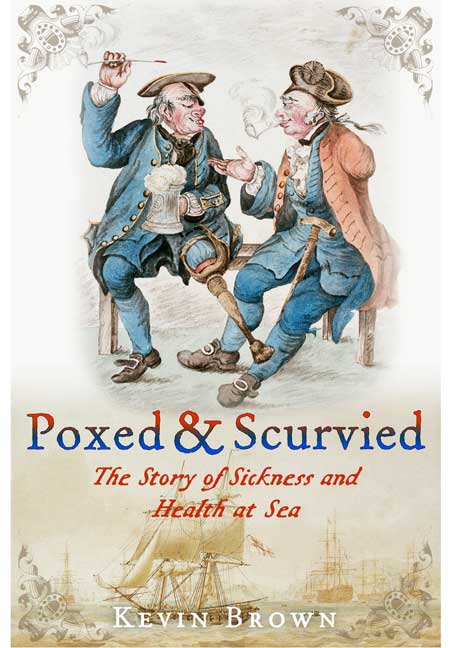
Poxed and Scurvied (Hardback)
The Story of Sickness & Health at Sea

(click here for international delivery rates)
Order within the next 5 hours, 2 minutes to get your order processed the next working day!
Need a currency converter? Check XE.com for live rates
| Other formats available | Price |
|---|---|
| Poxed and Scurvied eBook (4.6 MB) Add to Basket | £10.00 |
When European sailors began to explore the rest of the world, the problem of keeping healthy on such long voyages became acute. Malnourishment and crowded conditions bred disease, but they also carried epidemics that decimated the indigenous populations they encountered – and brought back new diseases like syphilis.
As navies developed, the well-being of crews became a dominant factor in the success of naval operations, so it is no surprise that the Royal Navy led the way in shipboard medical provision, and sponsored many of the advances in diet and hygiene which by the Napoleonic Wars gave its fleets a significant advantage over all its enemies. These improvements trickled down to the merchant service, but the book also looks at two particularly harsh maritime environments, the slave trade and emigrant ships, both of which required special medical arrangements. Eventually, the struggle to improve the fitness of seamen became a national concern, manifest in a series of far-reaching – and sometimes bizarre – public health measures, generally directed against the effects of drunkenness and the pox.
In this way, as in many others, an attempt to address the specific needs of the seafarer developed wider implications for society as a whole. It also produced scientific breakthroughs that were a universal benefit, so far from being a narrow study of medicine at sea, this book provides a fascinating picture of social improvement.
Register or Login now to post a review!
Poxed and Scurvied is a well balanced and well researched book that never fails to provide the reader with new insights and fresh reminders of what happened in olden days... it is a joy to read as Brown is closely acquainted with his material, and is thus able to convey much of his knowledge in relative ease and breeze.
Scalpen Blog
Read the full review here
Kevin brown fills in the gap in an extremely well researched examination of how sailors were kept healthy at sea. Brown’s expertise is reflected in previous works on the discovery of penicillin and the history of syphilis. In Poxed and Scurvied, he offers a vivid and detailed explanation of the centuries – old problem of sickness at sea and attempts to diagnose and overcome the maladies common to sailors.
The Historian, Phi Alpha Theta International Honor Society
Poxed and Scurvied is an impressive work in many respects; replete with numerous quotations and references, Kevin Brown has tackled this substantial topic by delving into the primary sources, most of which are located in The National Archives of the United Kingdom in London. This must be the first caveat: in general, Brown’s book concerns “The Story of Sickness and Health at Sea” as it pertained to British sailors and passengers and over half of his work focuses on the Royal Navy in particular.
International Journal of Maritime History
A fascinating and wide-ranging history of health, hygiene and the sea.
Ausmarine, March 2012
This is a great narrative of an important but often hidden aspect of seafaring.
Kevin Brown stands out with his comprehensive study. He moves beyond a specific sickness and examines the total health of sailors and travellers at sea.
Nautical Research Journal, Spring 2012
His book fills in many of the missing details about sickness at sea and illustrates how diseases at sea proved to be a catalyst in medical research and treatment throughout history.
Brown has a reliable writing style, usually opening a new chapter with a story or a surgeons personal account, followed by a discussion of the disease along with the major surgeons and doctors involved, and concluding with the healthcare provided to the sick and injured. Brown also discusses class and gender issues that are related to inequalities in medical treatment, a topic that I rarely discussed in maritime medicine.
This book could be read by anyone interested in medical history or maritime medicine regardless of age. The topics are intriguing, the research is thorough, and the book is a captivating read.
With chapters on every malady and danger the seaman’s flesh is heir to, Poxed and Scurvied tells the story of the struggle to improve the fitness of the not always jolly jack tar, and of the various scientific breakthroughs that would be of great benefit both on the high seas and dry land.
Family History Monthly, Feb 2012
In summary, Kevin Brown’s Poxed and Scurvied, decorated with an outstanding dustcover illustration, as a well-written scholarly work that should be a part of any serious maritime historian’s library.
Sea History, Winter 2011
… shows an attempt to address the needs of the seafarer developed wider implications for society as a whole. It also produced scientific breakthroughs that were of great benefit, the eradication of scurvy being one. The nook not only details a history of naval medicine, but of a wider social health improvement.”
The Nautical Magazine
Kevin Brown's book captures the flavour of these relatively recent, more expansive and expensive times, as well as that of the long-distant past. His history starts with the Black Death and moves to syphilis, but primarily has a strong naval focus - making extensive use of Royal Navy records in an authoritative account of maritime medicine and diseases spread by sea. Infections either dominate or lurk just under the surface. After all, amputations during naval battles were often done in an attempt to reduce the risk of death from gangrene. The book brings this to life very well, with its lurid account of the surgery and the knives and saws, as well as covering quarantine and the great pandemics of the past.Well-referenced, and well-written, this account is a good read as well as a useful source of in-depth information.
Microbiology Today
The impressive 36 pages of detailed notes and bibliograpghy mean that Poxed and Scurvied will find itself at home with academics of maritime history. However, its written in such an accessible form that it should also appeal to anyone curious about life – and death – at sea in the last millennium
Who Do You Think You Are Magazine, September 2011
It details the devastating diseases carried by early travellers and colonists. For example, the Black Death, which killed a third of Western Europe's population, was brought back by Genoan merchants returning from the Crimean.
Norwich Evening News, 23rd July 2011
...
There is also a chapter on emigrant and slave ships, where the need to keep the 'cargo' healthy while manacled for much of the voyage led to bizarre practice of forcing slaves to dance in their chains.
Poxed and Scurvied ends at the Falklands Wr which Brown describes as: " The last of the colonial wars ion which ships are isolated at sea"
Despite its gimcrack title this is a serious work by an author well qualified in medical matters. The first half describes health problems in the Royal Navy during the sailing ship era; there is little on the mercantile marine or on foreign seafarers. It is a story of gradual improvement, but from a low base.
BBC History Magazine, September 2011
The main task of ships' surgeons was treating battle casualties, usually by amputation (without anaesthetic). Arthur Devis's painting of the death of Nelson in the gloomy cockpit of the Victory gives an idea of the conditions in which surgeons carried out their bloody task. However, many more seamen died from sickness than in battle, and in treating disease most surgeons were more ignorant than their counterparts on shore. Although scurvy was notorious as the scourge of the sea, its ravages were chiefly confined to long voyages, and on routine cruises typhus, dysentery and yellow fever killed many more men.
The lot of the sick and wounded at sea was appalling, as they languished below deck amid filth and stench. Reformers at sea and on land slowly introduced improvements; better diet (the Admiralty authorised the issue of lemon juice in 1795 to combat scurvy), an emphasis on cleanliness and adequate ventilation, and the building of naval hospitals on shore.
The rest of the descriptions of the dire conditions on slaving ships and emigrant vessels to life on the passenger liners and cruise ships of the 20th century, where the doctor's role could be more social than medicinal. In today's navy, serious casualties are air-lifted ashore for specialist attention.
Kevin Brown's wide reading is shown by the number of quotations that enliven his text. There is space for only one here, Nelson's cautionary remark that " the great thing in all military service is health, and it is easier for an officer to keep me healthy than for a physician to cure them".
When European sailors began to explore the rest of the world, the problem of keeping healthy on such long voyages became acute. Malnourishment and crowded conditions bred disease, but they also carried epidemics that decimated the indigenous populations they encountered – and brought back new diseases like syphilis. As navies developed, the wellbeing of crews became a dominant factor in the success of naval operations, so it is no
ICSM Gazette, The Medical Schools Magazine, Summer 2011
surprise that the Royal Navy led the way in shipboard medical provision, and sponsored many of the advances in diet and hygiene which by the Napoleonic Wars gave its fleets a significant advantage over all its enemies. These improvements trickled down to the merchant service, but the book also looks at two particularly harsh maritime environments, the slave trade and emigrant ships, both of which required special medical arrangements. Eventually, the struggle to improve the fitness of seamen became a national concern, manifest in a series of far-reaching – and sometimes bizarre – public health measures, generally directed against the effects of drunkenness and the pox.
In this way, as in many others, an attempt to address the specific needs of the seafarer developed wider implications for society as a whole. It also produced scientific breakthroughs that were a universal benefit, so far from being a narrow study of medicine at sea, this book provides a fascinating
picture of social improvement.

About Kevin Brown
KEVIN BROWN is the Curator of the Alexander Fleming Museum at St Mary’s Hospital, Paddington and an expert on the history of medicine. He is the author of Penicillin Man, which tells the story of the antibiotics revolution that began in the laboratories he now curates, and also Fighting Fit, a history of military medicine in the wars of the twentieth century.





Pen and Sword Books
About Us | Contact Us | Delivery Information | Privacy Policy | Cookies | Affiliates | Terms and Conditions | Backlist | Mailing List | Reward Scheme | Review Request
© Pen and Sword Books Limited 2026. Registered in England No. 2527258.
Registered Office: 47 Church Street, Barnsley, S70 2AS.