


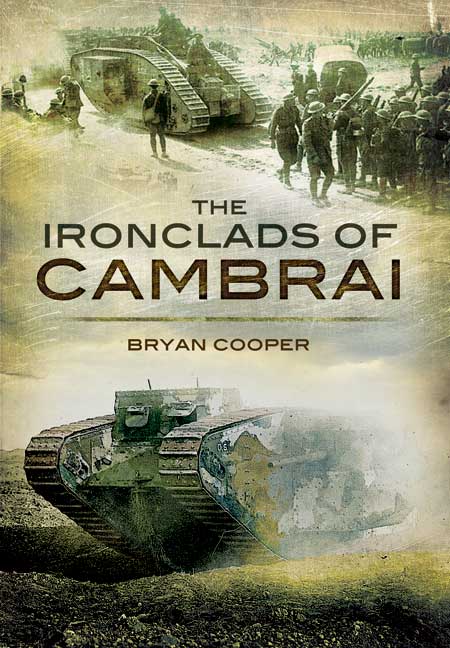
The Ironclads of Cambrai (Hardback)
Imprint: Pen & Sword Military
Pages: 244
Illustrations: 32 mono illustrations
ISBN: 9781848841765
Published: 17th March 2010
(click here for international delivery rates)
Need a currency converter? Check XE.com for live rates
| Other formats available | Price |
|---|---|
| The Ironclads of Cambrai Paperback Add to Basket | £7.50 |
| The Ironclads of Cambrai eBook (16.2 MB) Add to Basket | £6.99 |
When tanks, the newly invented British weapon, were used for the first time in a mass attack on November 20 1917, they not only achieved one of the most remarkable successes of the First World War but set the pattern for the future of mechanised warfare. For the first time in three years of bloody trench warfare, epitomised by the slaughter at Passchendaele which was then reaching its climax, tanks brought about a breakthrough of the massive German defence system of the Hindenburg Line, followed up by British infantry and cavalry divisions. They were supported for the first time by low flying fighter aircraft of the Royal Flying Corps.
The initial victory at Cambrai brought cheering crowds into the streets of London and the ringing of church bells in celebration. In seemed possible that the success might bring about the final defeat of Germany.
But the British High Command failed to exploit the success. Generals who still dreamt of massive cavalry charges had not had much faith in this strange new weapon that had been brought to them – funded initially by the Royal Navy at the behest of Winston Churchill who was then First Lord of the Admiralty and did see its value. The High Command did not really believe the breakthrough was possible and tragically miscalculated the necessary steps to follow it up. Within days the Germans counter-attacked and regained much of the ground that the British had won. What could have been the final victory was delayed for another year.
Register or Login now to post a review!
This is a marvellous hardback, well-presented version of a classical book original published in 1967. HIghly recommended.
Destructive Music
HERALDING the era of mechanised warfare, the famous battle of Cambrai in late 1917 saw the first use of tanks en masse and
Soldier, Dr Rodney Atwood, military historian
brought cheering crowds into the streets of London where church bells rang in celebration. Pen & Sword's reprinting of this classic, with a striking dust jacket by Jon Wilkinson, is very welcome. Bryan Cooper tells a vivid and exciting story, and it is not to belittle his work to say that research has advanced so far since 196] that it should be read rather as a period piece
than for new insights. Historians today would see tanks as a key part of the all-arms-battle rather than a war-winning weapon.
Bryan Cooper's work is fluent and to the point, and remains a good starting point for anyone wishing to learn about Cambrai, increasingly being seen as a turning point in British tactical development during the war. It is a readable account and good value. This is a nicely produced and welcome reprint.
The Long, Long Trail

The Battle of Cambrai
20th November 1917
The Battle of Cambrai was a British campaign of the First World War. Noted for the first successful use of tanks in a combined arms operation, the British attack demonstrated that the Hindenburg Line could be penetrated, while the German counter attack showed the value of new infantry tactics that would later be part of the Kaiserschlacht. Liddell Hart called the battle "one of the landmarks in the history of warfare, the dawn of a new epoch."


Pen and Sword Books
About Us | Contact Us | Delivery Information | Privacy Policy | Cookies | Affiliates | Terms and Conditions | Backlist | Mailing List | Reward Scheme | Review Request
© Pen and Sword Books Limited 2026. Registered in England No. 2527258.
Registered Office: 47 Church Street, Barnsley, S70 2AS.