


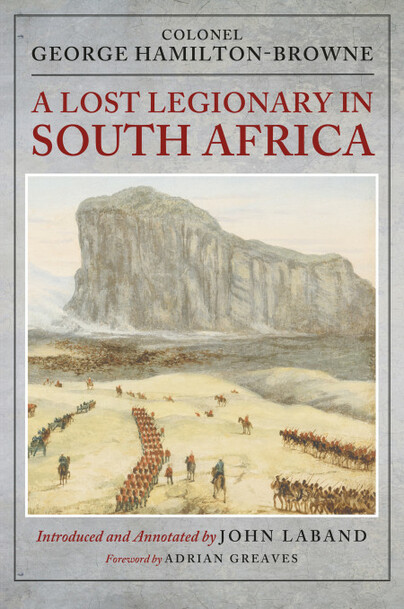
A Lost Legionary in South Africa (Hardback)
From the Ninth Cape Frontier War and the Anglo-Zulu War to the Bechuanaland Expedition and the uSuthu Rebellion

(click here for international delivery rates)
Order within the next 3 hours, 37 minutes to get your order processed the next working day!
Need a currency converter? Check XE.com for live rates
| Other formats available | Price |
|---|---|
| A Lost Legionary in South Africa eBook (12.6 MB) Add to Basket | £14.99 |
‘Colonel’ George Hamilton-Browne was a British soldier of fortune and adventurer who served in the Ninth Cape Frontier War in 1878 before fighting in the Anglo-Zulu War of 1879, and subsequently in the Bechuanaland Expedition of 1884–5 and the uSuthu Rebellion of 1888.
The centrepiece of the book is Hamilton-Browne’s vivid account of his part as Commandant of the 1st Battalion, 3rd Regiment, Natal Native Contingent during Lord Chelmsford first invasion of Zululand in January 1879. He took part in the attack on Sihayo’s homestead and in the operations around Isandlwana. He was part of the force that returned to the stricken British camp after the battle and relieved Rorke’s Drift the following day. After the Natal Native Contingent was disbanded, he spent the next month in garrison at Rorke’s Drift, guarding the border, before being transferred to the Cape to help raise a unit of mounted rifles.
This expanded new edition of the classic work offers readers a greater insight into the events Hamilton-Browne describes thanks to an introduction and commentary throughout by John Laband and a foreword by Adrian Greaves, both leading Anglo-Zulu War experts. A fascinating and distinctive memoir of the Anglo-Zulu War and the other conflicts described in the book, A Lost Legionary in South Africa is essential reading for anyone interested in the Anglo-Zulu War in particular.
‘Colonel’ – he never held a rank higher than major – George Hamilton-Browne (1851 –1916) was a soldier of fortune of Irish descent who emigrated to New Zealand in 1872 and then to the Cape Colony in 1878. In southern Africa he commanded colonial and local troops in many campaigns: the Ninth Cape Frontier War (1878); the Anglo-Zulu War (1879); the Bechuanaland Expedition (1884 –5); the uSuthu Rebellion (1888); the First Matabele War (1893); the Second Matabele War (1896); and Mashonaland (1896–7). He returned to England in 1902 where he wrote three popularly received books of colonial adventuring, including this one. He died in Jamaica in 1916.Colonel George Hamilton-Browne (1844-1916) was a British soldier and adventurer of Irish descent who took part in Britain's march into Zululand under Lord Chelmsford and fought in the Anglo-Zulu War. As an officer of the Natal Native Contingent (a Major in the 1st Battalion/3rd Regiment), he took part in the action at Sihayo's Kraal on 12 January 1879 and witnessed the final moments of the the battle of Isandlhwana ten days later on 22 January 1879. He died in Jamaica in 1916.
There are no reviews for this book. Register or Login now and you can be the first to post a review!
About Dr Adrian Greaves
In 1960 Adrian Greaves joined up as a Private soldier. A year later aged seventeen, he was selected for officer training and was commissioned into the Welch Regiment. Stationed in Berlin for three years he witnessed the Wall being built, undertook border patrols and once being taken hostage at gunpoint by East German Police. As this book reveals, Albert Speer, who befriended him, taught him German to interpreter level. He met international leaders including Kennedy and Khrushchev.
After leaving the Army he joined Kent Police achieving high rank. His hobbies included mountaineering and he and two friends successfully climbed the Eiger north wall. In 1984 he led an armed police team to quell a violent mutiny on a tanker in the English Channel.
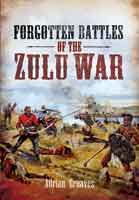
A qualified clinical psychologist, he has over twenty published titles, many with Pen and Sword including Forgotten Battles of the Zulu War (shortly to be re-issued)



Pen and Sword Books
About Us | Contact Us | Delivery Information | Privacy Policy | Cookies | Affiliates | Terms and Conditions | Backlist | Mailing List | Reward Scheme | Review Request
© Pen and Sword Books Limited 2026. Registered in England No. 2527258.
Registered Office: 47 Church Street, Barnsley, S70 2AS.