


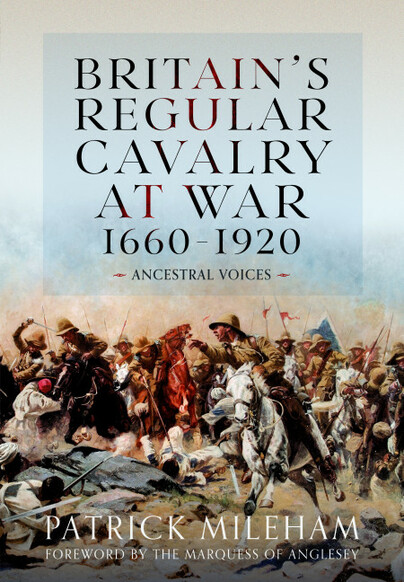
Britain's Regular Cavalry at War 1660 - 1920 (Hardback)
Ancestral Voices
Imprint: Pen & Sword Military
Pages: 448
Illustrations: c.150, full colour throughout
ISBN: 9781848847811
Published: 30th July 2026
This Week's Best Sellers Rank: #11
Special Offer
Special Offer: £35 Including P&P!
Use code CAVALRY35 at checkout – price includes P&P.
(click here for international delivery rates)
Order within the next 3 hours, 38 minutes to get your order processed the next working day!
Need a currency converter? Check XE.com for live rates
| Other formats available | Price |
|---|---|
| Britain's Regular Cavalry at War… eBook (110.2 MB) Add to Basket | £29.99 |
Patrick Mileham’s lively and scholarly history of Britain’s cavalry regiments takes the story from early roots in Cromwell’s army, and from Charles II’s reign over 360 years ago, to follow their history to the eve of the Second World War.
He describes the part they played in Britain’s wars and in peacetime, as regiments of Horse, Dragoon Guards, Dragoons, Light Dragoons, Hussars and Lancers. The way they maintained ‘the cavalry spirit’ in good times and hard, reveals a powerful story of the fabric of British military operational and regimental life at home and serving the Empire. As well as recording the collective history of Britain’s regular horsed cavalry, greater than the sum of parts, the individual regiments’ stories can be followed, including changing names and roles, and the complex amalgamations to the present-day Royal Armoured Corps.
For this fully comprehensive narrative, the author has carefully selected a wide range of colourful illustrations, some rare. The story is essential reading, both as a graphic account of horsed cavalry for the general reader, and an invaluable work of reference for anyone with a specialist interest in the mounted arm and the British Army.
Register or Login now to post a review!
What relevance, you might think, does the story of British cavalry have in a world in which drones and robot vehicles will increasingly dominate the battlefield? On the face of it, not a lot. In fact, Patrick Mileham’s rollicking and eminently readable, but nevertheless thoughtful and thorough gallop through the history of Britain’s horsed cavalry from 1660 to its ultimate demise after the First World War in 1920 - despite a short period of remission until the final departure of horses at the start of World War 2- reminds us that, while change is a fact of life, the essence of the cavalry spirit runs like a gold thread through the centuries, and is immediately recognisable in today’s cavalry regiments.
General (retd) Sir Richard Shirreff KCB CBE. Formerly Deputy Supreme Commander Europe, and Colonel The King’s Royal Hussars.
Mileham succeeds admirably in his task of crafting a compelling narrative, celebrating collectively and individually the regular cavalry regiments of the Royal Armoured Corps and understanding the character of their people in war – before, during and after. He brings to life the people and the regiments with an immediacy which bridges the gap over the centuries between the officers and troopers of Marlborough’s dragoons, in his consummately brilliant Blenheim campaign and the last of the horsed cavalry in France and Mesopotamia in the First World War, now over a century ago. But that immediacy continues, for their story will resonate immediately with anyone who has served in Britain’s cavalry in the wars of this and the last years of the last century.
This is a thoroughly good read. It brings to life a history which still underpins the values and traditions of today’s cavalry regiments and is a must for the bookshelves of all who have experienced the discipline of the troop, and in whom was inculcated the iron principle of tanks first, then soldiers and then, and only when the first two have been attended to, officers last. Equally, it will appeal to the general reader with an abiding love of military history.
Britain’s Regular Cavalry at War 1660-1920 – Ancestral Voices is a compelling account over nearly three centuries. From the Restoration to Marlborough; the Hanoverians to Wellington and Napoleon; to Victorian pomp and India; and the changing nature of war among the kops and drifts of South Africa and the mud of Flanders, this highly readable book tells the full story of the British Regular Cavalry: our story.
Colonel Matthew Wilkinson ADC (KRH). Colonel Royal Armoured Corps 2026
For the scholar, it is a meticulously researched work that records the development and actions of the cavalry in impressive detail. At its heart however, Mileham relates to us a story. A story of adventure, of heroism, of privation, of togetherness and the power of the ‘cavalry spirit’ to which he returns again and again.
Mileham canters through the broadest sweep of the actions of the cavalry, but where he is particularly effective is in also capturing the stories of those soldiers who served in its ranks. The history of our regiments is so much more than that which has been recorded in regimental records and diaries. It takes a cavalryman to understand these personal stories and an author to re-tell them and bring them to life. We are fortunate to have the perfectly-qualified Mileham execute both of these tasks for us with great style and flourish.
Of course, the author leaves us in 1920, just a few short years before the advent of mechanisation and the formation of the Royal Armoured Corps in 1939. But as his Postlude observes, the cavalry spirit of these famous old regiments was carried forward onto armoured vehicles and very much lives on in the men and women who serve on them today. The appendix with Regimental Pedigree Charts is particularly helpful, linking the current regiments to their origins in antiquity, with changing names and roles right up to the present day. A century on, the forebears that Mileham describes so elegantly would absolutely recognise today’s cavalry soldiers – with a wry smile and a glint in their eye – as they continue to write their own stories to this day.
Patrick Mileham’s history of ‘Britain’s Regular Cavalry at War’, is an engrossing read, covering the 250 years between the Restoration and the dawn of mechanisation post World War 1. The cavalry’s story is set out against British and European history; the centuries of European alliances, great power rivalries, warfare and changing societal values and economic circumstances of the age. To condense so much regimental history, so clearly and concisely, into 400 pages is a true feat of military scholarship. The text is beautifully illustrated with prints and pictures drawn from regimental property or those that hang in our major museums. The many maps of the major engagements are clear and detailed and add to understanding.
Colonel (retd) Tim Checketts OBE (Late LD)
Mileham captures the cavalry’s journey (at times unglamorous slog, at times glorious and heroic, at time disastrous), from Cromwell’s Army to the mounted cavalry’s last operations in Mesopotamia in World War 1. Drawing widely on contemporary and modern sources, he explains the Cavalry’s development from a locally raised 17 th Century militia, to arguably being the decisive combat arm in the wars of the 18 th and 19 th Century. The text brings to life today’s Cavalry’s wonderfully diverse military and social genealogy, despite being a much diminished corps of only 8 regular regiments. The Regimental Pedigree charts graphically illustrate this shrinkage over time. Despite this, the many threads running through the history will feel familiar to today’s serving officer or soldier. The ethos, tradition and the mental approach of today’s cavalry can clearly be seen to have been founded in the actions of their forbears centuries ago.
None of this of course could have been achieved without the horse. The book explores the art of military horsemanship, the development of riding skills and horse furniture, the relationship between the soldier and his charger and the different breeds and types of horse used by the different cavalry roles worldwide when campaigning. Beast of burden, charger and friend; none of the numerous actions portrayed so clearly would have been possible without the most gallant of horses, whose sacrifice at times was immense. Indeed, one wonders how much influence the cavalryman, be he a general or trooper, had when charges were pressed home by 200 horse galloping abreast across good country? The difference between charging and bolting in the chaos of battle was probably a very thin line! The millions of horses who underpin the feats in this book are the unsung heroes of this history to my mind.
Today the remaining Cavalry reflect the professionalism, inclusivity and the operational versatility of the modern Army. Today’s officers are drawn from the top quartile of the Sandhurst intake and the soldiers from amongst the best recruits to the Army. Modern regiments demand rigorous training, teamwork, flexibility and the integration of advanced technology in their mechanised steeds. But these modern demands can only flourish within a rock solid Regimental framework which has evolved over the years, evident in today’s elite small regiments, who still value their heritage and links to local communities and who still maintain the professionalism, strong cavalry ethos and tradition of their forebears. Visibly highlighted in their spirit, uniforms, messes and history. Many of these characteristics would still feel very comfortingly familiar to their peers in history.
This book should be essential reading for any Officer or Soldier or lay reader who wants to better understand the art and role of the Cavalryman. Not only will he better understand his own regiment’s part in the making of that history, but he will better understand what has helped shape his peers be they Elliot’s Tabs, Churchill’s Own, Cherrypickers or Lillywhites.
Patrick Mileham has done the Army, the Armoured Corps, and the cavalry regiments of the modern British Army a huge service by compiling this record of war and combat by the ‘mounted arm’ across two hundred and sixty years of service to the Crown. The British Army has always had three major roles: Home Defence; Sustaining the Balance of Power in Europe; Projecting Power Globally. This is therefore a complex tale that requires Mileham to set out a potted political, diplomatic and military history of every conflict in which the British cavalry served in this long period. And there were many. Within this grand narrative, he then has to position, not just the various types of cavalry ‘capability’ (light, heavy, cuirassiers etc),but the various regiments themselves (light dragoons, dragoons, dragoon guards, hussars, lancers etc), and their multiple incarnations as the Army expanded and contracted, and doctrine, tactics and equipment developed.
Lieutenant General (retd) Sir Simon Mayall KBE CB (late QDG) - Chairman, National Army Museum
That Mileham achieves this within a manageably-sized book is a tribute to his grasp of the subject, and his recognition of the tolerance of the modern reader for too many dates and too many regimental numbers. However, despite the appeal of stories of chivalric gallantry, he never loses sight of the fact that the powerful and compelling image of a cavalryman at full charge, captured in a thousand pictures, is also the story of man, horse and equipment, brought together in large numbers, at the moment critique, by political direction, resources, allies, leadership, training, ethos, discipline, and a demanding logistic supply system.
The scope of the book is ambitious, from the Restoration of Charles II to the end of the First World War, and the onset of mechanisation, and from the woods and villages of the American colonies, through the battlefields of Flanders, Germany and Spain, to the plains and nullahs of Sudan and India. All the cavalry actions that Mileham describes in this book were frightening or exhilarating for the participants, many of them were militarily significant, and a few were genuinely decisive, where the ‘shock action’ of a British cavalry charge changed the course of a battle, of a campaign, or of history. Lavishly illustrated, full of contemporary quotes and recollections, and with some very helpful annexes, this book is a very welcome addition to the story of the British Army.
Patrick Mileham’s Britain's Regular Cavalry at War 1660–1920: Ancestral Voices offers a compelling and informative exploration of the development of Britain’s cavalry regiments across more than two and a half centuries. The book clearly explains how individual cavalry regiments gradually came together to form a unified and effective force within the British Army. Mileham provides valuable insight into the distinctive identities of each regiment, highlighting their traditions, organisation, and the unique roles they played in warfare.
Colonel (retd) Guy Deacon CBE (late QDG) - Formerly, Colonel Royal Armoured Corps
One of the strengths of the book is its ability to combine historical narrative with an appreciation of the cavalry’s character and heritage. The author carefully examines how the regiments differed from one another while also demonstrating how they worked collectively on the battlefield. As the only branch of the British Army to rely on horses, the cavalry possessed a particular operational flexibility and prestige, which Mileham captures well throughout the text.
Enhanced by a mixture of colour and black-and-white illustrations, the volume is both visually engaging and historically rich. Overall, this impressive work provides an accessible and fascinating account of Britain’s regular cavalry and will appeal to anyone interested in military history or the evolution of the British Army.
About Dr Patrick Mileham
DR PATRICK MILEHAM was educated at the Royal Military Academy Sandhurst and University of Cambridge. Commissioned in 1965, he served on operational tours in Aden and Northern Ireland, then with the British Army of the Rhine, the Yeomanry, as principal staff officer of the Officer Training Corps, and in Defence Intelligence.
From 1992 taking up university posts, he worked with Chatham House, the Royal United Services Institute and later the Defence Academy. He conducted various studies for the MOD, and written numerous academic articles, chapters and histories, including The Yeomary Regiments (1985, 2004) and latterly on Defence ethics. His Wellington College. The First 150 Years (2008) was described by Professor Sir Michael Howard as ‘…an absolute triumph,,, it covers the ground in a quite masterful fashion’, and by Professor Brian Orend on Jus Post Bellum. Restraint, Stabilisation and Peace (editor, 2020) ‘… advances our thinking powerfully’.

Pen and Sword Books
About Us | Contact Us | Delivery Information | Privacy Policy | Cookies | Affiliates | Terms and Conditions | Backlist | Mailing List | Reward Scheme | Review Request
© Pen and Sword Books Limited 2026. Registered in England No. 2527258.
Registered Office: 47 Church Street, Barnsley, S70 2AS.