


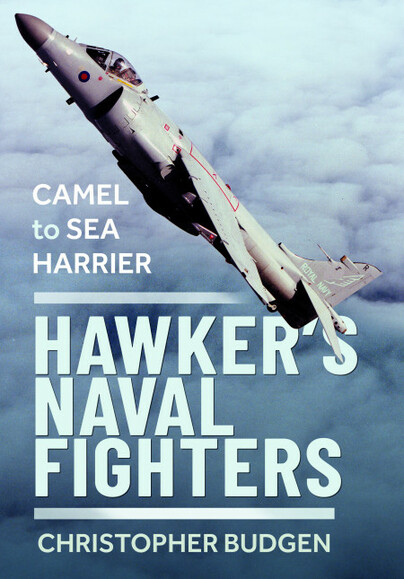
Hawker’s Naval Fighters (Hardback)
Camel to Sea Harrier
Imprint: Air World
Pages: 232
Illustrations: 16 colour illustrations, 110 mono illustrations
ISBN: 9781036102326
Published: 30th April 2026
(click here for international delivery rates)
Order within the next 5 hours, 22 minutes to get your order processed the next working day!
Need a currency converter? Check XE.com for live rates
In 1912, TOM Sopwith transitioned from running a flying school to manufacturing aircraft, leveraging his nautical interests to create designs purchased by Britain’s Royal Navy. The onset of the First World War solidified the Sopwith Aviation Company’s reputation with aircraft like the Sopwith Camel widely used onboard the ships of the day.
After the war, cancellations of government orders forced Sopwith Aviation into liquidation, However, a new company, the HG Hawker Engineering Company, was quickly formed, having been named after Sopwith’s test pilot, Harry Hawker. Throughout the 1920s and 1930s, Hawker produced designs that continued to be purchased by the Royal Navy, being used on the early aircraft carriers as well as the larger vessels of the fleet.
With the outbreak of the Second World War, the RN’s Fleet Air Arm found itself woefully unprepared for battle, having mainly biplanes and slow monoplanes with which to face the modern German fighters and bombers. As a temporary solution, Hawker adapted the Hurricane into the Sea Hurricane. Hawker later developed advanced piston-engine fighters like the Fury and its naval counterpart, the Sea Fury, which saw action during the Korean War and Suez Crisis in 1956. The Sea Fury was succeeded by Hawker’s first jet, the Sea Hawk, marking the Fleet Air Arm’s transition into the jet age. The Sea Hawk also served the Indian Navy during its conflicts with Pakistan.
Hawker’s successful Hunter, although primarily for the RAF, was used by the Royal Navy for land-based operations. Meanwhile, Hawker’s next design, the ground breaking Harrier, was ordered as the Sea Harrier; it saw action during the Falklands War, and, in due course, in the conflict in the former Yugoslavia and in Iraq.
From its earliest days then, the Hawker Aircraft Company has supplied winning designs to the Royal Navy and to many navies overseas, a feat that few other companies could match.
Register or Login now to post a review!
"There are a good number of images... An easy and enjoyable read..."
Aviation World, members magazine - The Air-Britain Trust Ltd
"I feel that the book is an engaging study of one of Britain’s most important aircraft manufacturers and its sustained relationship with naval aviation. For enthusiasts of Fleet Air Arm history, Hawker aircraft, or British military aviation in general, it makes a very worthwhile addition to the bookshelf."
Army Rumour Service Book Club
4 Stars
Read the full review here
About Christopher Budgen
CHRISTOPHER BUDGEN, growing up in the shadow of Hawker’s Flight Test Centre at Dunsfold in Surrey, entered employment there in the 1970s, shortly after the nationalisation of the aircraft industry and the company’s amalgamation into state-owned British Aerospace. During 21 years with BAe, as well as working on many Hawk, Harrier and Sea Harrier projects, he was also fortunate to be involved with Hawker’s superlative Hunter in the guise of a modified T.8M used in the development of the Sea Harrier for aircrew training. Chris’s previous book detailing Hawker history – Hawker’s Secret Cold War Airfield – is now followed by this work. As an archivist for some years engaged at Brooklands Museum and specializing in Hawker Aircraft Ltd and successor companies, Chris is well-placed to bring to light the previously unrecorded detail of Hawker’s fascinating history.


Pen and Sword Books
About Us | Contact Us | Delivery Information | Privacy Policy | Cookies | Affiliates | Terms and Conditions | Backlist | Mailing List | Reward Scheme | Review Request
© Pen and Sword Books Limited 2026. Registered in England No. 2527258.
Registered Office: 47 Church Street, Barnsley, S70 2AS.