


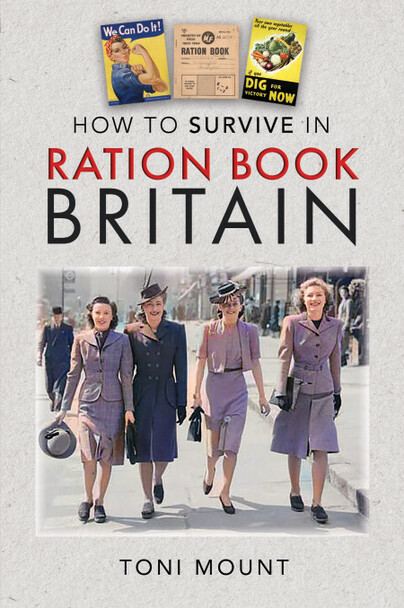
How to Survive in Ration Book Britain (Hardback)
Imprint: Pen & Sword History
Pages: 216
Illustrations: 50 mono illustrations
ISBN: 9781036117627
Published: 6th November 2025
(click here for international delivery rates)
Order within the next 6 hours, 42 minutes to get your order processed the next working day!
Need a currency converter? Check XE.com for live rates
This guide, How to Survive in Ration-Book Britain, will help the time-traveller who journeys back to mid-twentieth century Britain. From 1939 to 1945, the country is involved in World War Two and even after victory is achieved, Britain is cash-strapped and years of austerity follow. Throughout, food, clothing, fuel, furniture and items we take for granted today are rationed and people are scrimping, scraping and using their imagination just to get by.
As cities and towns are bombed, lives lost and homes destroyed, men are called to serve the country, children are evacuated and women are expected to ‘do their bit’ on the ‘Home Front’, maintaining the house as a place of welcome, boosting morale and stretching meagre food allowances to keep everyone fed and fit. This is no easy life yet people find lighter moments and ‘carry on carrying on’. Whatever the disaster, somebody will find a way to make tea. The English ‘cuppa’ is the answer to almost every problem. You have to admire their spirit.
Enjoy the experience as this book helps you to survive the hazards and live life to the full in Ration-Book Britain.
Register or Login now to post a review!
In this unique how-to historical guide to mid-twentieth century Britain, Toni Mount helps readers understand the ration book system and the years of austerity that followed the Second World War. Exploring changes in the ration system and the saving, recycling, and reusing strategies the British had to use to survive, the book contextualizes the challenges and shortages of the period and the incredible strength the British, during and after World War II, demonstrated in this period of economic scarcity. Detailed, fascinating, and unlike other books focusing on World War II, this book heavily focuses on the years after the war and the many challenges and shortages British citizens faced during and after the war. Offering incredible insights into the true value of the ration book, different rations, and changes in the rationing policy, Toni Mount really captures the hardships and ingenuity required to survive during this period of British history. Mount’s research really brings this book to life and hammers home the larger message of the book, and frequent readers of World War II fiction and nonfiction will definitely find this to be a useful reading companion. Informative and detailed, this is a fascinating new book about civilian life during World War II on the British home front.
NetGalley, Lily Amidon
Rating: 5 out of 5 stars
NetGalley, Annie Buchanan
How to Survive in Ration Book Britain is an all-ages readable look at life (and how it felt day-to-day) in wartime (1939-1945) England written by Toni Mount. Released 30th Nov 2025 and due out (US release) 10th Jan 2025 from Pen & Sword, it's 224 pages and is available in hardback and ebook formats. It's worth noting that the ebook format has a handy interactive table of contents and links throughout.
The author takes an actively engaging point of view with this daily-life vignette - the reader is a time-traveler heading to England during the straitened circumstances under wartime bombing to study and experience life. What should they expect? What will they experience? What's food like? How does the culture differ from the modern day?
Chapters are arranged thematically by subject: aspects of daily life (housework, laundry, costs, housing), food (rations, calories, shopping, growing your own food, cooking, eating away from home), health & medicine and safety, jobs and working, clothing, social aspects, supporting the war effort, assorted other issues (pets, blackout, misdirection and sabotage aimed at the enemy, recycling, and life after war (austerity). The book is meticulously annotated and the chapter notes will provide a wealth of sources for further reading. There's also an abbreviated bibliography and cross-referenced index.
The book is modestly illustrated throughout with period illuminated pages showing scenes from domestic life, implements such as eating utensils and tools, and drawings of famous (and unknown) people going about their daily lives.
The fact that the book is layman accessible and engagingly easy to read will make it a very good choice for school or library acquisition. I would recommend it for re-enactors as well, as there are a number of good illustrations for copyable tools, fashions, etc.
Five stars.
Rating: 5 out of 5 stars
NetGalley, Kevin Manley
This charming book will find a range of enthusiastic readerships, differentiated largely by age. For those who lived through WW2, and were old enough to remember the details of life in those six alarming years, it will be a poignant reminder of people and events. For those, like me, born in the 1940s, thee is still much that is etched in memory. I still remember my ration card - eventually (and regrettably) a simple plaything and tossed without a thought for future mementoes. Rationing was something that children were certainly aware of - sweets, for sure, but also the many things that we take for granted today. Moving swiftly through the years to the present, there are now several generations who, as schoolchildren, have been taught about the home front in the Second World War, and for whom this book will fill some gaps and provoke an interest in those, now distant, days.
Toni Mount does a good job in conjuring up the atmosphere of the wartime years, as well as providing the reader with many facts and anecdotes that enliven the cold statistics. At first I thought the style a bit patronising or false, but then realised that it almost captured the tone of a government information broadcast or a Pathé newsreel, so a good choice after all.
In summary, this is a well conceived and executed sketch of life in wartime Britain and should find an enthusiastic audience in different generations.
Strongly recommended
Rating: 5 out of 5 stars
NetGalley, Miranda Yeung
A great and detailed book about the WW2 time in the UK with the ration book. It's a special and unique content! This is such a must-read book for those who would like to know more about the war time lives.
This book was fascinating to me because my mother was a nurse in England during WW2 and she had told me many stories about how everyone had to sacrifice for the war effort. This book has lots of info and pictures about how life was like in England. Everyone had a ration book for food, clothing etc during the war and even for years afterwards as England tried to recover from the devastating effect to their country after the war. There are many first hand accounts , interviews etc which help you get a feel for the time period . Great historical read!
NetGalley, Mary Cummins
Rating: 5 out of 5 stars
NetGalley, Ruth Rousseau
How to Survive in Ration Book Britain, by Toni Mount, is a manual for the time-traveler visiting Britain in the mid-twentieth century.
I greatly enjoyed reading about a bleak, yet strangely hopeful time in history told humorously as a manual of instructions for a time-traveler.
Rating: 5 out of 5 stars
NetGalley, Terri Wangard
Written as a guide to a time traveler visiting WWII Britain, this is chockful of fascinating tidbits of things large and small having to do with life in a warworn country. Such things as: Neatly patched, carefully darned and revamped clothes earn you more respect with clothing rationed than wearing new clothes. However, nothing lowers the spirits worse than a dowdy-looking female, so wear makeup. Accept with enthusiasm whatever the butcher has left for you, even if it’s a whole sheep’s head complete with eyeballs and long, brown teeth. Dried potato peelings make good kindling.
Aircraft factories manufactured prefabricated, single-story homes using recycled aluminum airframes from crashed planes. These helped replace the 200,000 houses destroyed by bombing. The prefabs had indoor plumbing, bathrooms and modern kitchens, which the bombed-out houses they replaced often did not.
Land girls grew chamomile, not for making tea but to make turf lawns. Chamomile was far more hard-wearing than grass and the idea was to cover airfields in chamomile turf to disguise the runways. From above, to enemy pilots, they appeared to be nothing more than green fields.
And on it goes. Life today is so soft.
Toni Mount’s How to Survive in Ration Book Britain is a highly enjoyable consideration of various aspects of British life from 1939 to the early 1950s. It assumes that the reader is about to use a time-machine to visit Britain during that period, probably during WWII, and offers appropriate advice. The chapters address questions such as:
NetGalley, Colin Edwards
- Where would I live?
- What would I eat?
- How can I keep healthy and safe?
- What jobs could I do?
- What would I wear?
- How could I keep calm and carry on?
- How could I do my bit to support the war effort?
- When will it end?
“Where would I live?” explains how new houses built during the inter-war period differed from Victorian/ Edwardian ones because of the disappearance of servants. It uses an imaginary dialogue between an electricity showroom salesman and the time-traveller in the guise of a 1930s’ housewife. The author uses several such dialogues in various chapters, some of which are poignantly with the author’s late mother. I’m not a fan of invented material in non-fiction books, but I have to admit that Toni Mount does it very well and overcame my reservations. Mount explains the jobs that a housewife would be expected to tackle, e.g. the daily cleaning of the front entrance (path / steps / door) and the weekly laundry. This chapter also discusses the varied experiences of evacuees and refugees.
The period chosen is one during which many aspects of life were constrained and governed by rules like no other period in British history. Even the COVID lock-downs didn’t come close. Although much of the book discusses the six years during which we were at war, we are remined that rationing didn’t end until July 1954 – it extended long after the war.
Mount uses an excellent variety of sources to back up her points: diaries – both private and Mass Observation ones; oral histories such as old conversations with her mother; magazines; government pamphlets; and other published works. The chapters are a fine synthesis of detail taken from this source material and Mount’s analysis and conclusions from analysing it. If you have an interest in the period, I recommend this book.
How to Survive in Ration Book Britain really puts you in the shoes of that everyday life, in real detail from how people spoke to recipes to pictures of ads and leaflets, homes, and the people living through it all.
NetGalley, Jessica Moran
If you have any interest in WW2 life and how people survived, pick this up!
"A survey is conducted in 1942 by women asking others from all backgrounds about how they cope with their periods or on 'certain days', as an advert coyly phrases it [...]. Some women make their own towels from soft, absorbent rags – apparently the shirts of German prisoners-of-war officers make excellent towels and come complete with little swastika designs: the perfect way to insult the enemy. Others buy them from drapers' shops or chemists but there's a lot of embarrassment about having to ask a male assistant for them – in the days before selfservice – even though sanitary products are sold in discreet, plain packaging without anything to denote what they are. The results of the survey remain secret, for government eyes only, until 1972." (loc. 705*)
NetGalley, Catriona Maryon
Picture this: It's the 2020s, and you've agreed to test out your friend's time machine. Your friend is a would-be inventor, emphasis on *would-be*, and you never expected it to work...but here you are, suddenly in 1940s Britain. The country is at war, daily life looks markedly different than your 2020s norm, and you're afraid of what might happen if you let on that you're not from this time and place. But good news! Your friend, who of course never doubted the time machine's success, has stashed a copy of "How to Survive in Ration Book Britain" in your rucksack.
Mount's premise (which I've taken some liberties with above, hah) is so clever that I was just kind of delighted most of the way through the book. As promised, this is a guide to daily life in wartime Britain, from clothing styles (and laws!) to types of bomb shelter and how to access them to, of course, using your ration book...as a local or as a newcomer. (Oddly, despite having read many dozens of books set in WWII Britain, I'd never given all that much thought to how ration books worked.) I didn't know that even new furniture was rationed! I spent some time struggling to imagine just how all of this rationing would go over today, and obviously it's not impossible but it does feel very of a different time.
Two ideal readers for this one: First, anyone who's just chronically, perpetually, fatally curious and loves a good premise. (That's me!) And second, those doing their own writing set in World War II Britain or who are otherwise doing research involving the time and place. This would be a great resource for historical fiction writers and for high school students alike—so much research, already in one place! If you don't fall into one of those two groups, this might have limited value for you, but I'm now eager to read Mount's similar book about medieval England.
Rating: 5 out of 5 stars
NetGalley, A D
Equal parts practical and playful, this guide shows how rationing shaped everyday life long after the war ended. Food, clothing, fuel, and furniture were scarce, but imagination was abundant.
Rating: 5 out of 5 stars
NetGalley, Cozy Book Reviews
This is a fascinating book set in Britain between 1939 to 1952. The author so aptly describes life during rationing and how the people survived. The food is so interesting and good advice for todays thrifty kitchen. I enjoyed that the author focused on how women stood together and helped their families and community with sharing ideas , recipes, gardening and entertainment.
A must read. This book reminds us of necessary sacrifice and resourcefulness in difficult times of incredibly strong people.
Rating: 5 out of 5 stars
NetGalley, Carren Joye
The book operates on the premise that you are going back in time to live in Britain during the World War II and post-war eras, and it serves as a preparation guide for that experience. I absolutely loved it! The author thoroughly covers everything you would want to know about Britain between about 1939 and 1952, including details on food, clothing, entertainment, and health.
The content does lean slightly toward the woman's viewpoint, addressing concerns such as stocking availability; however, this is appropriate given that women largely managed life in Britain during the war years.
The author maintains a consistently lighthearted and conversational tone, making the reader feel as if they are speaking face-to-face. I highly recommend reading it!
Rating: 5 out of 5 stars
NetGalley, Stephen Dale
Life in Britain from the beginning of WWII in 1939 to the end of rationing in 1954. How we lived, dressed and eat at a time when doing so was difficult and times austere. Fairly lighthearted but informative and it brought back memories as a very young child in those later years but will inform those younger readers of just how it was like. Would many of today living in relative 'luxury' have liked to have been struggling in those years?
Rating: 5 out of 5 stars
NetGalley, Megan Beech
I've always been fascinated by history in particular food sciences in regards to the origin of recipes in times of desperation. The way the British handled the food ration situation during WWII helped to save the nation from starvation. While this book the takes a deep dive into how Britain survived one of the most devastating events in modern history, the author includes a bit of humor and being lighthearted in certain moments.
I've really enjoyed this book and recommends it to anyone who is wanting to learn about WWII that focuses more on the home front instead of the battlefields, ways to ration food in times of uncertainty, and survival.
Rating: 5 out of 5 stars
NetGalley, heather bennett
Very good book, it took you back to that harrowing time of severe food insecurity that was being felt with on the home front of Britain during the years of WW2.
Rating: 5 out of 5 stars
NetGalley, Hayley Remmington
My daughter and I love Toni Mount’s ‘How to Survive’ books and this latest was no exception! ‘Ration Book Britain’ is lighthearted, humorous but also respectful and incredibly informative. The hilarious GI Handbook excerpts were one of our favourite inclusions. We so hope there are more How to Survive books to come!
Rating: 5 out of 5 stars
NetGalley, Brenda Carleton
How to Survive in Ration Book Britain by Toni Mount is one of the most captivating and illuminating books I have read in awhile, and I read a LOT of Nonfiction. My attention was spellbound by the wit, cleverness, historical tidbits and eclectic topics written in a friendly and conversational tone. The author talks to the reader, the time traveler, about what life in Britain was like during World War II with the focus on enterprise, economy, and ingenuity of civilians (especially housewives) "doing their bit". During this horrific time in history, families were torn apart and men went to the front. The women suddenly had to make do with the little food and materials available. How they stretched practically nothing into something is nothing short of miraculous. Included are fascinating photographs. One of my favourites is of the women sitting on a pile of rubble enjoying her cuppa which gave her some soothing semblance of normalcy.
Putting sticky tape on windows to guard against broken glass, the removal of road and train station signs to thwart the enemy, recycling clothes, drying potato peelings for kindling, sending children to safety in the countryside, living in pre-decorated prefab homes, and ration details (the most detail I've ever read!) are just some of the intriguing topics discussed. Governments issued pamphlets on an array of tips such as sewing, recycling, gardening, and cooking were distributed to households with an emphasis of feeding young children, and only children, their full milk quota. Women took on dangerous jobs such as carrying messages and felling trees (Lumber Jills). Women dusted their legs with cocoa before pulling on stockings. Elbow patches became fashionable. Vogue issued sewing patterns for siren suits, paper was rationed with pages cut smaller with fewer pages for newspapers and magazines. Morale boosting was of utmost importance. Cooking fat from roasted meat became glycerin, bones were used as glue in plane construction, carrots were used in cakes (see also the recipes for Bible Cake and pet biscuits), postal workers kept mail safe under extreme conditions, and citizens were advised on what to do with pets. The last ration was not abolished until July 4, 1954, which was meat and bacon.
My expectations were exceeded in this wonderful, wonderful book. What a privilege to learn more about British households and their stoic keep calm, carry on attitudes during years of of turmoil and despair and the government's role in boosting spirits, hearts and minds with practicalities. There just isn't any way I could love this book more!
Rating: 5 out of 5 stars
NetGalley, Claire Smith-Simmons
This book was an easy read for me, I love this particular period in history and I was happy to dive into this well laid out book. The premise is that you are travelling back to this time period and the book will give you an overview of how to survive. It covers everything from money to food to jobs and how to interact with the locals.
It was chocked full of first hand accounts with snippets from their recollections. It was informative without being too in-depth, so I would recommend it to any reader and would find it useful to talk about with my son, as the chapters are easy to digest and form great discussion points.
The photos and illustrations were colourful and a perfect fit for each of the topics. Overall a fantastic book and one I will recommend.
Well researched. An interesting book. I would recommend it to people who like historical fiction. It's nonfiction, but reads like fiction. The vintage advertisements were memorable.
NetGalley, Laurel Zeisler
Rating: 5 out of 5 stars
NetGalley, Joanna Lai
This book is both informative and accessible. This book covers in History from an angle that feels almost immersive. It works like a Tardis teleporting you back to that era. I am definitely buying this one once it is out.
Rating: 5 out of 5 stars
NetGalley, Fernando Fernandez Jr.
A cuppa saves the day! A time-traveller in 1939-1948 would need this book! Rations for food, clothing, fuel, furniture and items we take for granted today, somethings even required I don’t need stretching resources but using your imagination. Enjoy this descriptive and thought provoking experience through the book as it helps you the time traveler to survive and live life to the fullest in ration book era England.
Rating: 5 out of 5 stars
NetGalley, Yvonne Strong
This book was a wonderful lot of fun, as well as being very informative. It covers major wartime topics such as rationing, blackout, air raids, evacuees, and conscription as well as more mundane things like how to celebrate Christmas and what to feed your pets. The premise is that the reader is a time traveller visiting Britain during World War II, and the book explains what to expect while maintaining an air of surprise and bemusement as well as liberal helpings of humour. Wartime Britain seems to be another universe from the perspective of the 21st century, but those of us with parents or grandparents who lived through the war will find a lot to connect with.
Rating: 5 out of 5 stars
NetGalley, Maggie Palner
A clever piece of writing that gives the reader an idea of what it was like to actually live during World War Two in Britain. It was compelling, entertaining and educational.
Rating: 5 out of 5 stars
NetGalley, Nicola Wilton
Absolutely loved this read and found it so entertaining. It’s not only chock full of interesting information but also written in such a way that keeps you easily engaged.
Ever wondered how you would fit into wartime Britain? How would you live, what jobs would you get, how do you get about with the rations and your place in society? Think no further. I had fun imagining how I would slot into this time although of course, it was such a tumultuous place to be. With bombs, uncertainty and the everyday stresses of war, it wasn’t an easy life.
It’s the perfect book for not only a history buff but for anyone who wants to know more about this time and read an entertaining non-fiction. I really enjoyed it.
Rating: 5 out of 5 stars
NetGalley, Katie C
This book is a treasure trove of information for history buffs, historical fiction novelists, and people who want to live a more sustainable, lower-consumption lifestyle. It is especially engaging due to its clear organization and unique tone (it’s addressed to “the time-traveler”). It certainly made me feel grateful to live in the time and place that I do!
Rating: 5 out of 5 stars
NetGalley, Jill Speedman
What an interesting book! I was so curious to learn about this time period and I found this book to very informative and helpful understanding it.
I loved this! A great read for DIY-ers, feminists, and history buffs. The mood is light and readable considering the topic - the fatalities of wartime (and other sad bits, like sending kids to the countryside for safety) are respected but not the focus of the book. The book lives up to its promise: here’s what to know about surviving and thriving in WW2 England, as if you were a time traveler. The author’s personal photos and tidbits from her mother are well-placed and sweet. The history really comes to life this way - how would you prepare your meals, talk (or not talk!) to neighbors, or entertain yourself? So many details about how people got creative, like decorating their required gas mask bags (which may have actually contained their lunches.) Will absolutely check out the author’s other titles and suggest this book to my shoppers.
NetGalley, Novie Nim
About Toni Mount
Toni Mount researches, teaches and writes about history. She is the author of several popular historical non-fiction books and writes regularly for various history magazines. As well as her weekly classes, Toni has created online courses for www.MedievalCourses.com and is the author of the popular Sebastian Foxley series of medieval murder mysteries. She’s a member of the Richard III Society’s Research Committee, a costumed interpreter and speaks often to groups and societies on a range of historical subjects. Toni has a Masters Degree in Medieval Medicine, Diplomas in Literature, Creative Writing, European Humanities and a PGCE. She lives in Kent, England with her husband.

Pen and Sword Books
About Us | Contact Us | Delivery Information | Privacy Policy | Cookies | Affiliates | Terms and Conditions | Backlist | Mailing List | Reward Scheme | Review Request
© Pen and Sword Books Limited 2026. Registered in England No. 2527258.
Registered Office: 47 Church Street, Barnsley, S70 2AS.