


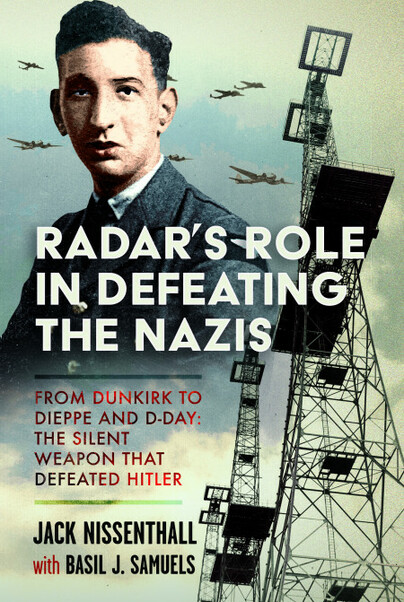
Radar's Role in Defeating the Nazis (Hardback)
From Dunkirk to Dieppe and D-Day: The Silent Weapon That Defeated Hitler

Pages: 224
Illustrations: 16 mono illustrations
ISBN: 9781036198244
Published: 30th August 2026
(click here for international delivery rates)
Order within the next 5 hours, 36 minutes to get your order processed the next working day!
Need a currency converter? Check XE.com for live rates
There was a silent battle fought between the Allies and the Third Reich during the Second World War – the war of the airwaves. As a radar expert, Jack Nissenthall was at the very heart of the development of radar detection and jamming.
From as early as 1936, Jack was involved in the development of radar as part of the team led by Robert Watson-Watt which resulted in the Chain Home system so vital to the RAF’s success during the Battle of Britain. He then found himself as a key member of the British and Canadian forces which undertook the infamous raid on Dieppe in August 1942. His role was to break into the Pourville Radar Station to gain vital intelligence on the new German Freya radar. Though unable to enter the station, Jack was able to cut the site’s telephone cables, which meant the German operators had to communicate by radio. These transmissions were intercepted by listening posts in England, through which much was learned. After returning from Dieppe, Jack continued his vital work on radar.
It is Jack’s opinion that while there are countless books on the D-Day landings and the fighting that followed, little attention has been paid to the achievements of radar. In this narrative, Jack gives the reader an insight into the inventiveness of those involved, how they sought answers to the thorny problems of an amphibious attack on heavily defended coast, and how by careful planning, absolute secrecy, ingenuity, collaboration, cunning and deception they achieved what most thought was impossible.
As Jack wrote about the Normandy landings, ‘If a miracle occurred on the morning of 6 June 1944, it was one very carefully planned by the Allies. By finding solutions and thoroughly testing their designs they made it happen. At long last I can tell the whole story.’
There are no reviews for this book. Register or Login now and you can be the first to post a review!
About Jack Nissenthall
JACK NISSENTHALL was born in 1919 of Jewish Polish parents in the East End of London. At an early age he became fascinated by the new science of electronics. He worked at EMI assembling, installing and maintaining television sets in pre-war London. While working at EMI, he was asked to volunteer at Bawdsey, aiding Watson-Watt’s team. This forged the lifelong link with radar and the scientists who developed it.
About Basil Samuels
Retired architect BASIL SAMUELS is the son-in-law of Jack Nissenthall, and the son of Dr Leslie Samuels MC. Fascinated by their stories, he has for many years had a great interest in the Second World War and is an avid reader of its history. His other interests are ceramics and calligraphy. He is married to Linda Nissen Samuels, an artist and author.




Pen and Sword Books
About Us | Contact Us | Delivery Information | Privacy Policy | Cookies | Affiliates | Terms and Conditions | Backlist | Mailing List | Reward Scheme | Review Request
© Pen and Sword Books Limited 2026. Registered in England No. 2527258.
Registered Office: 47 Church Street, Barnsley, S70 2AS.