


Preorder
Google Books previews are unavailable because you have chosen to turn off third party cookies for enhanced content. Visit our cookies page to review your cookie settings.
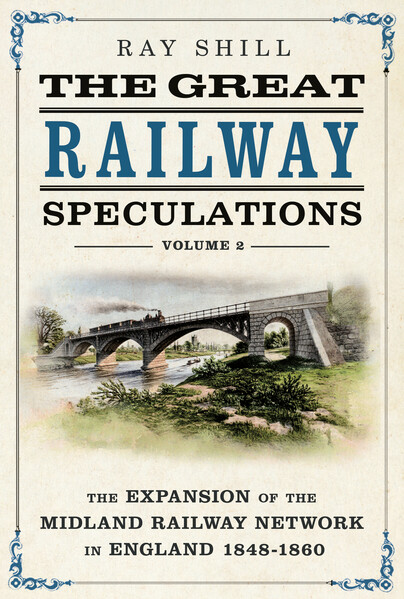
The Great Railway Speculations (Hardback)
Volume 2: The Expansion of the Midland Railway Network in England 1848–1860
Imprint: Fonthill
Pages: 176
Illustrations: 94 black and white
ISBN: 9781036157005
Published: 30th September 2026
Pages: 176
Illustrations: 94 black and white
ISBN: 9781036157005
Published: 30th September 2026
You'll be £17.60 closer to your next £10.00 credit when you purchase The Great Railway Speculations. What's this?
+£4.99 UK Delivery or free UK delivery if order is over £40
(click here for international delivery rates)
Need a currency converter? Check XE.com for live rates
(click here for international delivery rates)
Need a currency converter? Check XE.com for live rates
The establishment of the core railway network in the Midlands by the mid-nineteenth century led to further expansion and the creation of four principal operators: Great Northern Railway, Great Western Railway, London & North Western Railway and the Midland Railway. A host of new independent companies also appeared and various joint lines and railways remained under independent ownership, but the operation of trains was in the hands of one of these four main concerns.
It was a period marked by intense rivalries, especially between the Great Western Railway, a broad-gauge operator, and the other companies which operated on standard gauge. In a short-term compromise, the mixed gauge was created, enabling the Great Western Railway to reach the West Midlands. Mergers and amalgamations were another key aspect of the period, with authorised routes being continually absorbed by the principal operators. Their shareholders profited from these takeovers, but there were plenty of schemes in which investors lost money, especially those that were authorised but, for various reasons, never happened.
This second volume of The Great Railway Speculations explores a period of outstanding progress in civil engineering and locomotive design, when the four principal operating companies expanded their networks and consolidated their operations to provide an improved public service for passengers, freight and parcels traffic. Opportunities to make astonishing returns on investments remained as rich as ever, and yet there were also many projects that ended in failure and ruin.
Other titles in Fonthill...


Pen and Sword Books
About Us | Contact Us | Delivery Information | Privacy Policy | Cookies | Affiliates | Terms and Conditions | Backlist | Mailing List | Reward Scheme | Review Request
© Pen and Sword Books Limited 2026. Registered in England No. 2527258.
Registered Office: 47 Church Street, Barnsley, S70 2AS.