


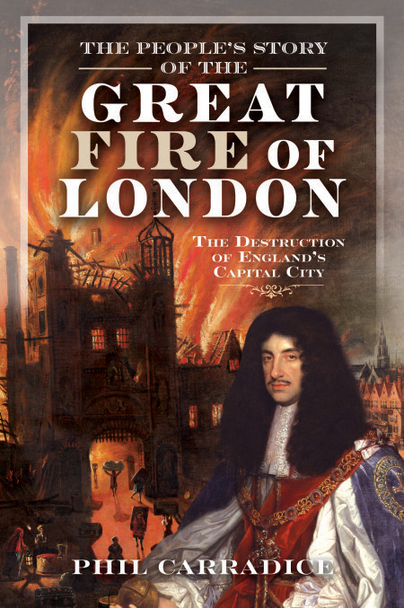
The People's Story of the Great Fire of London (Hardback)
The Destruction of England's Capital City
Imprint: Pen & Sword History
Pages: 176
Illustrations: 30 mono illustrations
ISBN: 9781036116972
Published: 15th October 2025
(click here for international delivery rates)
Order within the next 5 hours, 21 minutes to get your order processed the next working day!
Need a currency converter? Check XE.com for live rates
| Other formats available - Buy the Hardback and get the eBook for £1.99! | Price |
|---|---|
| The People's Story of the Great… eBook (16.1 MB) Add to Basket | £6.99 |
The Great Fire of London which destroyed much of England's capital city in the autumn of 1666 was one of those seminal events that stand out in history, enthralling, fascinating and yet repulsive in the damage and destruction it caused.
The story of the fire, which began in the early hours of Sunday 4th September, has been told many times. Phil Carradice's new re-telling of the disaster is different in focusing mainly on the people involved. From Thomas Bloodworth, the inept Lord Mayor, to diarists Samuel Pepys and John Evelyn, from the supposed arsonist Robert Hubert to Puritan foretellers of disaster like Humphrey Smith, these people witnessed the Great Fire first-hand. Their views and descriptions make compelling reading.
The book does not necessarily give reasons and causes for the fire. Rather it explores how people responded to what was, in reality, the greatest challenge they had faced in their lives. Heroes, cowards and villains are presented in illuminating fashion. King Charles and his brother James, the Duke of York, emerge with nothing but credit, leaving you to wonder how and why James switched from hero of the hour to a position of villain once he became king on the death of his brother.
The upsurge of anti-Dutch and French emotion, the panic which seized the population as they tried to flee the stricken city, the breadth and width of the disaster, along with the gradual re-building of London, are all dealt with in Phil Carradice's easy and elegant style. Historical facts and individual characterisation make this book a compelling and accurate read.
Register or Login now to post a review!
Rating: 5 out of 5 stars
NetGalley, Andrea Romance
This meticulously researched account reveals the Great Fire of London through a fresh lens, focusing on the personal stories of those who witnessed the devastation. It explores the reactions of key figures—from King Charles II to ordinary citizens—revealing their courage, failings, and the complex emotions of a city in crisis. Written in an elegant and accessible style, this book offers a compelling and authoritative portrayal of a defining moment in London’s history.
Rating: 5 out of 5 stars
NetGalley, Susan Johnston
I have always felt that history is the story of real people. Others may disagree that. It is the recitation of minutiae, of facts and figures, but not the author. Right up front he states that his purpose is to tell the story of what happened in the words of those who lived it. Naturally, the vast bulk of what has survived through time are the words of the great and powerful. Their words from Charles II to the prolific Samuel Pepys to the sadly inept Lord Mayor are repeated here. But so are the thoughts and words of many of the common folks and it is often through their eyes and words that we can capture the full scope of what happened in early September 1666 but also what happened thereafter as people strove in many cases just to survive.
The old and the infirm, of course, were the largest group of victims. I have always thought the number of dead counted has been an unbelievably low amount. To have such devastation and only have a handful of corpses was beyond common sense. The explanation for why this number has been so low and what the more realistic count might be is covered in the book. That was not the only thing that was a revelation. I like when I can read a book on a subject of which I consider myself knowledgeable and still be amazed. Well done. Well done indeed. Five purrs and two paws up.
Rating: 5 out of 5 stars
NetGalley, Lisa Sanderson
It’s easy to imagine that you are right in the thick of this terrible disaster when you read this book! Phil Carradice paints a vivid picture of the terror and destruction that the fire caused, and also examines the causes and the aftermath of the event thoroughly. He also discusses the people involved, with extracts from such famous people as Samuel Pepys and John Evelyn.
The heroism of King Charles II and James, the Duke of York, shines while the Mayor Thomas Bloodworth hardly did anything because he was worried about having to pay compensation to owners of destroyed houses. He was a weak and ineffective leader. It’s fascinating to read about the royal brothers’ roles.
Rating: 5 out of 5 stars
NetGalley, Yvonne Strong
This book is really fascinating. It gives a detailed account of the origin and development of the fire, as well as the conditions that led to such a massive conflagration and the practical and emotional issues that people had to deal with in the aftermath. In many ways, the fire was a demarcation between medieval and modern London, and the decision to modernize the post-fire city while retaining at least some of the medieval infrastructure has led to a city whose history is still apparent. Architects wanting to remake the city in their own image could have destroyed much of London’s heritage, and we should be grateful that wiser heads prevailed, even if their motivation was largely economic.
The aftermath of the fire takes up the final third of the book and, while very interesting, is also somewhat depressing. The need to point the finger of blame at traditional enemies (foreigners and Catholics in this case) rather than looking for the real culprit, the outbreak of conspiracy theories, the descent into superstition and hysteria, and of course the crime and profiteering are depressingly familiar to anyone watching the news these days. However enlightened people fancy themselves to be nowadays, human nature doesn’t change.
This book is a must-read for anyone visiting London and wanting to understand the history behind the geography.
Rating: 5 out of 5 stars
NetGalley, Carren Joye
What a great read! I previously only knew the basic facts about the Great Fire of London, so this book was incredibly interesting.
As the title suggests, the author focuses on the people involved, but not just the great and important. While we often read about figures like King Charles II and the Duke of York, this book also highlights the actions of the cowardly mayor and everyday citizens during and after the fire. I never thought about the ordinary people who worked so hard to put out the fire, those who tried desperate measures to stop its spread, and the families who had to survive afterward without homes or workplaces and yet still persevere. Their true stories are truly compelling. I highly recommend this book.
Rating: 5 out of 5 stars
NetGalley, Suzann Maddox
The information provided by Phil Carradice was very detailed and educational. It is clear Mr. Carradice did his research! Well done!
Rating: 5 out of 5 stars
NetGalley, Rebecca Stewart
Definitely would recommend this book. Haven't read much about this topic before and what little I had in the past was years ago. This book was so interesting!
An interesting look at the Great Fire of London and how it affected the ordinary people who lived through it, not just the royals who some thought were responsible.
NetGalley, Caroline Palmer
About Phil Carradice
Phil Carradice is a well-known writer and historian with over 60 books to his credit. A poet, story teller and broadcaster, his most recent books are The Cuban Missile Crisis (Pen and Sword), The Call Up (Fonthill) and the novel Stargazers for Accent Press. He is a regular broadcaster on BBC Radio and TV, presents the BBC Wales History programme 'The Past Master' and is widely regarded as one of the finest creative writing tutors in Wales.
Great Fire of London
2nd September 1666
Great Fire of London begins at 2am in Pudding Lane, 80% of London is destroyed


Pen and Sword Books
About Us | Contact Us | Delivery Information | Privacy Policy | Cookies | Affiliates | Terms and Conditions | Backlist | Mailing List | Reward Scheme | Review Request
© Pen and Sword Books Limited 2026. Registered in England No. 2527258.
Registered Office: 47 Church Street, Barnsley, S70 2AS.