


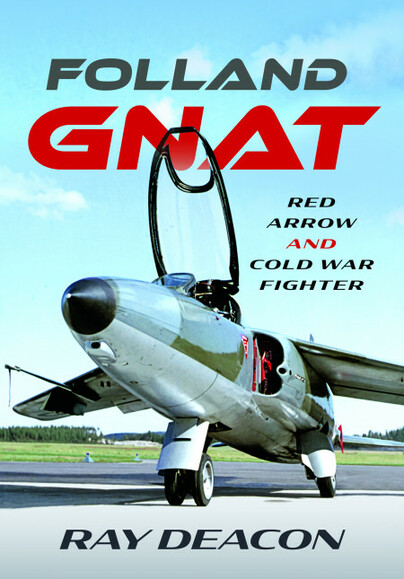
Folland Gnat (Hardback)
Red Arrow and Cold War Fighter
Imprint: Air World
Pages: 240
Illustrations: 80 mono illustrations, 70 colour illustrations
ISBN: 9781036148416
Published: 30th August 2028
(click here for international delivery rates)
Order within the next 5 hours, 22 minutes to get your order processed the next working day!
Need a currency converter? Check XE.com for live rates
Folland Gnat: Red Arrow and Cold War Fighter presents an illustrated and factual record of the challenges faced by William Petter, chief designer at Folland Aircraft, in gaining recognition for his cheap, lightweight fighter concept. He saw it as a viable alternative to other front-line interceptors, such as the Hunter and Swift, under development in the early 1950s. Petter called his fighter the Gnat, although ‘pocket rocket’ became a popular alternative.
Unperturbed at having failed to attract interest from the RAF or Air Ministry, Petter decided to proceed with a privately-funded prototype powered by an Armstrong-Siddeley Viper engine to prove his design’s viability. Named Midge, the aircraft made its maiden flight at Boscombe Down in August 1954 and performed well. In July of the following year, the prototype Gnat made its maiden flight powered by a more powerful Bristol Orpheus engine. The Ministry of Supply finally began to offer support, placing an order for six development Gnats for trials work, but no production orders were forthcoming.
Conversely, the Indian Government was very impressed, placing orders for a batch of Gnat fighters, followed by licenced-manufacture of several hundred examples in India. The Gnat went on to serve the country well in two wars with neighbouring Pakistan. Recalled in detail are the shooting-down of a number of Pakistani F-86 Sabres by the Gnat leading to the legendary sobriquet, ‘Sabre Slayer’. At the other end of the spectrum, Finland decided to expand its air force with the purchase of a squadron of Gnat fighters.
Anticipating a requirement for a Vampire T.11 replacement, Petter wasted no time in preparing designs for a tandem-seat trainer based on the Gnat fighter, his efforts being rewarded with orders for a production variant for the RAF. There are also detailed accounts of the aircraft’s impressive period displaying with the famous Yellowjacks and Red Arrows aerobatic teams.
Register or Login now to post a review!
"The Folland Gnat by Ray Deacon fills a gap in post-war UK military aircraft histories. The Gnat was designed for the RAF as a lightweight fighter but was rejected, however it achieved significant export sales to Finland and India, where it was involved in the shooting war with Pakistan, acquitting itself well against Sabres of the Pakistani Air Force. All was not lost as the two-seat trainer variant assured the Gnat’s fame as the initial mount of the Red Arrows as well as its intended role as a pilot trainer. After withdrawal from flying, quite a few served as maintenance trainers and a number eventually managed a second flying career in private hands in the UK and the USA. All of these aspects, and projected developments, are fully described in Ray’s copiously illustrated book and supporting appendices including full serial number histories. This book was an enjoyable read and thoroughly recommended."
The Air-Britain Trust
About Ray Deacon
Born in Farnborough, Kent, in 1942, Ray grew up in South-East London and went on to study at William Penn Technical School before joining the Royal Air Force. On passing out in December 1959, he was posted to the Central Flying School (CFS), before arranging an exchange with a fellow radio mechanic on the DH Vampire T.11 line. Much to Ray’s delight, the squadron was also responsible for handling Hawker Hunters whenever they paid visits from their operating base at RAF Kemble. The opportunity to work on the ‘queen of the skies’ kindled a passion that has remained with him ever since.
His career in the Royal Air Force involved service in Aden, where he lived for two years, working on a busy front-line operational squadron equipped with the more potent ground attack and fighter reconnaissance versions of Hawkers impeccable aircraft. He also worked at RAF Little Rissington on the Varsity squadron, a posting that was followed by time spent at the CFS Gnat Base Engineering Team, where he became familiar with the Gnats operating with the Red Arrows Aerobatic Team and 4 Squadron CFS.
He left the RAF in May 1967. A year with the RAE at Farnborough was followed by a 25-year career in computing with IBM. Early retirement enabled Ray to dedicate his free time to carrying out in-depth studies of his favourite subjects; RAF Little Rissington during the CFS years and Hawker Hunter operations in the Middle East.





Pen and Sword Books
About Us | Contact Us | Delivery Information | Privacy Policy | Cookies | Affiliates | Terms and Conditions | Backlist | Mailing List | Reward Scheme | Review Request
© Pen and Sword Books Limited 2026. Registered in England No. 2527258.
Registered Office: 47 Church Street, Barnsley, S70 2AS.