


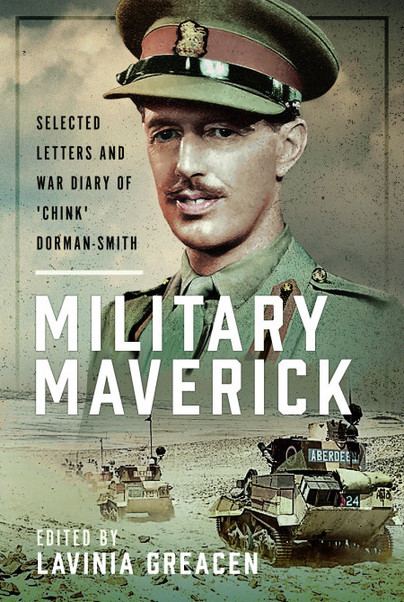
Military Maverick (Hardback)
Selected Letters and War Diary of 'Chink' Dorman-Smith
Pages: 328
Illustrations: 8 mono illustrations
ISBN: 9781036102272
Published: 29th November 2024
(click here for international delivery rates)
Need a currency converter? Check XE.com for live rates
| Other formats available - Buy the Hardback and get the eBook for £1.99! | Price |
|---|---|
| Military Maverick eBook (9.3 MB) Add to Basket | £6.99 |
A follow-up to the best-selling biography ‘Chink’, this selection from private letters and intimate war diary has the impact of a fresh ‘no holds barred' autobiography. Dorman-Smith the man – flesh and blood – comes alive here on the page.
Provocative, irreverent, caustic and witty, his disdain for Churchill – and for the Establishment in general – increases as his military career unravels. Egotistical? Yes. Arrogant? Certainly. His own worst enemy? Perhaps. But Dorman-Smith’s grasp of tactics and strategy was unsurpassed, as his exchanges with Basil Liddell-Hart demonstrate.
Full of contradictions, he was externally reserved and inwardly super-sensitive. Growing up in style in Ireland and educated at public school in England, his religion was Catholic and he scorned any Anglo-Irish tag. His private life while rising up the Northumberland Fusiliers proved colourful, while a brief dalliance with the IRA in the 1950s never endangered his vow of silence over the Enigma/Ultra secret.
This book gives a marvellous picture of personal war experience in two world wars, from RMC Sandhurst and life in the trenches, via the Staff College to high command in Egypt and India between the wars, until service in North Africa under Wavell began, and working side by side with Auchinleck at the First Battle of El Alamein. That would lead to confrontation with Churchill and Brooke, and subsequent breakout from Anzio under fire. Readers will know what it was like to survive the trenches, to serve in HQ as crises arose, and to have command involving losses - the reality of war is dramatic and moving.
The First Battle of El Alamein, fought under Auchinleck in the emergency that dangerous summer of 1942, was to be followed within three months by Montgomery’s celebrated battle and its consequent fame. The important argument of Military Maverick, however, is that First Alamein was the real turning point in the Desert War, and that makes Dorman-Smith’s account even more valuable.
The letters and diary entries are linked by commentary and explanation by the editor Lavinia Greacen, and by the military historian John Lee.
Register or Login now to post a review!
"This volume was one of the notable books in our discipline to appear last year, and its publication has justly attracted attention."
The Irish Sword - The Journal of the Military History Society of Ireland - Summer 2025
‘In the current number [of Irish Catholic] I gave "Military Maverick" as my favourite read of 2025'
Charles Lysaght
The name of Brigadier Eric Dorman O’Gowan, of Cavan, whose letters are the subject of this volume, is found in 1951 in the first published list of members of the Society. He was then living at Bellamont Forest, the beautiful house he had inherited from his father. At that stage of his life, having changed his name from Dorman-Smith to Dorman O’Gowan, not only was he corresponding with old friends like Ernest Hemingway, whom he had met in Italy in 1918, and British military colleagues from the two wars, but with Irish liberal luminaries such as Hubert Butler and Owen Sheehy Skeffington, and with ‘Eoin MacNeill’ [might this have been Eoghan O Neill?] of the Military College at the Curragh, where he had lectured. The young military historian Corelli Barnett was invited to stay at Bellamont, where the two got on well. Minded to assert his Irishness to another prominent military historian, he wrote a letter to Liddlell Hart than began ‘A Basil, a cara’. He stood (unsuccessfully) in a local election for Clann na Poblachta, wrote letters to newspapers advocating a United Ireland, and allowed the I.R.A to exercise in the grounds of Bellamont. He engaged solicitors to prepare a libel action against Churchill (a subject on which Charles Lysaght is on the verge of publishing an account in a volume of legal essays).
Kenneth Ferguson, The Irish Sword
Having married, for the second time, after the war, he had a young family under his roof in Bellamont, a son and daughter. His son Christopher (who went on to be a U.C.D. graduate, a Northumberland Fusilier, and a judge) inherited his father’s papers and made them available to his biographer. In March 2020 he was due to give a lecture to the Society on his father’s role in the first battle of El Alamein. Covid frustrated the lecture, but the event was rescheduled as an internet presentation. Such are the circumstances that place Eric Dorman O’Gowan (1895-1969) in an Irish context. He is an intriguing figure, and one squarely within the Society’s field of interest.
The focus of this volume of letters is one of the grand British themes of the Second World War, the war in the Desert. Dorman-Smith’s career reached its high point under Auchinleck at the time of the first battle of El Alamein. When Churchill came out to Egypt to relieve Auchinleck of his command, Dorman-Smith was sent home too. His career never recovered, and he left the army disillusioned and without the expected retirement promotion to Major-General. He retained some military friends, but there were others, well-connected, who, if they spied Chink (the nickname he had early acquired) preferred to keep their distance from him.
Chink, intellectual soldier and civilised man, was the author of succinct military assessments and entertaining letters. The military maverick into whose life we are privileged to peep wrote agreeable prose. He has been fortunate in his biographer, Lavinia Greacen, a literary gentlewoman who is a star practitioner of her craft. It is thirty-five years since her original biography, entitled Chink, was published in 1989. She has since had Chink’s papers in a box under her desk with this book in mind. In the mean time she became the biographer of another fascinating figure, also one with links on both sides of the Irish Sea: the writer J.G. Farrell. In publishing a volume of her subject’s own writings after she had written his biography she has followed a precedent she set with her work on J.G. Farrell.
This volume was one of the notable books in our discipline to appear last year, and its publication has justly attracted attention. ... It justly made the shortlist for the Templer Medal of the Society for Army Historical Research.
Article: Chink in the Armour
The Gloss
“Historians and readers with an interest in the Western Desert campaign and the British army in the Second World War are well-served by the publication of this documents volume. The editor has done a good job in selecting materials for inclusion and providing explanatory text and end notes for people, places, and other clarifications.”
A Blog on Winston Churchill
Read the full review here
Article: War hero turned IRA advisor
Irish Times
Reviews in the Newsletter of:
Women in War
One is always fascinated by someone who cocks a snook at pomposity, does things differently and generally is proved right, even if eventually he falls foul of the establishment. Major General Eric Dorman-Smith was such a man and as the only candidate, before or since, ever to have achieved, when a captain, 100% in the tactics paper in the entrance examination for the British Army Staff College he ought, perhaps, to be better known to posterity. History is, however, written by the victors, and as ‘Chink’ (nicknamed after the chinkara antelope mascot of his regiment) had managed to alienate most of them, it is not surprising that he has almost disappeared except to a few military historians. That while a student at the Staff College he ostentatiously burned all the precis compiled by one of the instructors, one Lieutenant Colonel BL Montgomery, would be remembered by a man who never forgot a grudge.
Gordon Corrigan’s online review on Substack May 2025
There is only one good biography of him, ‘Chink – A Biography’ by Lavinia Greacen, published in 1989 and rightly lauded as a masterly account of the man and his times, describing his undoubted intellect and abilities while also recognising his flaws. It deservedly became a best seller and was translated into several languages. After that brief flowering, Chink’s life once more receded into obscurity.
Recently however, Greacen has returned to the fray with ‘Military Maverick’, the selected letters and war diary of Chink, ranging from his time as a young officer on the Western Front and Italy of 1914-18, through post-war pre-partition Ireland and command of a battalion in the Middle East to his service in the Second World War. It is this latter period that takes up most of the book, and fascinating it is, with his diary entries showing Chink’s inner thoughts where he rails against what he sees as a dinosaur mentality and slavish adherence to the orthodox among some politicians (particularly Churchill) and senior officers (including, amongst lots of others, Brooke, Alexander, Jumbo Wilson, Ritchie and Montgomery, although he is surprisingly temperate in his assessments of the latter). He is particularly vehement about the lack of recognition of Auchinleck’s talents and of his stopping of the Axis advance at the First Battle of Alamein, with all the credit subsequently given to Montgomery’s subsequent battle, rarely referred to as the ‘second’. He considers the treatment meted out to Auchinleck, and to himself, then a local major general, in the ‘Cairo purge’ of August 1942, to be the result of a conspiracy at the highest level, although he says little about Corbett who was also treated most unfairly. As a brigade commander in England he criticises everything from unrealistic training to the influence of padres and army food. His removal from brigade command and reversion to his substantive rank of colonel irritates, (understandably), particularly when he is kept in the dark as to any future employment.
He is cheered by his eventual posting as a brigade commander to Anzio, despite his divisional commander telling him bluntly that he had not wanted him. There he completes two successful brigade operations and is hopeful of further advancement, when he is abruptly removed from command, rusticated to England and permitted to retire. His letters support his diary entries, and here his correspondents included Ernest Hemingway, Basil Liddell Hart, Corelli (Bill) Barnett and the biographers Tommy Thompson and Jack Connell. In retirement he dabbled in politics, firstly in England and then in his ancestral home in Ireland, where he changed his name to Dorman O’Gowan, and became a supporter of and collaborator with the ‘old’ IRA (he would never have approved of the Provisionals). The text of the book is well supported by extensive notes by the author and additions by John Lee, a highly regarded historian of both world wars.
This book is a fascinating insight into the mind of a far thinking officer with, in many respects, a brilliant mind, who was undoubtedly unfairly treated, but who brought much of his misfortune on himself. Chink’s life and times are certainly worth study, by serving officers as well as historians, if only to learn how not to do it. Perhaps the moral might be that if you are cleverer than your superiors you should endeavour to avoid them finding out.
As the only candidate, before or since, ever to have achieved 100% in the tactics paper in the entrance examination for the army Staff College Eric Dorman-Smith ought perhaps to be better known to posterity, but as history is written by the victors, and as ‘Chink’ (nicknamed after the antelope mascot of his regiment) had managed to alienate most of them, it is not surprising that he has almost disappeared except to a few military historians. That while at the Staff College he ostentatiously burned all the precis compiled by one of the instructors, one Lieutenant Colonel BL Montgomery, would be remembered by a man who never forgot a grudge. There is only one good biography of him, ‘Chink – A Biography’ by Lavinia Greacen, published in 1989 and rightly lauded as a masterly account of the man and his times, describing his undoubted intellect and abilities while also recognising his flaws. It deservedly became a best seller and was translated into several languages. After that brief flowering, Chink’s life once more receded into obscurity.
Aspects of History - Gordon Corrigan, author of Mud, Blood and Poppycock - Britain and the First World War, and The Second World War - A Military History
Now Greacen has returned to the fray with ‘Military Maverick’, the selected letters and war diary of Chink, ranging from his time as a young officer on the Western Front and Italy of 1914-18, through post-war pre-partition Ireland and command of a battalion in the Middle East to his service in the Second World War. It is this latter period that takes up most of the book, and fascinating it is, with his diary entries showing Chink’s inner thoughts where he rails against what he sees as a dinosaur mentality and slavish adherence to the orthodox among some politicians (particularly Churchill) and senior officers (including, amongst lots of others, Brooke, Alexander, Jumbo Wilson, Ritchie and Montgomery, although surprisingly temperate in his assessments of the latter). He is particularly vehement about the lack of recognition of Auchinleck’s talents and his stopping of the Axis advance at the First Battle of Alamein, with all the credit subsequently given to Montgomery’s subsequent battle, rarely referred to as the ‘second’. He considers the treatment meted out to Auchinleck, and to himself, then a local major general, in the ‘Cairo purge’ of August 1942, to be the result of a conspiracy at the highest level, although he says little about Corbett who was also treated most unfairly. As a brigade commander in England he criticises everything from unrealistic training to the influence of padres and army food. His removal from brigade command and reversion to his substantive rank of colonel irritates, (understandably), particularly when he is kept in the dark as to any future employment.
He is cheered by his eventual posting as a brigade commander to Anzio, despite his divisional commander telling him bluntly that he had not wanted him. There he completes two successful brigade operations and is hopeful of further advancement, when he is abruptly removed from command, rusticated to England and permitted to retire. His letters support his diary entries, and here his correspondents included Ernest Hemingway, Basil Liddell Hart, Corelli (Bill) Barnett and the biographers Tommy Thompson and Jack Connell. In retirement he dabbled in politics, firstly in England and then in his ancestral home in Ireland, where he changed his name to Dorman O’Gowan, and became a supporter of and collaborator with the ‘old’ IRA (he would never have approved of the Provisionals). The text of the book is well supported by extensive notes by the author and additions by John Lee, a highly regarded historian of both world wars.
This book is a fascinating insight into the mind of a far thinking officer with, in many respects, a brilliant mind, who was undoubtedly unfairly treated, but who brought much of his misfortune on himself. Perhaps the moral might be that if you are cleverer than your superiors you should endeavour to avoid them finding out.

Pen and Sword Books
About Us | Contact Us | Delivery Information | Privacy Policy | Cookies | Affiliates | Terms and Conditions | Backlist | Mailing List | Reward Scheme | Review Request
© Pen and Sword Books Limited 2026. Registered in England No. 2527258.
Registered Office: 47 Church Street, Barnsley, S70 2AS.