


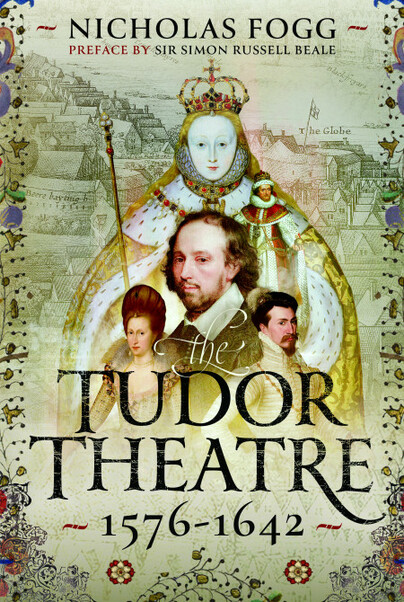
The Tudor Theatre (eBook)
1576-1642
Imprint: Pen & Sword History
File Size: 17.3 MB (.epub)
Pages: 320
ISBN: 9781036130701
Published: 12th January 2026
| Other formats available - Buy the Hardback and get the eBook for £1.99! | Price |
|---|---|
| The Tudor Theatre Hardback Add to Basket | £20.00 |
In 1576, a young man could have attended the first performance at The Theatre, newly-built by James Burbage, the first arena exclusively dedicated to the drama in England since Roman times. Sixty-years later, as a very old man, he could have attended the last performance at the Globe Theatre before its summary closure by the Puritans. The two dates represent the beginning and the end of the golden age of English theatre. In this book, Nicholas Fogg recounts the epic and often tumultuous story of those years – the great poets and actors, the rivalries, personalities, hostility and panache that contributed to a monumental era, going beyond such household words as Shakespeare, Marlowe, Burbage, Alleyn and Jonson to the lesser-known who also made their vital contribution to the world that was the stage, which ranged from the humble provincial inn yard of the touring company to the sumptuous royal palace. Yet it was at heart a popular theatre, created by the people for the people, reflecting the vital breath of its times and continuing to speak to us today: a story which involves us all because it represents the universal drama in which we all play our many parts.
Register or Login now to post a review!
"Amazing achievement in bringing alive in your book all those actors, writers and hustlers from the Tudor theatre world."
Ellis Jones, former Deputy Principal and Head of Acting at RADA
"Am enjoying your account of the Elizabethan stage: a cocktail of formidable scholarship and an elegant style with some enjoyable splashes of humour."
Lawrence James - Historian
Rating: 5 out of 5 stars
NetGalley, Hannah Gardiner
This was way more about the business and survival of theatre and honestly that made it so interesting 📜🎭
The opening alone stuck with me, men literally dismantling The Theatre piece by piece and dragging it across the Thames to build the Globe, ohh the drama before the drama even starts 😭 it really sets up that this world is not romantic, it's practical and driven by necessity
What i found most fascinating is how much of the English stage was shaped by things like lease disputes, property law and money rather than just creativity. The idea that theatre was this precarious, litigious industry constantly under economic and political pressure just reframes everything 🏛️💰
I also loved how it tracks the shift from improvised inn yard performances to actual playhouses and treats them as legal and financial entities, not just artistic spaces. Even small details like thrust stages being tapered instead of rectangular and how that affects sight lines and blocking that kind of specificity was so cool 🎭✨
the whole sharer system was really interesting aswell, actors owning stakes in companies and buildings and the reminder that writing itself rarely made anyone rich. It really pulls shakespeare down from that solitary genius pedestal and shows him more as a businessman shaped by the system he worked in. 📖💼
Then the political side, theatre being genuinely dangerous, performances tied to things like the Essex Rebellion, plays acting almost like political tools, even getting shut down after drawing huge crowds. it adds this layer of risk that you don’t always think about when looking back at this period. ⚔️🔥
The research side is so strong. court cases, wills, eyewitness accounts, account books you can feel how much this is built on real documentation. but i also liked that it acknowledges the gaps, those moments where the author has to say it is likely or let us suppose because the evidence just isn’t fully there 📚
...overall, this really shifts how you think about theatre history. It is not just art, it's survival, money, politics, risk and collaboration all tangled together
The book provides a fascinating look at the golden years of English theatre, detailing the operations and evolution of The Globe and other London venues. It is meticulously researched yet written in an accessible style, featuring engaging details about historical rivalries and personality clashes. I don’t think there is another quite like it, and I highly recommend this book.
NetGalley, Carren Joye
"The Tudor Theatre 1576-1642" succeeds by insisting that drama cannot be understood apart from material conditions. Fogg shows how plague closures, censorship, and financial desperation shaped repertory as much as literary ambition. For readers interested in how art works under economic and political pressure, this book offers insight into early modern England's most volatile industry.
NetGalley, Jonathan Crain
Rating: 5 out of 5 stars
NetGalley, Janine Skavnak
As an English major, Shakespeare is a required course , so I was so glad to receive this “wished for” book from #PenandSwordBooks (thank you too NetGalley). This is a nicely recorded history of early English theatrical history that roughly covers the periods of Elizabeth I through early Stuarts and includes Shakespeare, of course.
All the “biggies” of the day appear: Burbage, Marlowe, Kyd, Jonson, Shakespeare, etc. The short histories of the playwrights and theatre patrons are delightful - where was this book when I needed it in college? LOL. I particularly enjoyed the Marlowe piece having just read The School of Night by Karl Ove Knausgaard - Faust is such an enduring character. Shakespeare’s given credit for writing all those marvelous plays in this book, though many modern historians question that (I kind of do too having read Jodi Piccoult’s marvelous book, By Any Other Name, and learning of Emilia Bassano). Regardless of this controversy, Shakespeare’s plays were the rage of his time.
Learning of touring groups bringing plays to English cities and towns and these groups’ popularity was interesting to learn. The various theatrical structures of the time was something I wasn’t aware of as The Globe usually figures more prominently in courses than the smaller or lesser known ones. These had to be licensed to show plays. How the theatre known as the Globe came to be again was not known to me but so enjoyable to learn about.
Theatrical patrons, the names of lesser known plays and the actors (I knew boys played women’s roles - oh the misogyny) of the time are chronicled which broadens the scope of the book. I particularly liked the pictures of some of the playbills.
Written history at times can be pedantic, but in this instance, it comes alive. Enjoyed the read.
This book covers the birth and success of the English theatre during the reigns of queen Elizabeth I, king James I and Charles I, the last king before the Civil War and the subsequent closure of the theatres in 1642.
NetGalley, Titti Capasso
It gives an in depth historical and cultural context of his main players and authors such as Burbage, Shakespeare, Jonson and more that may be less known to those who are not from this background. I have a background in English literature and history of theatre so a lot of this was known to me but I still found bits of new information that I didn't know. The book also analyses the plays and gives insight into who played who, the controversies behind a play etc.
Rating: 5 out of 5 stars
NetGalley, Lindsay Conn
The Tudor Theater by Nicholas Fogg is an engaging and illuminating exploration of how English theatre grew from a fragile, often-criticised pastime into a powerful cultural force. Rather than focusing solely on famous names like Shakespeare or Marlowe, Fogg gives a vivid sense of the wider theatrical world: the players, entrepreneurs, patrons, and even the political enemies who shaped the stage. The result is a richly textured picture of a profession constantly adapting to social pressure, censorship, disease, and shifting royal attitudes. What lingers most is a sense of how vibrant and inventive early theatre was, even when much of its output has been lost. This book succeeds in bringing that vanished world to life and makes the survival of the theatre itself feel like a remarkable achievement.
This book provides a lot of interesting background for the famous people and plays in the early English theatre. Shakespeare, Marlowe, Burbage, and Jonson are just a few of the many playwrights and actors - the sheer numbers of playwrights, actors (including children but not women), managers, owners, plays, and theatres are quite remarkable, although most of the plays don't seem to have survived. What is even more remarkable is how the theatre itself survived; right from the start it was under attack from in-fighting, lawsuits, the plague, and the Puritans. Nicholas Fogg puts the development of the theatre in the context of society, politics, the aristocracy, and the royal court and shows in a very entertaining way how it survived one crisis after another until it was finally shut down in 1642 by Puritans who had become powerful in Parliament as Charles I gradually lost his grip on the country.
NetGalley, Yvonne Strong
Although the theatre started in the reign of Elizabeth Tudor, approximately half the book deals with its development during the time of the first two Stuart kings and how it was used to satirise and sometimes directly attack powerful people, both English and foreign. This is a fascinating look at a very colourful aspect of a very colourful period of English history.
About Nicholas Fogg
Nicholas Fogg, MBE, was born in Stratford-upon-Avon and educated at Warwick School and the Universities of Nottinghan, Oxford and London. His varied career includes founding a charity for the homeless, working with the City of Birmingham Orchestra and at Harvard University, teaching in the East End of London and Marlborough College. As the three-times Mayor of Marlborough, he was the 418yh successor to John Walford, who was sued for a debt of £30 by William Shakespeare’s father.

Pen and Sword Books
About Us | Contact Us | Delivery Information | Privacy Policy | Cookies | Affiliates | Terms and Conditions | Backlist | Mailing List | Reward Scheme | Review Request
© Pen and Sword Books Limited 2026. Registered in England No. 2527258.
Registered Office: 47 Church Street, Barnsley, S70 2AS.