


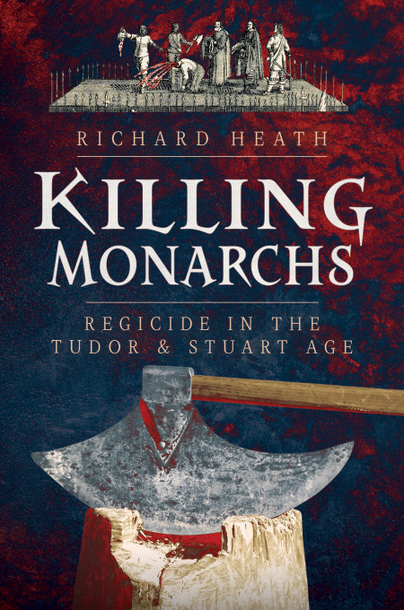
Killing Monarchs (eBook)
Regicide in the Tudor and Stuart Age
Imprint: Pen & Sword History
File Size: 18.3 MB (.epub)
Pages: 248
ISBN: 9781036105334
Published: 19th September 2025
| Other formats available - Buy the Hardback and get the eBook for £1.99! | Price |
|---|---|
| Killing Monarchs Hardback Add to Basket | £18.75 |
Rulers (and would-be rulers) have always faced the possibility of a violent death. Between the seventh and eighteenth centuries over 20% of all British and European monarchs suffered such a fate. Some died in battle or in accidents but most of them were murdered or executed.
During the time of the Tudors and Stuarts some monarchs were the victims of lone assassins, some were killed after palace coups led by relatives or royal officials, and others after being defeated in a civil war. Their manner of death included public beheading, internal injury as a result of a knife attack, being hacked down by a group of noblemen, and ritual strangulation with a silk cord.
Killing Monarchs takes us on a journey across Europe. Starting in England and Scotland (Lady Jane Grey and Mary Queen of Scots), it moves to France (Kings Henry III and Henry IV), and then further east to Russia (Tsar Feodor II and various pretenders to the throne) and the Ottoman Empire (Sultans Osman II and Ibrahim I). It then returns to Britain to consider why Charles I was executed.
It provides a clear picture of the various forces that existed in society at the time and these are reflected in the motives of the regicides - the killers of monarchs – even though many were not honest about them. The lust for power, the desire for a more effective leader, religious differences, and occasionally the wish to do away with monarchy altogether, all played a significant role.
Register or Login now to post a review!
Rating: 5 out of 5 stars
NetGalley, Amanda Sedlak-Hevener
A Throne Is Never Safe
There’s something endlessly gripping about the idea that kings and queens—those at the very top of the hierarchy—were never entirely secure. Richard Heath’s Killing Monarchs: Regicide in the Tudor and Stuart Age dives straight into this unsettling truth, showing how the crown, for all its pomp and ceremony, could also be a perilous burden. From whispered conspiracies to public executions, Heath uncovers the ways ambition, religion, and power struggles intersected to make monarchs vulnerable. His storytelling makes it clear that regicide wasn’t just about blood and violence—it was about the shifting tides of history. This book reminds us that the throne was as fragile as it was exalted.
A Sweep Through Tumultuous Times
Heath takes readers across the turbulent years of Tudor and Stuart rule, a period defined as much by drama behind the throne as by decisions made upon it. He places regicide not as isolated acts of madness but as calculated events deeply embedded in the politics of the age. We see how questions of legitimacy, divine right, and loyalty often became matters of life and death. The book doesn’t just recount the deaths of monarchs; it situates those events within the broader landscape of England’s struggles with religion, succession, and governance. In doing so, Heath gives readers both the big picture and the gripping details that bring history vividly to life.
More Than Just Gruesome Tales
While the subject matter could easily veer into sensationalism, Heath manages a steady balance between dramatic storytelling and thoughtful analysis. The beheadings, plots, and betrayals are certainly compelling, but they’re always framed in a way that highlights their significance. For example, he demonstrates how each regicide influenced not only the royal family but also the trajectory of the nation itself. Instead of reducing history to shocking moments, Heath shows how the act of killing a monarch became a catalyst for change—sometimes painful, sometimes transformative. This makes the book not only engaging but also intellectually rewarding.
A Read That Keeps You Thinking
One of the book’s greatest strengths is its readability. Heath writes with a clear, approachable style that makes even the densest political struggles easy to follow. He manages to keep the pace brisk without glossing over important context. Readers with a deep knowledge of Tudor and Stuart history will appreciate the fresh insights, while those newer to the subject won’t feel lost. The narrative flows smoothly, mixing sharp analysis with an eye for detail that keeps you hooked from start to finish. It’s history that feels alive, not like a lecture.
A Bold and Rewarding History
Killing Monarchs succeeds as both a fascinating story and a sharp historical study. Heath reminds us that power always comes with risk, and that even the mightiest figures in English history were subject to the ambitions and grievances of those around them. The book is well-researched but never dry, dramatic without being sensational, and filled with insights that linger long after the final chapter. For anyone interested in the precarious nature of monarchy—or in the drama that shaped England’s past—this book is a rewarding and thoroughly enjoyable read. Heath has turned a grim subject into a compelling portrait of power and its perils.
I thoroughly enjoyed this book. Whilst it seems quite large, the book felt quick and was a very interesting read. I loved learning about the regicide in all these different time periods and places across the world. I felt very well researched and was very informative. Richard Heath has done a very good job with this.
NetGalley, Blaise Henderson
Killing Monarchs is a compelling and meticulously researched exploration of regicide during the Tudor and Stuart periods. Richard Heath delves into the turbulent political landscapes of 16th- and 17th-century Europe, examining the motivations and circumstances surrounding the assassinations and executions of monarchs. The narrative spans across England, France, Russia, and the Ottoman Empire, providing a comprehensive view of the era's political intrigue and power struggles.
NetGalley, Moira Frederickson
Heath's writing is engaging and accessible, making complex historical events understandable for a broad audience. The book is well-organized, with each chapter focusing on a different monarch or event, allowing readers to easily follow the historical timeline. The inclusion of various case studies, such as the executions of Mary, Queen of Scots, and Charles I, adds depth and context to the discussion... Overall, Killing Monarchs is an informative and thought-provoking read that sheds light on a darker aspect of European history. It's a must-read for history enthusiasts and anyone interested in the complex interplay of power, politics, and violence in shaping the course of nations.
Rating: 5 out of 5 stars
NetGalley, Amber Ward
Read this within a few hours…it’s really good book on history about what stuff was committed against famous royals in history. I enjoyed reading this but I’m just an oddball person who enjoys historical facts about famous figures and their life’s.
Rating: 5 out of 5 stars
NetGalley, Rebecca Stewart
This is an amazing book detailing regicide, which, frankly, I would have thought would be at a higher rate at 22%. I would actually love a further breakdown more by each century. I think the numbers would be crazy high for some of them.
I learned so much about the different royals in this book. I definitely don't read up on royal history all the time (although I occasionally do follow the Megan and Kate drama). So there was tons here I had never learned about.
Definitely would recommend!
About Richard Heath
Richard Heath is a graduate of the University of Cambridge and enjoyed teaching history for thirty-five years. His life-long interest in the sixteenth century and the Renaissance was ignited by exploring many historic buildings in Britain and visiting Florence in his youth. He has since read extensively and travelled widely in Europe, often following in the footsteps of Emperor Charles V. His study of the life and times of the emperor, Charles V: Duty and Dynasty, was published in 2018 and he curates www.emperorcharlesv.com.

Pen and Sword Books
About Us | Contact Us | Delivery Information | Privacy Policy | Cookies | Affiliates | Terms and Conditions | Backlist | Mailing List | Reward Scheme | Review Request
© Pen and Sword Books Limited 2026. Registered in England No. 2527258.
Registered Office: 47 Church Street, Barnsley, S70 2AS.