


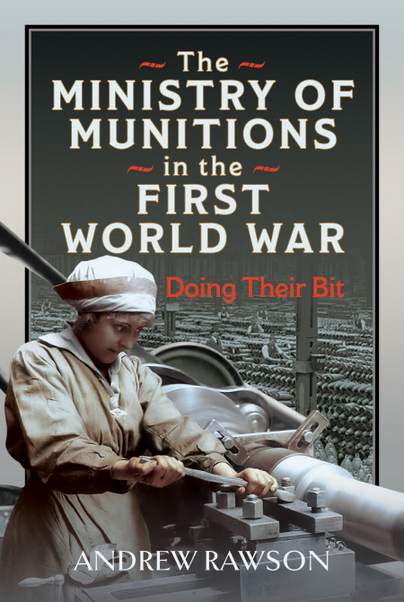
The Ministry of Munitions in the First World War (Hardback)
Doing Their Bit
Imprint: Pen & Sword Military
Pages: 280
Illustrations: 20 mono illustrations
ISBN: 9781036115388
Published: 3rd July 2025
(click here for international delivery rates)
Order within the next 10 hours, 35 minutes to get your order processed the next working day!
Need a currency converter? Check XE.com for live rates
| Other formats available - Buy the Hardback and get the eBook for £1.99! | Price |
|---|---|
| The Ministry of Munitions in the… eBook (5.8 MB) Add to Basket | £6.99 |
This is the history of Britain’s munitions industry in the First World War. It begins with the shortages caused by an expanding army required to fight in trenches, then shows how the country was organised, with the expansion of private companies and the introduction of state owned factories. It also explains how new laws regulated industry.
The narrative describes how production was initially estimated, until experience illustrated how the armed services’ demands could be met. It also looks at the problems caused by unchecked enlistment, which took no account of men’s skills, and the attempts to recall key workers from the armed services.
The story continues with the raw materials, such as coal, which was dug by one million miners, and the huge amounts of iron ore imported from Spain. Learn how Britain’s steel industry struggled to make enough forgings for shells, while many more were imported from North America. See how manufacturing issues were resolved, while battlefield experience led to modifications being made. Also see how the nation’s chemical industry expanded to produce enough explosives before working out how to make large amounts of lethal gases.
Learn how the war required the relations between the government, the employers, the unions, and the workforce to change; in some cases, forever. See how diluting production allowed the workforce to increase and how tens of thousands of women entered the factories. Also hear how various issues caused widespread industrial unrest at times, as the cost of living rose and the rules became stricter. On a positive note, a desire to improve production increased awareness of health and safety, as well as the benefits of positive welfare.
The story ends with a nation being pushed to its limits suddenly demobilising, leaving everyone wondering what the future would hold for them.
Register or Login now to post a review!
Andrew Rawson is the author of over forty books, including eight Pen and Sword ‘Battleground Europe’ travel books and three History Press ‘Handbook’ reference books. His catalogue includes volumes on the Second World War, including Poland’s struggle in the twentieth century, Auschwitz and wartime Krakow. Much of his work is on the Great War, including a ten-part series on the Western Front campaigns between 1914 and 1918.
Barbara Taylor, The Western Front Association
I have previously reviewed Mr Rawson’s The 1914 Campaign about the first months of the war; basically the battles of the Old Contemptibles’, which is a distillation of information from the Official History (OH), the Pen and Sword Battleground series, Divisional and Regimental histories. The author seems to have made this type of approach a specialism as this current volume is of a similar construction in that the great majority of the Notes listed are from the papers of the Ministry of Munitions official government records.
The necessity for the formation of the ministry became clear, certainly after the ‘shell crisis’ of early 1915, which showed that the existing production of munitions for a war of this sort was hopelessly insufficient and inefficient. As a largely naval power with a small standing army designed as an Imperial ‘police force’, small arms and field gun/howitzer munitions were only produced in numbers to suit those requirements.
During the course of the war, the ministry was in the hands of four men; David Lloyd George, Edwin Montague, Christopher Addison and then Winston Churchill through to the cessation of hostilities. Messrs Montague and Addison both only heading up the ministry for approximately six months each.
The transformation of munitions production during the war was the result of a complex structure, involving labour supply and relations, manpower planning, raw materials, national and international finance. Also included was research and development of new weaponry; here
the tank and aeroplane spring readily to mind. The importation of raw materials and therefore the transportation and insurance of the goods to be imported was also included in the ministry’s responsibilities. It was soon discovered that the recruitment campaign had been allowed to draw far too many skilled men needed to make the munitions in the first place and companies that were given contracts to manufacture arms and all other necessities, had to compile lists of key workers that they needed back.
The contents of the book are organised in a largely chronological order, starting as one might expect from the declaration of war, with mobilisation and a brief rundown on the pre-war industrial unrest. The last section is on the preparation for the war’s end, demobilisation and the running down of munitions production.
This is not a book to sit down and read from cover to cover, but for anybody who needs to add information about any aspect of the munitions provision as an adjunct to their own research and work, this is the book for you. I can only think that Mr Rawson must be a very patient and thorough researcher to have distilled a great deal of information from volumes and volumes of official documents into something that has all the relevant facts and figures in an easy to find and digestible form!
Books which tell the story of the Battlefront during World War One are numerous. Much fewer however are those which relay the store of the other equally important battlefront that took place, that of the Homefront.
Jon Sandison
This book is yet another immense piece of work by Andrew Rawson, providing an important text for reading, reference and research for any First World War bookshelf. The author had written so many fantastic books; "The British Army Handbook, 1914-1918", and "The Somme Campaign" just being a few. This is another additional classic to his list. What the author continually does well in all his work, is write a book which can cater as much for the novice and learner of the Great War, alongside the embedded expert.
This work tells the story of such a vital part of the First World War story. It is thoroughly reserved and broke down so so well structured, both as a book you can enjoy from start to finished, but equally as importantly, as an accessible reference book. Rawson has written over 40 books, and this is another valuable addition.
This was of course the first time that Britain had gone through the experience of Total War, when everyone had to play their part, from the worker on the factory floor, the to the shipbroker and coal miner. The role of the Ministry of Munitions was of such vital importance to the work of the Homefront with everyone doing their bit.
The author details the story of the transformation of British munitions production during the war, and how it incorporated a major logistical operation of labour supply, man power organisation, labour relations, raw arterials; all of which was inter connected to finance, imports, shipping alongside development and crucially, transport.
Chapter headings are broken down with key main headings of Organising Industry, Raw Materials, Factories, Workforce, Weapons, Mechanised Warfare and The War Ends. This ensures that book acts so well as an easy point of reference for any researcher or student. Further sub headings include Munitions output,, The Railways, Chemical industry, Royal Arsenal, as well as Dilution of Workforce, wages and Shipbuilding.
Each sweep of the text makes such informative reading, such as a section detailing the location of National Filling Factories for shells, with each area broken down, including North West England, Yorkshire, Midlands, South Wales and West Scotland.
It was interesting to note also how Britain sent munitions to the Belgian army also given of course Belgium had lost all its factories in the early months of the war. Equally, France also lost her iron ore mining districts during the German advance into Lorraine in August 1914. To that end Britain started sending in support. Such elements put extra strain on British production.
All of the chapters in the book are interesting in their own way. One which I found extra captivating was the section which focussed on The Artillery and the making of Field Guns and Howitzers. This covers both the Gun and Howitzer designs, Repairing and Relining Artillery. A further section then goes on to develop logistics and processes of shell manufacture.
The author brings the book to a close by detailing how the war work ended and in turn the transition of people leaving work and return to pre-war practices.
The photographs throughout the book are striking, and they include images of the key political players involved such as Lloyd George and Winston Churchill, alongside other pictures which reinforced the key content of the text, including coal yard, ship building, shell factories and the assembly line for tanks.
The result is a first class book which provides effectively a 'one stop' access point for the impact of war on the Home Front during 1914-1918, one which incorporates both the economic and social aspects of that. It reminds us of the remarkable story of how British rose to the ominous challenge of Total War.

About Andrew Rawson
ANDREW RAWSON has over forty books to his name, including eight Pen and Sword ‘Battleground Europe’ travel books and three History Press ‘Handbook’ reference books. He has edited the minutes of the Second World War conferences and the top-secret correspondence between George C. Marshall and Dwight D. Eisenhower. He books include covering Poland’s struggle in the twentieth century, Auschwitz Extermination Camp and wartime Krakow. He has also written a ten-part series on the Western Front campaigns between 1914-18. He has a master’s degree with Birmingham University’s history department.





Pen and Sword Books
About Us | Contact Us | Delivery Information | Privacy Policy | Cookies | Affiliates | Terms and Conditions | Backlist | Mailing List | Reward Scheme | Review Request
© Pen and Sword Books Limited 2026. Registered in England No. 2527258.
Registered Office: 47 Church Street, Barnsley, S70 2AS.