


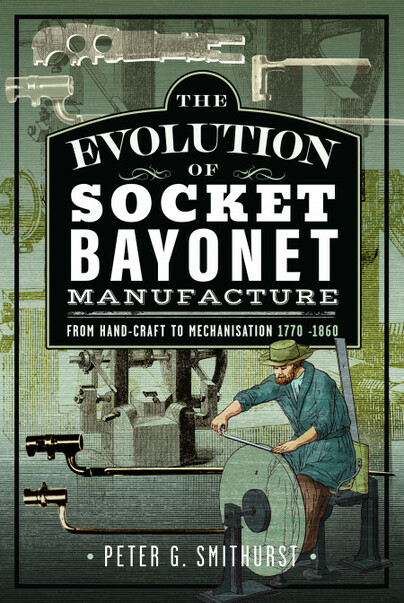
The Evolution of Socket Bayonet Manufacture (eBook)
From Hand-Craft to Mechanisation 1770 -1860
Imprint: Pen & Sword Military
File Size: 32.0 MB (.epub)
Pages: 288
ISBN: 9781036137212
Published: 15th October 2025
| Other formats available - Buy the Hardback and get the eBook for £1.99! | Price |
|---|---|
| The Evolution of Socket Bayonet… Hardback Add to Basket | £22.49 |
In the case of military muskets and rifles the bayonet was, and still is, an integral part of the ‘weapon system’. There are many excellent books covering the history of the bayonet in its myriad varieties adopted and used by the armed forces of the world. These books provide a wealth of detail on national variations and often include many rare, and in some instances, bizarre bayonets. They focus on the end of the bayonet’s story and do not cover its beginning – the conversion of more or less amorphous pieces of iron and steel into finished products. That is the focus of this publication.
It might be asked why, out of all the bayonets of the world, these three have been selected since at first sight they appear very ordinary and mundane when compared with some of their more ‘exotic’ brethren. However, as with the arms they were fitted to and whose manufacture has been covered in two earlier companion volumes, they are the only bayonets whose manufacture is described in varying degrees of detail in contemporary publications. They also share another kinship since, like the weapons they fitted, the Russian M.1808 is a direct copy, and the Enfield Pattern 1853 bayonet a descendant of, the French M.1777. This bayonet was a major landmark in socket bayonet design. It may be distasteful and not something to be contemplated lightly, but the socket bayonet’s function at the end of a musket was to penetrate the body of an enemy in close combat. Earlier bayonets having a plain mortice or ‘zig-zag’ slot engaging with a stud on the barrel to hold them in place, might easily be removed from the musket by one or other of the adversaries twisting it in the wrong direction. Honoré Blanc’s design, with its medial locking ring, prevented such accidental removal and became the prototype for many, if not all, socket bayonets which followed through to the end of the 19th century.
Register or Login now to post a review!
This book describing bayonet fabrication processes during the era of the early Industrial Revolution comes from a foremost firearms historian: Peter Smithurst is a former Senior Curator of Firearms, now Curator Emeritus, at the British Royal Armouries. He has published extensively on both the history of, and the manufacturing technology behind, a variety of artillery, firearms, ammunition and edged weapons. Both his technical expertise and clarity of writing on technical subjects are amply shown in this book.
Edward Hull - Society of American Bayonet Collectors, Charter Member
The era 1770 to 1860 saw the transition of arms making from hand-craft methods to mechanization and parts interchangeability. The author’s focus here is describing those maturing manufacturing processes as related to bayonet fabrication: the conversion of raw pieces of iron and steel into a finished weapon. Herein he describes three representative bayonets of similar design from this era: the French Model 1777 with its new idea of a locking ring on the socket, the Russian Model 1808, and the Enfield Pattern 1853. The three types are chosen both to compare manufacturing processes as the technology matured and because of the availability of contemporary published sources, which are otherwise limited. The latter bayonet is also included because the Birmingham City Museum holds an extensive set of specimens that show each step in the manufacturing process.
There are three chapters to the book, one for each of the bayonet designs. Following a brief Preface, Chapter 1 discusses the eleven steps in the fabrication of the French Model 1777 bayonet. Chapter 2 covers the fourteen steps for the Russian Model 1808 bayonet. Chapter 3 discusses the 25 steps for the British Pattern 1853 bayonet; included here are photographs of actual examples of the start and end products of each step. In all cases, discussion of each step includes both a textual description of the process and, as appropriate, illustrations of both the part of the bayonet being fabricated and the tools and/or the machinery used.
The differences in the processes between the three bayonet types are most evident in the fabrication of the bayonet’s socket. For the French Model 1777, the socket is made from a forged plate (which has a projection for the elbow, or neck, to which the blade is to be attached); this plate is wrapped around a mandrel and welded to form a tube. The forged blade is then welded to the elbow. For the Russian Model 1808, the socket is formed by welding an elbow onto a preformed tube of suitable diameter; the blade is then welded to the elbow. For the British Pattern 1853, the socket is first formed by forging a short, square iron bar into a cylindrical shape, to which a steel bar (which would become the elbow and blade) is welded at right angles. Next, the steel bar is forged into the long blade. The socket is then completed by drilling a hole in the cylindrical bar. The British process makes more use of machinery for each step.
The author makes it easy to compare each process of fabrication between the bayonet types by laying out each chapter with correspondingly titled steps.
Six appendices contain additional information. Appendix 1 provides comparative tables of English, French and Russian weights and measures. Appendix 2 is a complete reprint, with English translation included, of the contemporary French text referred to in Chapter 1: Processes for the manufacture of bladed weapons…1793, by F.-A. Rauch. Appendix 3 reprints an article from The Guardian British magazine from January 10, 1855, about bayonet manufacture. Appendix 4 is a six page listing of deliveries of bayonet steel from the foundry of Thomas Firth & Sons to different end users. Appendix 5 is a table showing the variation in the muzzle diameters of 23 examples of Pattern 1853 rifle muskets from different makers. Appendix 6 reproduces three British patents that describe ideas for mechanizing bayonet manufacture.
This book of 224 pages has a sturdy hard cover with a color book cover. The interior bright white paper cleanly reproduces the text and illustrations. The text is clearly written. The author’s expertise allows him to interpret the foreign texts to both translate technical terms into modern English and also to fill in gaps in the detailed process description. In that age—and even today—written instructions assume that the practitioner is knowledgeable of the basic “art” of the object’s fabrication. The 226 drawings and photographs of the bayonet parts, and the tool and machine designs, are reproduced clearly. These illustrations—from black and white photographs to original diagrams to the author’s line drawings—effectively supplement the text to aid the reader in understanding this technical subject. While there is no index for the book, the detailed table of contents is a ready aid to locating relevant information.
This book is a companion to the author’s earlier works, THE EVOLUTION OF GUN MAKING and MAKING THE ENFIELD PATTERN 1853 RIFLE-MUSKET—both also published by Pen & Sword. Historians and students of arms making technology will find this book to be a worthy addition to this trilogy and to their library.
Peter Smithurst’s The Evolution of Socket Bayonet Manufacture from Hand Craft to Mechanisation 1770-1860 has opened up a new dimension in the collectors’ world. In the same way that the Haynes Owner's Workshop Manual supports the automobile enthusiast this excellent publication enlightens the bayonet devotee. Many such individuals admire the appearance and history of such artefacts. Others even covet, collect, classify and cosset the weapons themselves. Few, if any, research the technological processes behind the items. Publications, until now, have informed this reality. Peter’s work has now filled the gap. Research based on primary sources, backed with huge expertise on industrial and technical subjects, has provided a well illustrated, easily readable, layman’s guide to socket bayonet manufacture. Of particular advantage, for non-linguists, is the translation of French and Russian descriptions that would otherwise be out of reach. The detailed comparison of French, Russian and English processes allows for a good understanding of their differences. The in-depth coverage of the Pattern 1853 bayonet is particularly noteworthy. Original drawings and illustrations have been analysed and enhanced by Peter’s own clear diagrams and explanations. Obscure technical terms have been defined, and, in some cases where descriptions are vague, Peter has formulated an interpretation.
Graham Priest - Bayonet collector and a prominent expert
As a collector of bayonets since the mid 1950s, with a specialist interest in socket bayonets since the early 1970s, I am grateful to Peter for enhancing my knowledge of the subject. Several details of construction that have puzzled me for decades are now clear. I have no hesitation in recommending this publication to others.
About Peter G. Smithurst
Peter G Smithurst graduated in Chemistry and Biochemistry in 1968 spending several years as a research chemist before pursuing his passion for industrial and technological history, moving in to museum work.
Peter was appointed Assistant Curator of the Industry and Technology section of Sheffield City Museums in 1975 including the planning and opening of the Kelham Island Industrial Museum in 1982 leading to a promotion to Principal Keeper, Industry and Technology. In 1994 Peter was appointed Assistant Curator of Artillery at the Royal Armouries Museum at Fort Nelson before transferring to the Royal Armouries in Leeds for its opening in 1996.
In 2001, Peter became the Executive Director at the American Precision Museum in Windsor, Vermont housed in the Robbins & Lawrence factory where much of the technology for the mechanised manufacture of firearms, including the Enfield 1853 rifle, had been developed before finally returning to the Royal Armouries in 2002 retiring in 2009 as Senior Curator of Firearms. Just prior to retirement Peter was appointed Visiting Research Fellow at the University of Huddersfield resulting in a PhD from the School of Engineering and Computing in 2020 for a study of the manufacture of the Pattern 1853 Enfield Rifle-Musket and was subsequently elected Fellow of the Society of Antiquaries of London in 2021.






Pen and Sword Books
About Us | Contact Us | Delivery Information | Privacy Policy | Cookies | Affiliates | Terms and Conditions | Backlist | Mailing List | Reward Scheme | Review Request
© Pen and Sword Books Limited 2026. Registered in England No. 2527258.
Registered Office: 47 Church Street, Barnsley, S70 2AS.