


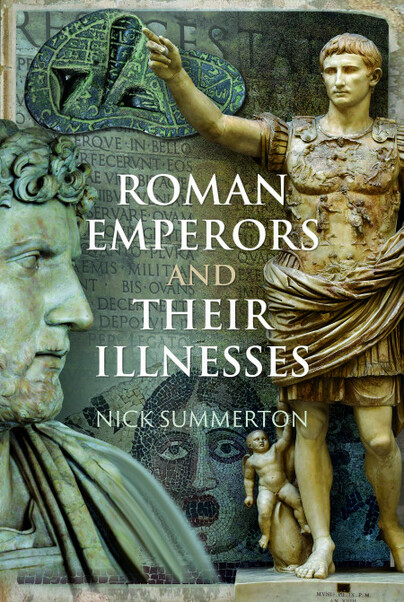
Roman Emperors and their Illnesses (eBook)
Imprint: Pen & Sword History
File Size: 4.2 MB (.epub)
Pages: 224
ISBN: 9781399094184
Published: 12th January 2026
| Other formats available - Buy the Hardback and get the eBook for £1.99! | Price |
|---|---|
| Roman Emperors and their Illnesses Hardback Add to Basket | £20.00 |
Medical history has been particularly unkind to some historical figures. The, so-called, 'mad emperors' Caligula, Tiberius and Nero cannot question their various psychiatric diagnoses or request a second opinion. Neither can Maximinus Thrax, Nero or Caligula demand further testing to refute or confirm the suggestions that they all suffered from a type of hormonal disorder.
By undertaking a detailed evaluation of the ancient sources relating to Augustus, he has been re-characterised as an individual surviving to the age of 75 with a long-term lung condition. Perhaps some of his enigmatic behaviours and actions represented a reaction to developing a chronic disease at a young age?
Claudius suffered from a movement disorder that affected his mobility and speech. Although highly intelligent, the response of the Imperial family to his disability was to keep him in the shadows, out of politics and public affairs. He became of figure of fun, ridiculed within Roman high society and subjected to insults and cruel tricks. The indignities and hardships he experienced in his youth probably had an impact on his character, health and behaviour. Also, it seems much more likely that he died due to a stroke or a heart attack rather than from consuming poisoned mushrooms!
Marcus Aurelius might not have been as physically unwell as has been suggested by both modern and ancient historians. Despite suffering from sinusitis, gastroenteritis plus various aches and pains, there is no evidence that he had any longer-term health problems.
Diagnosing the illnesses of Roman emperors might not be viewed as an appropriate line of enquiry given the enormous gulf that separates ancient and modern medicine. However, although there are certainly some major challenges in using present medical knowledge to identify past diseases, there are potential opportunities too in augmenting – or even correcting – the historical record.
Register or Login now to post a review!
Rating: 5 out of 5 stars
NetGalley, Rina Di Raimo
I finished this book and had to sit with it for a while. Not because I wanted to, but because I needed to, I mean, it is A LOT. The kind of a lot that lingers. Who knew so many emperors carried themselves as frail Victorian children, and bodies always on the verge of failing them? There is something almost unsettling in that, how power is housed in weakness, an empire resting on bones that could so easily break.
Roman Emperors and Their Illnesses by Nick Summerton is nearly 220 pages of relentless attention to detail. The author does not look away. He studies these men, their bodies, their suffering, their limits with a precision that feels almost obsessive (btw that’s the way I like my nonfiction books), and yet you can’t help but be impressed.
What stayed with me is not just the catalog of illness, but how medicine, imperfect and uncertain, shaped the course of history, how healers worked with what little they knew, how the fate of the Empire could hang in the balance because of a fever, gout, a random weakness, or a body that refused to cooperate.
It is not an easy read. But it is, undeniably, a necessary one for anyone curious about the fragile humanity behind imperial power.
"Nick Summerton has researched this subject in great depth and has made an important, scholarly contribution to the field of ancient history and medicine. The book is well written with an extensive bibliography, and provides insightful and fascinating information on the physical and mental illnesses that afflicted these ancient Roman leaders."
Hektoen International - Dr Arpan K Banerjee MBBS( LOND) FRCP FRCR FBIR
Read the full review here
This was an extremely informative novel about multiple Roman emperors and their illnesses. The author openly states that the information he is using could be wrong due to the historical sources being biased and other forms of incorrect information. Even with that state of mind, this book goes into immense depth about the different emperors and what illnesses they could have had. The book also takes into account that their major differences in what one of the emperors could be diagnosed with due to the environment they were in (political, geographical, etc.). Different emperors, like Augustus to Lucius Verus, are also discussed, using an interesting method of how the author would go about making a proper diagnosis. Overall, the author does a fascinating job of highlighting the different emperors and discussing what illnesses or injuries they have carried throughout their lives, while also stating that "do no harm" as a doctor's promise should be followed through, even in ancient times, as many struggled with illnesses and injuries.
NetGalley, Donna Robinson
Overall, Roman Emperors and Their Diseases succeeds because it resists easy answers. It respects both the limits of modern medicine and the complexities of the ancient world, offering a careful, well-researched exploration rather than speculative certainty. This is a rewarding read for those interested in medical history, Roman history, or the intersection of power, health, and mortality — provided they appreciate nuance over neat conclusions.
NetGalley, Kyle Wendy Skultety
Roman Emperors and their Illnesses by Nick Summerton is an informative look at the medical issues that several Roman emperors experienced. Summerton clearly did an intensive amount of research to write this book.
NetGalley, Jonathon Pinkard
The book starts with an overview of how medicine worked in Ancient Rome and it was quite fascinating. I’ve read a lot about this recently but it’s always interesting to read more about it. It then goes over several different Roman emperors, their bouts with illness, and what may have been the cause of them.
NetGalley, Pauline Stout
The book rightly points out that is incredibly difficult/problematic to assign modern day illnesses to the symptoms that the different emperors were said to have. There are a multitude of things (translation errors, personal reporting, minimization/overreporting of symptoms, disease evolution) standing in the way of this correlation. Still, it was interesting to read about these spells of illness and the attempts to figure out what indeed might have been wrong.
I found this book well researched and well written. Was very easy to read.
Roman Emperors and Their Illnesses is written by Nick Summerton, a physician who has carefully and thoughtfully researched this intriguing subject. He describes the danger of ascribing modern pathology and evidence to ancient supposition. He also explains the sociocultural implications and the types of information used in researching ancient symptoms and diagnoses. Using real-life examples of Roman emperors' illnesses and deaths, he details ancient mortality, therapeutics, medicine, healers such as Galen, the importance of mental wellness and sleep, and coming to terms with chronic illness. As a chronic illness sufferer, much of the information is very relatable.
NetGalley, Brenda Carleton
Ancient Roman history has beguiled me since I was a young child. Many trips to Roman territories have made all-things Roman come alive for me and I was thrilled to get my hands on this book to learn more. It pulled me into the lives of several emperors but the story which always stands out to me as a mushroom forager is that of Claudius who was purportedly poisoned by his wife, Agrippina. But the symptoms do not make sense. It will always be a mystery but the author deduced by documented events Claudius' death was more likely a heart attack or stroke. Not quite as exciting as poisoning! Interesting nonetheless.
All in all, this was an informative and fetching read. I appreciate the addition of photographs.
Rating: 5 out of 5 stars
NetGalley, Judith Babarsky
I appreciated the care and effort the author put into explaining the methods used in researching illnesses from thousands of years ago! The author uses historical records from contemporaries (or near contemporaries) of the emperors themselves. It is apparent that the author is well-versed not only in medicine, but in ancient studies as well. I definitely recommend this book to any that are looking for a detailed account of the illnesses of the Roman Emperors specifically, but also for any interested in how medicine was practiced in ancient times.
Rating: 5 out of 5 stars
NetGalley, Janine Skavnak
I am a Roman history buff of sorts (four years of Latin may have helped). And, I particularly enjoy the period between Augustus and Nero - this could be from enjoying reading I, Claudius (Robert Graves, 1935), 1 Loved Tiberius (Elisabeth Dored, 1959) and watching the 1976 BBC series, I, Claudius. So this book intrigued me and I was thrilled to receive this ARC from NetGalley and the publisher, Pen & Sword.
I found the book a delightful read. Not being in the medical field, I enjoyed learning how medicine was conducted in this period of history, learning what Galen and other men of the time handled sickness and disease, and how religion played into the care for the sick and dying. The historical context of the Roman emperors studied in this book was particularly of interest as were the suppositions that many of these men did not die natural deaths but were poisoned. I was particularly intrigued by Caligula (who was the worst of the emperors studied) and by Suetonius's observation at Caligula's death: "a tyrant humbled, an executioner executed, and a would-be usurper of divinity exposed as a mere mortal." Very prescient even for our times.
I enjoyed this book for what I learned and for how it brought Roman life alive. It was well researched too.
About Nick Summerton
Dr Nicholas Summerton qualified as a medical doctor in 1984, and has worked in hospital medicine, general practice, public health and clinical research. He has written three books on diagnosis and screening plus a short booklet entitled Medicine and Health Care in Roman Britain. He also has longstanding interests in the Roman world and a specific focus on Ancient Medicine.




Pen and Sword Books
About Us | Contact Us | Delivery Information | Privacy Policy | Cookies | Affiliates | Terms and Conditions | Backlist | Mailing List | Reward Scheme | Review Request
© Pen and Sword Books Limited 2026. Registered in England No. 2527258.
Registered Office: 47 Church Street, Barnsley, S70 2AS.